
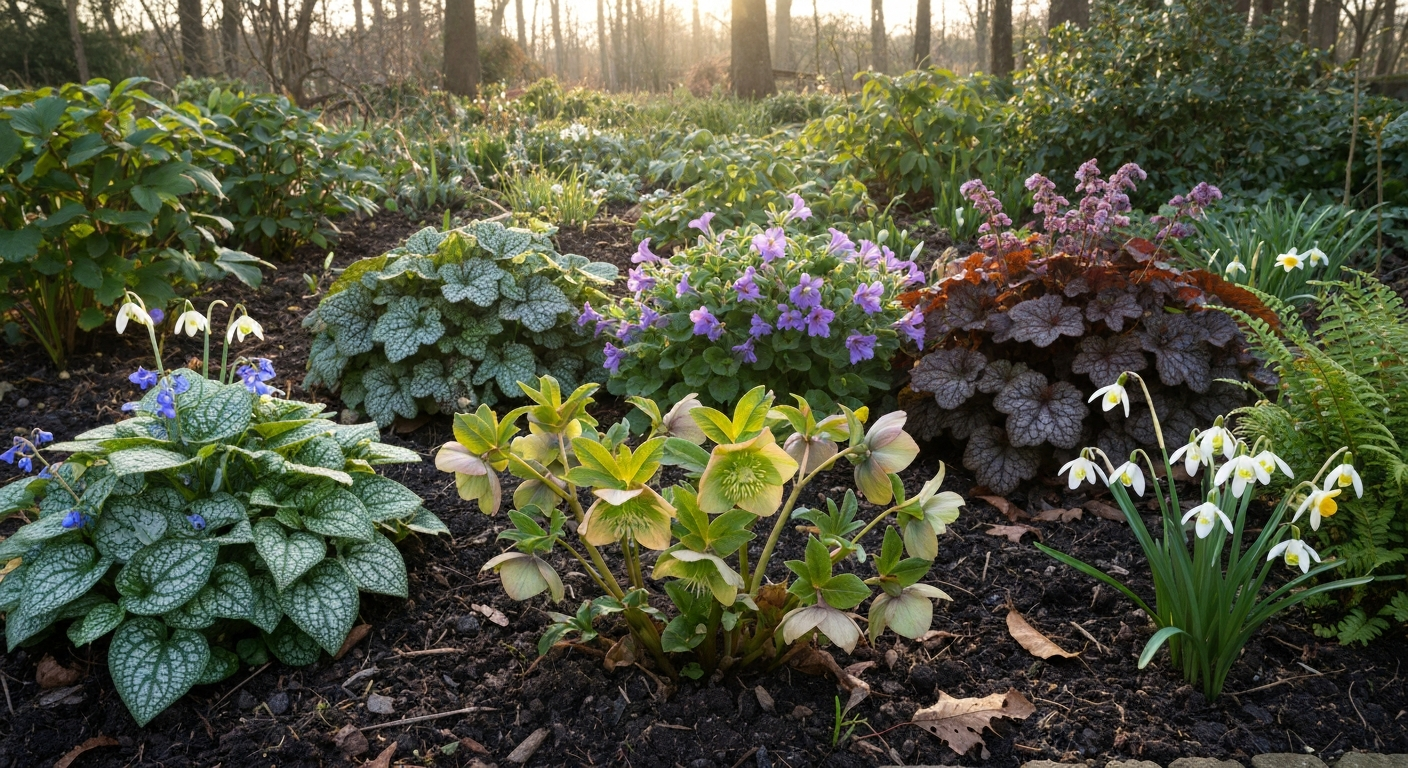
The best companions for hellebores are plants that genuinely enjoy the same conditions: dappled to full shade, humus-rich soil that drains well, and moderate moisture. Think Brunnera macrophylla 'Jack Frost', Pulmonaria 'Diana Clare', Heuchera 'Palace Purple', woodland ferns, hostas, Epimedium, Tiarella, and a succession of small bulbs like snowdrops, crocus and dwarf narcissus. Get those pairings right and you'll have color and foliage interest from late winter through summer with almost no conflict between plants.
What to Grow with Hellebores: Best Companions & Planting Tips

Marcus Holloway
25 Jul 2026
Why bother with companions at all?
Hellebores are extraordinary plants, but they have a timing problem from a garden design perspective. They bloom in late winter and early spring, then spend the rest of the year as a mound of handsome, leathery foliage. That foliage is attractive, but without companions you get a lot of empty-looking soil in summer when everything else is going. Add the right partners and you solve three problems at once: you fill seasonal gaps, you create foliage contrast that makes the hellebore flowers look even better when they appear, and you reduce the bare soil that slugs and weeds love. It's genuinely one of those cases where the combination is worth more than the sum of its parts.
There's also a practical reason. Hellebore crowns need air circulation to stay healthy. Companion plants placed at the right spacing help suppress weeds without sitting directly on the crown, and low groundcovers reduce soil splash, which is one of the ways hellebore leaf spot spreads. So this isn't just about aesthetics: thoughtful companionship is part of good hellebore maintenance.
What hellebores actually need (so you pick companions that fit)
Before choosing companions, it helps to be clear about what hellebores want, because this is the filter everything else has to pass through. Helleborus × hybridus and H. orientalis (Lenten roses, the types most gardeners grow) are hardy in USDA zones 4 to 9. They form evergreen to semi-evergreen clumps about 1 to 1.5 feet tall and wide and bloom for roughly 8 to 10 weeks across late winter and spring. They prefer partial to full shade in moist, humus-rich, well-drained soil. Once established they tolerate some drought and heavy shade, and deer largely leave them alone. H. foetidus is naturally more tolerant of deeper shade and tends to do better in heavily wooded spots. H. niger, the Christmas rose, is fussier: it dislikes cold, waterlogged soil and is often grown in containers where drainage can be controlled more precisely.
On the soil side, the RHS recommends planting hellebores at the same depth they sat in the pot. If you're dividing and replanting, set the first roots about 2.5 cm (1 inch) below the surface. They do not want to be planted deep. Soil should be enriched with organic matter before planting, and a mulch layer helps retain moisture and moderate soil temperature, but keep it clear of the crown. Newly planted hellebores need regular watering through their first season. Once established, they need only supplemental water in dry spells. For step-by-step growing instructions, see how do you grow hellebores. With all of that in mind, you want companions that are genuinely comfortable with these same conditions, not plants that merely tolerate them.
A quick checklist for matching companions to your site
Every site is a little different. Before you buy anything, work through these questions. You'll save money and avoid the frustration of replanting things that simply aren't suited to the spot.
- How much shade does the spot actually get? Count hours of direct sun. Under 2 hours is deep shade; 2 to 4 hours is partial shade; dappled light through canopy all day counts as partial shade. Match your companion list to the correct shade category below.
- Is the soil free-draining or does it sit wet in winter? If it stays wet, both hellebores and most of their companions will struggle with root rot. Improve drainage with grit and organic matter before planting.
- Are tree roots a major factor? Dry shade under shallow-rooted trees (beech, silver maple) is hard going. Epimedium and Liriope handle root competition better than hostas or astilbe.
- What is your primary interest: flowers, foliage texture, or year-round structure? This determines whether you lean toward bulbs, ferns, or evergreen shrubs.
- Do you have slug pressure? If yes, avoid thin-leaved hostas in the front row. Ferns, Epimedium and Heuchera are more slug-resistant.
- Is the planting area visible in winter? If yes, prioritize evergreen companions and plants with late winter flowers (snowdrops, Pulmonaria, Cyclamen coum) alongside the hellebores.
- How much maintenance time do you have? Low-maintenance combinations rely on Epimedium, ferns and evergreen heucheras. High-reward but more hands-on combinations include bulb layers that need lifting and dividing every few years.
Best companions for partial shade
Partial shade, meaning roughly 2 to 4 hours of direct sun or consistent dappled light, is the sweet spot for hellebores and opens up the widest range of companions. These are the plants I come back to again and again in this light level.
Brunnera macrophylla 'Jack Frost'
This is probably my single favorite hellebore companion. 'Jack Frost' grows 12 to 18 inches tall with silver-mottled, heart-shaped leaves that are almost luminous in low light, and it produces forget-me-not blue flowers in April and May that overlap with or follow hellebore bloom. RHS lists Brunnera macrophylla 'Jack Frost' as a shade‑loving, clump‑forming groundcover with silver‑mottled heart‑shaped leaves and spring forget‑me‑not blue flowers, growing about 12–18 in tall RHS lists Brunnera macrophylla 'Jack Frost' as a shade‑loving, clump‑forming groundcover with silver‑mottled heart‑shaped leaves and spring forget‑me‑not blue flowers, growing about 12–18 in tall.. It clumps neatly, tolerates moist shade, and does not aggressively spread into neighboring crowns when given standard spacing. Plant it in front of and to the side of hellebores, not directly underneath them, and give each plant about 18 inches of space. The silver foliage carries the combination all through summer long after both plants have finished flowering.
Pulmonaria (Lungwort)
Pulmonaria is another near-perfect companion. 'Diana Clare' has the RHS Award of Garden Merit, producing silver-marked semi-evergreen leaves and violet-blue flowers from late winter through late spring. Its bloom window overlaps directly with hellebores, so you get two plants flowering together at the same time, which is a genuinely lovely effect. Pulmonaria stays low, usually under a foot, and is non-invasive. It's one of the few plants that actually looks good while hellebores are at their peak rather than just taking over when they're done. Plant it at the front of the bed where its early flowers are visible.
Heuchera (Coral Bells)
Heucheras like 'Palace Purple' and dozens of modern cultivars are workhorses in the partial-shade garden. They contribute year-round foliage color, occupy a manageable 12 to 18 inch footprint, and tolerate the humus-rich, well-drained soil that hellebores need. After hellebore bloom fades in spring, the heuchera's foliage becomes the main event, bridging the gap to summer with purples, bronzes and limes depending on the variety. If you're looking at growing heuchera in more detail, it's worth exploring a dedicated growing guide for heucheras to get spacing and soil prep right, since cultivars do vary.
Woodland ferns
Dryopteris (buckler ferns) and Athyrium (lady ferns) are structurally perfect partners for hellebores. They emerge in spring just as hellebore flowers are fading, providing fresh green fronds that frame the spent blooms, then build into substantial clumps through summer that give the bed depth and movement. Position them to the side or slightly behind hellebore clumps rather than in front: medium to large ferns can reach 2 to 3 feet and will shade shorter companions if placed wrongly. Semi-evergreen Dryopteris cultivars are especially useful because they provide some winter structure too.
Hostas
Hostas are the obvious choice for a reason. They emerge after hellebores bloom, so there's no competition for the same moment in the spotlight, and their bold, textured foliage creates a completely different visual effect. Space medium to large hostas about 24 to 36 inches from neighboring crowns to avoid root competition and overcrowding over time. Smaller, slug-resistant varieties like 'Halcyon' work better in the foreground; large statement hostas like 'Sum and Substance' work best behind or beside hellebore groups as a backdrop.
Companions for deep shade and heavy woodland conditions
Deep shade under dense tree canopy or on north-facing walls is genuinely limiting. Most plants can't cope with it, but hellebores (especially H. foetidus) handle it better than almost anything that flowers. For these difficult spots, your companion list narrows significantly, but there are reliable options.
- Epimedium (barrenwort): Probably the toughest companion for dry, deep shade and root-compacted soil under trees. Epimedium forms spreading mats of heart-shaped leaves, often with attractive red or bronze tints in spring, and produces delicate flowers in April. It won't win a competition for showiness but it is genuinely resilient where almost nothing else survives. Cut back old foliage in late winter to show the flowers.
- Liriope muscari (lilyturf): An evergreen groundcover that handles deep shade and dry conditions. Grass-like foliage provides texture contrast, and it flowers in late summer with violet spikes. Plant it as an edging or low groundcover in front of hellebore clumps.
- Vinca minor (lesser periwinkle): Evergreen mat-former with blue flowers in spring. Useful for covering bare ground under trees. Be aware it can spread: use it in areas where spreading is acceptable, not tucked against individual plants.
- Cyclamen coum: Small tuberous plant that flowers in late winter in shades of pink and magenta, right alongside hellebores. It naturalizes under deciduous trees, tolerates dry shade in summer dormancy, and is far more effective planted in large drifts (50 or more corms) than in small groups.
- Dryopteris filix-mas (male fern): The most shade-tolerant of the common garden ferns and one that handles drier conditions. Semi-evergreen, architectural, and undemanding once established.
In deep shade I'd also make a case for keeping the planting simple. One or two companion species done well looks far better than six struggling ones. Hellebores, Epimedium and Cyclamen coum is a combination that practically takes care of itself once established, and it provides interest across three seasons.
Dappled shade and edge plantings: spring ephemerals and native bulbs
The edge of a woodland garden or the dappled shade at the base of deciduous trees is prime hellebore territory, and it's also where spring-flowering bulbs really shine. The idea is to stagger flowering so you get a sequence from midwinter through late spring, with each plant taking its turn before the next one picks up. Designers commonly recommend staggering early bulbs (Galanthus, Eranthis), small narcissi such as 'Tête‑à‑Tête', crocus and scilla so they flower before and as hellebore blooms fade, ensuring continuous interest and allowing emerging hellebore foliage to conceal dying bulb leaves (see How to plant, grow & care for hellebores, Sarah Raven (design & bulb-succession advice)) How to plant, grow & care for hellebores — Sarah Raven (design & bulb-succession advice). Here's how it works in practice.
Galanthus (snowdrops) are the opening act. Plant them about 5 cm (2 inches) deep and 5 to 10 cm apart. They bloom from January onward in mild climates and naturalize happily in partial shade with the moist, leaf-mold-rich soil hellebores also enjoy. They're best planted 'in the green' (immediately after flowering while still in leaf) rather than as dry bulbs, which often fail to establish. Eranthis hyemalis (winter aconite) follows close behind with small yellow cups and colonizes the same conditions.
Then come the crocus and early scilla, overlapping with the peak of hellebore bloom in late winter to early spring. These are small enough that they tuck between hellebore clumps without competing for space. Crocus tommasinianus, the slender species crocus, naturalizes brilliantly in grass and under deciduous trees and produces hundreds of pale purple flowers in late winter. Plant them in generous sweeps, not in rows, for a naturalistic effect.
Dwarf narcissus like 'Tête-à-Tête' and 'Jetfire' take over as hellebores finish. Plant narcissus at roughly 6 inches (15 cm) deep. The key design trick here is to position bulbs so that the emerging hellebore leaves in spring conceal the narcissus foliage as it dies back, which is tidier than having yellowing bulb leaves on full display. This takes a little thought about which plants go where, but it's worth planning before you plant.
Ornamental alliums can extend the bulb season from May into July. Small allium species like Allium moly work well in partial shade. Plant allium bulbs at roughly 2 to 3 times their own diameter in depth. They bridge the gap between spring hellebore season and the summer foliage garden that takes over, and their globe-shaped flowerheads add a structural element that contrasts well with the softer forms of ferns and hostas.
Evergreen shrubs and groundcovers that work alongside hellebores
A planting built entirely of perennials and bulbs will look great in the growing season but can feel sparse and flat in winter. Evergreen shrubs and groundcovers give the planting a backbone that looks intentional all year. The key is choosing shrubs that won't eventually overshadow hellebore clumps or compete aggressively for moisture.
- Sarcococca (sweet box): A compact evergreen shrub that flowers in midwinter with tiny, intensely fragrant white flowers just as hellebores are coming into bud. It tolerates deep shade and dry conditions once established. Keep it pruned to a manageable 2 to 3 feet so it doesn't shade neighboring perennials.
- Mahonia japonica or M. x media 'Charity': Structural, architectural shrubs with spiny evergreen leaves and yellow flowers in late autumn and winter. Use them as a backdrop rather than a foreground plant. They can get large (5 to 6 feet) so give them room and expect to prune them occasionally.
- Skimmia japonica: Low, dome-shaped evergreen with white or red berries through winter. Tolerates shade and works well as a mid-layer shrub. Female plants need a male pollinator for berries.
- Pachysandra terminalis: Dense, mat-forming groundcover for difficult shady spots. Spreads steadily but doesn't aggressively invade established perennial clumps when planted at the right distance (12 to 18 inches from hellebore crowns).
- Ajuga reptans (bugle): Low-growing, spreading groundcover with purple-bronze foliage and blue flower spikes in spring that coincide nicely with hellebore bloom. It can spread, so use it where you want coverage between larger plants rather than in a confined bed.
- Ophiopogon planiscapus 'Nigrescens' (black mondo grass): Evergreen, very low, with near-black strap leaves. Visually striking as an edging or foreground plant against the pale flowers of Helleborus × hybridus cultivars.
One word of caution on shrubs: it's easy to underestimate how much shade and root competition a shrub creates as it matures. Sarcococca and Skimmia are well-behaved; Mahonia and larger Viburnums can eventually overwhelm perennials planted too close. Give shrubs the space their mature size demands and position hellebores and perennials in front of or beside them, not underneath.
Building seasonal succession: from winter flowers to summer foliage and back again
The goal in a hellebore planting is to avoid any month where the bed looks tired or abandoned. Here's how I think about layering the seasons.
| Season | Plant(s) | Role in the combination | Placement |
|---|---|---|---|
| Midwinter (Jan–Feb) | Galanthus, Eranthis, Cyclamen coum, Sarcococca | Opening-act flowers before hellebores fully open | Woven through and in front of hellebore clumps |
| Late winter–early spring (Feb–Apr) | Helleborus × hybridus, Pulmonaria, Brunnera (early) | Main event: hellebore bloom with simultaneous companions | Hellebores as focal points; Pulmonaria at the front |
| Mid-spring (Apr–May) | Dwarf narcissus, crocus, Heuchera, Brunnera (peak) | Continuation flowering as hellebores finish | Bulbs threaded between perennials; Heuchera mid-layer |
| Late spring–early summer (May–Jun) | Allium, Geranium 'Rozanne', Astilbe, ferns emerging | Bridge to summer; ferns expand to fill gaps | Ferns and Astilbe toward the back; Geranium at edge |
| Summer (Jun–Aug) | Hostas, ferns (mature), Hemerocallis, Astilbe | Foliage and summer flower structure; conceals gap left by dormant bulbs | Hostas and ferns as back/middle layer; Hemerocallis at edge |
| Autumn–winter (Sep–Jan) | Cyclamen hederifolium, evergreen ferns, Heuchera foliage, Sarcococca buds | Winter structure and late-season interest | Cyclamen under tree canopy; evergreens throughout bed |
The daylily column in that table is worth expanding on. Hemerocallis (daylilies) bloom in midsummer when most woodland plants are purely foliage, and some varieties are surprisingly tolerant of partial shade, though they flower better with at least 3 to 4 hours of light. They bring warm yellows, oranges and reds to a planting that can otherwise be dominated by cool blues and purples. If you want summer vertical color similar to daylilies, consider kniphofia (red hot pokers), see this guide on how to grow kniphofia for planting, siting and care tips. If you're interested in daylilies as shade-tolerant summer performers, a detailed guide on growing hemerocallis is worth reading before you choose a variety, since hardiness and shade tolerance vary considerably by cultivar.
Hydrangeas (hortensias) also deserve a mention here, particularly Hydrangea macrophylla and H. quercifolia (oakleaf hydrangea), which tolerate partial shade and bloom in summer. They work as shrubby backdrops to a hellebore planting and provide structure in all four seasons. If you're already growing hortensia elsewhere in the garden, the two can form part of a connected shaded border.
Planting, spacing, and soil preparation in practice
Prepare the bed before planting everything, not just before planting the hellebores. Dig in a generous amount of well-rotted organic matter (garden compost or leaf mold), and if drainage is poor, work in some horticultural grit. Aim for a soil that holds moisture but does not sit wet after rain. Hellebores, Brunnera, Pulmonaria and ferns all share this requirement, so you're not compromising for any one plant.
For spacing, here are the practical numbers to work from. Hellebores go in at 35 to 45 cm (roughly 14 to 18 inches) apart. Heuchera and Pulmonaria go in at similar spacings, 12 to 18 inches. Brunnera at 18 inches. Hostas vary enormously by variety: read the label and trust the mature spread, not the size of the plant in the pot. Ferns should be positioned so their mature spread (often 2 to 3 feet for medium varieties) doesn't crowd hellebore crowns. Plant bulbs after perennials are in place, threading them into gaps rather than digging up and repositioning perennials.
Autumn is the best time to plant most of these companions. Hellebores, heucheras, ferns and perennials establish root systems through winter and are well anchored before the dry stress of summer. Spring planting works too, especially for hostas and Astilbe, but plants need more attentive watering. Bulbs go in in autumn as a rule: snowdrops are the exception (plant in the green in late winter/early spring).
Maintenance for mixed hellebore plantings
The most important maintenance task in a hellebore bed is cutting back the old hellebore leaves in late winter, before the flowers open or just as they do. This serves two purposes: it shows the flowers off properly, and it removes infected material that can carry hellebore leaf spot through to the new season. Don't skip this step if leaf spot has been a problem. I usually do this in January or February here, just as the first flower buds are rising above the crown.
After bloom, remove spent hellebore flower stems to encourage new basal growth, unless you want seed to self-sow (hellebores self-sow prolifically and can produce interesting seedlings, but the seedlings take 2 to 3 years to flower). Replenish the organic mulch after the leaf-cutting and weeding is done, keeping it 2 to 3 inches thick and clear of the crown.
Dividing hellebore clumps can be done in autumn or spring. Autumn is generally easier because the plants are not in growth. Dig the clump, split it with a sharp spade or knife, and replant divisions with the first roots about 1 inch (2.5 cm) below the surface. Water in well and keep consistently moist through the following growing season. This is also a good time to lift and divide Heuchera and Pulmonaria, which can become woody in the center after 3 to 4 years.
Watering, feeding and mulching the combination
In the first season after planting, water regularly throughout the growing season: all of these plants need consistent moisture while establishing. From year two onward, hellebores and Epimedium are notably drought-tolerant once their roots are established and will need only supplemental watering in prolonged dry spells. Hostas, Astilbe and Brunnera are thirstier and will flag visibly in a dry summer, so pay attention to these first. A thick mulch layer reduces the need for supplemental watering significantly.
For feeding, a top-dress of well-rotted compost or leaf mold in autumn or early spring is all most of these plants need. I'm skeptical of regular applications of balanced granular fertilizer in established woodland gardens: with adequate organic matter in the soil, most shade plants grow steadily without pushing them with additional nitrogen. Excess nitrogen pushes leafy growth at the expense of flowers and can increase disease susceptibility in hellebores. If you do use a granular feed, apply it once in early spring and don't overdo it.
Common problems in mixed plantings and how to handle them
- Hellebore leaf spot: Fungal disease that causes brown blotches on leaves. Cut off all affected foliage in late winter and dispose of it (don't compost). Ensure good air circulation by not overcrowding plants. Companion plants don't cause this but tight, humid conditions between plants worsen it.
- Hellebore black death: There is no cure. If a plant shows distorted, streaked, blackened growth with stunted leaves, remove and destroy it immediately to prevent spread. This is a virus, not a fungal issue.
- Slugs: Slugs are drawn to newly planted hostas, Brunnera and young hellebore leaves in spring. Iron phosphate slug pellets (wildlife-friendly) work well applied in early spring when soil warms and slug activity increases. Avoid piling mulch directly against plant crowns.
- Overcrowding over time: The most common long-term mistake. Hostas in particular can expand over several years and begin competing with hellebore crowns for space and light. Check spacings every two or three years and lift and divide anything that's encroaching.
- Root competition in dry shade: If companions directly beneath large deciduous trees struggle and yellow, the problem is usually root competition combined with dry soil, not shade alone. Epimedium and Liriope are the most resilient options in these conditions. Top-dressing with leaf mold each autumn helps.
- Aphids and hellebore leaf miner: Check leaves in spring and remove damaged tissue. For aphids, a strong blast of water handles mild infestations; persistent colonies can be treated with an insecticidal soap. Companions don't typically introduce these pests but monitoring is easier when you're in the bed regularly for routine maintenance.
Container combinations and small-space ideas
H. niger (Christmas rose) is often recommended for containers, partly because it flowers earliest and you can move it somewhere prominent for the display, and partly because containers let you control drainage precisely (it dislikes sitting in cold, wet winter soil). A classic container pairing is H. niger with Cyclamen coum, small Galanthus and Ivy as a trailer: all four are evergreen or persistent, all flower in winter or very early spring, and the container looks good from October through March.
For Lenten roses in containers, use a large pot (at least 14 to 16 inches diameter) with a free-draining loam-based compost enriched with leaf mold. For gardeners also interested in tropical container plants, see our guide on how to grow heliconia for tips on warm-soil requirements and companion choices. Pair with a small Heuchera for foliage contrast and Muscari for spring color. Avoid crowding the hellebore's crown with too many neighbors in a small container: three plants maximum in a medium-sized pot. For more on container plant care and trailing species, see a guide on how to grow Hoyas. Move containers out of afternoon sun in summer and water regularly since containers dry out faster than border soil.
Three ready-to-plant hellebore combinations
If you want to stop planning and just plant, here are three combinations that work reliably in the real world.
- Classic woodland edge (partial shade, moist soil): 3 Helleborus × hybridus (white or blush) + 3 Brunnera 'Jack Frost' in front + 2 Dryopteris erythrosora behind + a scatter of Galanthus and dwarf narcissus threaded through. Plant in a 6 to 8 square foot area. Early spring interest, beautiful foliage through summer, almost self-maintaining after year one.
- Deep shade combination (north-facing or dense canopy): 2 H. foetidus + 3 Epimedium x rubrum at the front + 1 Sarcococca confusa to one side + a drift of 20 Cyclamen coum corms woven through. Minimal maintenance, genuinely hardy in deep shade, and provides interest from October through April.
- Winter container for a doorstep or terrace: 1 H. niger (Christmas rose) + 1 Heuchera 'Marmalade' + 5 Galanthus 'in the green' + trailing Hedera. Plant in a 16-inch pot with gritty, leaf-mold-enriched compost. Repot hellebore into the border in late spring when flowering is finished.
A note on hellebore toxicity
All parts of hellebores contain toxic glycosides and alkaloids and are poisonous to humans and domestic animals if ingested. This is worth knowing when you're designing a mixed planting: if you have young children or pets with free access to the garden, keep this in mind. Wear gloves when cutting back foliage and handling roots, and wash hands afterward. Companions like Galanthus (snowdrops) and Narcissus (daffodils) are also toxic, so in a child- or pet-accessible garden it's worth considering the full picture of what's in the bed, not just the hellebores.
FAQ
Which plants make the best companions for hellebores in part‑shade gardens?
Choose low‑conflict, shade‑tolerant perennials and bulbs that share humus‑rich, well‑drained soil and modest moisture: pulmonaria (lungwort), brunnera (e.g., 'Jack Frost'), heuchera (coral bells), epimedium, tiarella, woodland ferns (Dryopteris, Athyrium), small hostas, snowdrops (Galanthus) and small Narcissus. Plant low foliage in front and taller/summer fillers behind to avoid shading hellebore crowns.
What should I plant with hellebores in deep shade or woodland settings?
Use species that tolerate deeper shade and low light: H. foetidus (works well itself), native woodland ferns, epimedium, tiarella, some hostas, and spring ephemerals like trilliums, snowdrops and eranthemum/eranthis (winter aconite). Keep soil humusy and ensure good drainage; avoid sun‑loving fillers that will fail or stress hellebores.
How do I layer seasonal succession so the bed stays interesting after hellebore bloom?
Stage plants by bloom time: early bulbs (Galanthus, Eranthis, small Narcissus) and Pulmonaria/Brunnera for late winter–spring; after hellebore bloom, bring in spring/early summer bloomers (Geranium spp., Brunnera, some Allium); then summer fillers (Astilbe, Hemerocallis/daylilies, larger hostas). Use foliage contrast (heuchera, hosta leaves, ferns) to provide summer structure when flowers fade.
How far apart should I space hellebores and their companions?
Space hellebore plants 35–45 cm (14–18 in) apart for typical hybrids; adjust wider for larger varieties. Place low companions (heuchera, pulmonaria, brunnera) 20–30 cm from hellebore crowns so roots don’t sit on top of crowns and foliage can intermix. Keep larger hostas or shrubs 45–90 cm away depending on their mature spread to avoid heavy shading or root competition.
When is the best time to plant hellebores and companion bulbs?
Plant hellebores in spring or autumn; keep the crown about 1 in (2–3 cm) above soil level and avoid planting too deep. Plant bulbs in autumn (timing depends on zone and species) — snowdrops and early daffodils can be planted in autumn for spring bloom. Stagger bulb depths so emerging leaves don’t smother hellebore crowns and so spent bulb foliage can be hidden by hellebore leaves.
How should I prepare soil for mixed plantings with hellebores?
Aim for a humus‑rich, well‑drained soil with neutral to slightly alkaline pH. Work in 5–10 cm (2–4 in) of well‑rotted compost or leaf mold and a small amount of balanced slow‑release fertilizer if soil is poor. Improve drainage in heavy clay by adding sharp sand and organic matter and planting on a shallow raised ridge if necessary.