
To grow a forsythia hedge that fills in thickly and blooms reliably every spring, you need three things nailed from the start: full sun, well-drained soil, and the right pruning timing. Plant in spring or fall with plants spaced 18 inches to 4 feet apart depending on how quickly you want density, mulch well, water through the first season, and then prune only right after the spring flowers fade. Get those basics right and forsythia is one of the easiest hedges you can grow. If you want a fuller walkthrough, see this guide on how to grow forsythia step by step. Get the pruning timing wrong, and you'll wonder why you're getting a wall of green with no flowers.
How to Grow a Forsythia Hedge: Planting, Care, Pruning

Marcus Holloway
14 Jun 2026
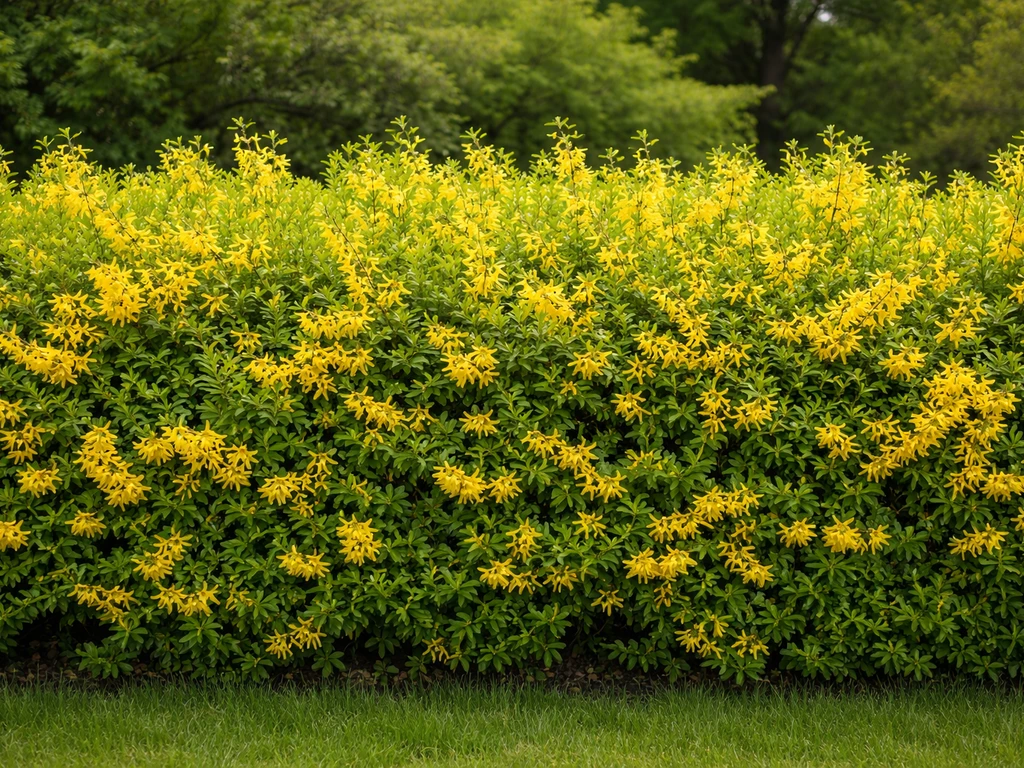
Choosing the right forsythia for a hedge
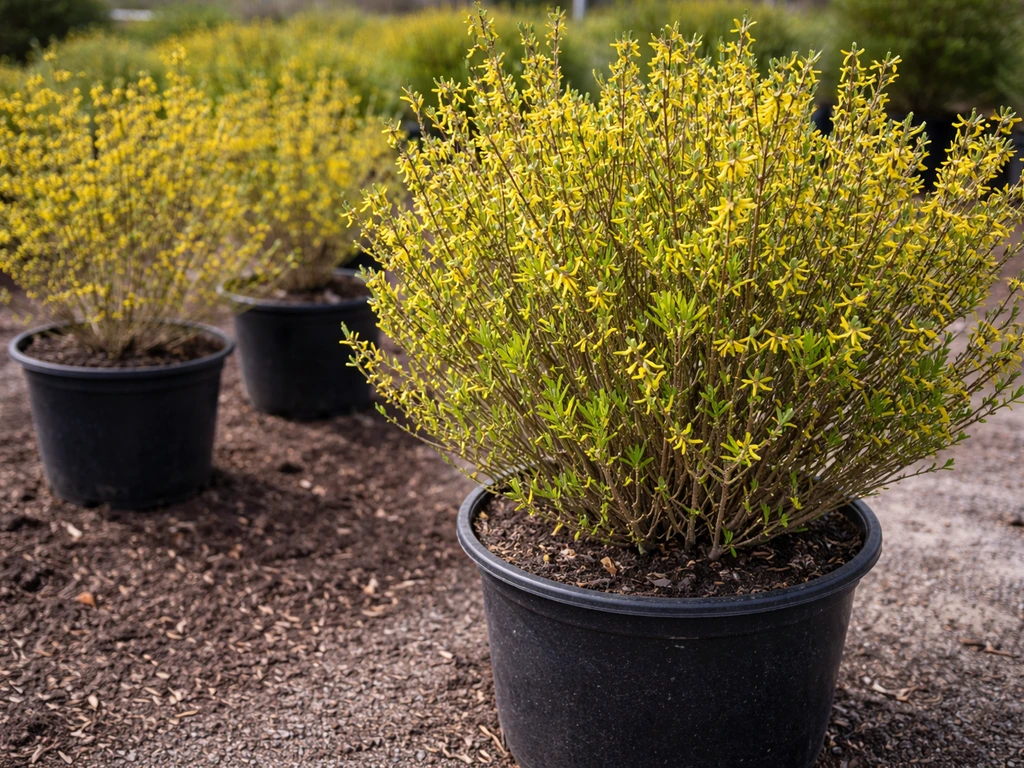
Not all forsythias hedge equally well. The species you want for a formal or semi-formal hedge is Forsythia × intermedia, the border forsythia. It's the workhorse of the group: vigorous, dense when pruned regularly, and covered in bright yellow flowers before the leaves even emerge in early spring. It blooms for about two to three weeks, which is one of the more reliable shows you'll get from any spring shrub.
For cultivar selection, the key questions are your climate zone and the final size you want. If you're in a colder region (USDA Zones 3 to 4), look for cultivars specifically bred for bud hardiness. In cold winters, forsythia flower buds can be killed even when the plant itself survives, which is why some older cultivars disappoint gardeners in the upper Midwest and northern New England. Cold-hardy selections like 'Meadowlark' and 'Northern Sun' were developed specifically for these zones.
'Fiesta' is another solid choice, noted for its dense, bushy habit and better bud hardiness compared to older cultivars, and it stays compact at around 3 to 4 feet tall, making it great for lower hedges or front-yard boundaries where you don't want something towering. The RHS Growing Guide also notes that the 'Fiesta' cultivar typically reaches about 1 to 1. 2 m (around 3⅓ to 4 ft) tall [Fiesta is about 1–1. 2 m (≈3⅓–4 ft) tall](https://www.
rhs. org. uk/plants/forsythia/growing-guide). For taller, more substantial hedges, standard Forsythia × intermedia varieties left to their natural height will reach around 6 to 7 feet unpruned.
If you're comparing forsythia to other shrubs for hedging purposes, it occupies a different niche than azaleas or photinia. If you’re wondering about azaleas too, the approach changes, especially for light and pH requirements how to grow azaleas outdoors. If you’re wondering how to grow photinia instead, the key differences are in sun exposure and routine watering after planting.
Azaleas have more specific requirements than forsythia, so it helps to know the right soil, light, and maintenance habits for encore azaleas. Forsythias are a different shrub from azaleas, so if you want to grow an azalea successfully, plan for its specific light, soil, and pH needs how to grow an azalea. Once you know that, the basics of how to grow an azalea come down to providing the right light, well-draining acidic soil, and consistent moisture grow an azalea successfully. Forsythia is deciduous, extremely fast-growing, and extremely cold-tolerant.
It's not a year-round privacy screen the way an evergreen hedge would be, but for a spring-blooming flowering hedge that's tough, fast, and inexpensive to establish, it's hard to beat.
| Cultivar | Mature Height | Cold Hardiness (Zone) | Best For |
|---|---|---|---|
| Forsythia × intermedia (standard) | 6–7 ft | Zone 5–8 | Tall, dense informal hedges |
| 'Fiesta' | 3–4 ft | Zone 5–8 (better bud hardiness) | Compact, lower hedges |
| 'Meadowlark' | 6–8 ft | Zone 4–8 | Cold climates, taller screens |
| 'Northern Sun' | 6–8 ft | Zone 3–8 | Very cold climates, reliable blooming |
Site prep: sun, spacing, and soil to prevent thin growth
Sun is non-negotiable for a blooming hedge. Forsythia grows and survives in partial shade, but partial shade gives you straggly, leggy growth and far fewer flowers. You want full sun, meaning at least six hours of direct sun per day. More is better. If you're choosing between two potential hedge spots, always go with the sunnier one.
Soil drainage matters just as much. Forsythia is adaptable to almost any soil type, which is one of its great virtues, but it genuinely cannot tolerate wet or waterlogged soil. If your site stays boggy after rain, you'll need to either raise the bed, amend heavily with grit and organic matter, or choose a different spot. Beyond drainage, forsythia is remarkably flexible on pH: it grows well anywhere from 5.
5 to 8. 0, so you almost certainly don't need to fuss with pH adjustments. A fertile, well-drained soil with a neutral to slightly acidic pH is ideal, but forsythia is far more forgiving than, say, azaleas growing in clay soil, which require much more careful pH management. If you're wondering how to grow azaleas in clay soil, focus on improving drainage and managing the pH so they can thrive azaleas growing in clay soil.
Before planting, work the bed to loosen compaction and remove perennial weeds. If your soil is poor or very sandy, mix in compost to improve moisture retention. If it's heavy clay, add grit or coarse sand along with compost to open up drainage. You don't need perfect soil to grow forsythia, but you do need it to drain.
Spacing is where most people underplant for a hedge and end up waiting years for fill-in, or overplant and create a crowded mess. Here's a practical way to think about it: for a fast, dense hedge that fills in within two to three seasons, space plants 18 to 24 inches apart. This matches the RHS recommendation of 45 to 60 cm for a formal hedge.
If you're less in a hurry and want to spend less money upfront, spacing plants 4 to 6 feet apart (as the Arbor Day Foundation recommends) still works, but expect a more open hedge for the first few years. For a double-row hedge, stagger the plants and keep rows 4 to 6 feet apart with 2 to 4 feet between plants within each row.
Planting timing and planting method for a dense hedge
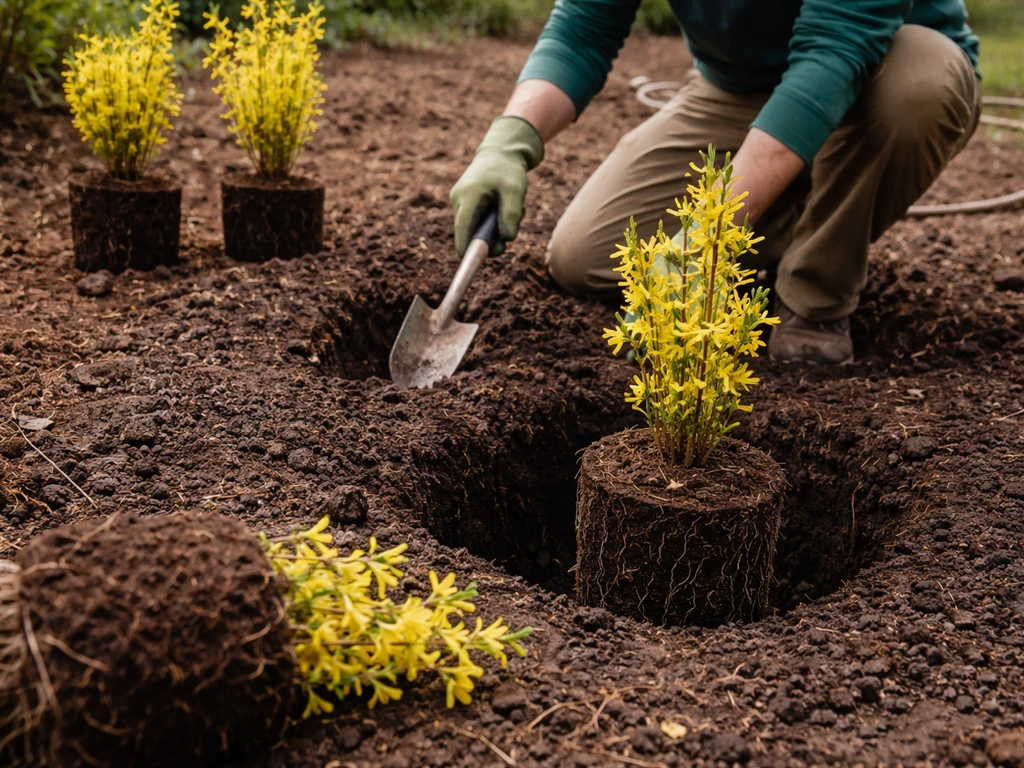
You can plant forsythia in spring or fall. Spring planting (April through early May in most climates) gives plants a full growing season to establish before winter. Fall planting (August through early November) also works well because cooler temperatures and autumn rains reduce transplant stress, and roots keep growing even after top growth stops. Bare-root plants, which are sometimes available during dormancy from November through February, are an economical way to plant a long hedge run. Container-grown plants are the most flexible and suffer the least transplant shock because you're not disturbing the root system.
Dig each hole at least as wide as twice the root ball diameter and no deeper than the root ball is tall. Planting too deep is one of the most common mistakes with shrubs and leads to slow establishment and poor growth. The root flare (where the trunk meets the roots) should sit at or just slightly above the surrounding soil level. For balled-and-burlapped plants, remove any twine or cord around the root ball before backfilling, and cut back or fold down the burlap so it doesn't wick moisture away from the roots. For container plants, check whether the roots are circling the pot and gently loosen or straighten them before planting.
Backfill with the soil you removed, tamp it gently to eliminate air pockets, and water thoroughly right away. Then apply 2 to 3 inches of wood chip mulch over the root zone, keeping it a few inches away from the stems to prevent rot. Mulch is one of the best things you can do for a newly planted hedge: it conserves moisture, moderates soil temperature, and suppresses weeds during that critical first season when plants are getting established.
Watering and fertilizing in the first year (and after)
The first year is all about getting roots established, and that means consistent watering. Check the soil moisture at least once a week by pushing your finger or a screwdriver 6 inches into the soil near the root zone. If it's dry at that depth, water. How much?
A good rule of thumb for newly planted shrubs is to apply water equal to about one-quarter to one-third the volume of the container the plant came in. That sounds technical, but in practice it means a slow, deep soak rather than a quick splash. Deep, infrequent watering encourages roots to chase moisture downward, which builds drought resilience. Shallow, frequent watering keeps roots near the surface and makes plants more dependent on you.
Once established (generally after the second full growing season), forsythia becomes quite drought tolerant. During dry spells, water with a thorough soak once or twice a week rather than little bits every day. You'll know the plant is established when it puts on strong new growth without wilting between waterings.
On fertilizing: forsythia doesn't need much, and overfeeding is a real mistake. Too much nitrogen pushes lush leafy growth at the expense of flowers and can leave plants more vulnerable heading into winter. If your soil is reasonably fertile, a light application of a balanced slow-release fertilizer in early spring is all you need. Apply it no later than mid-July so you don't stimulate a flush of soft late-season growth that won't harden off before cold weather. In practice, I skip fertilizer entirely in years when the plants are putting on good growth and only feed if growth seems weak or if a soil test shows a specific deficiency.
Pruning and training for hedge shape and big spring blooms
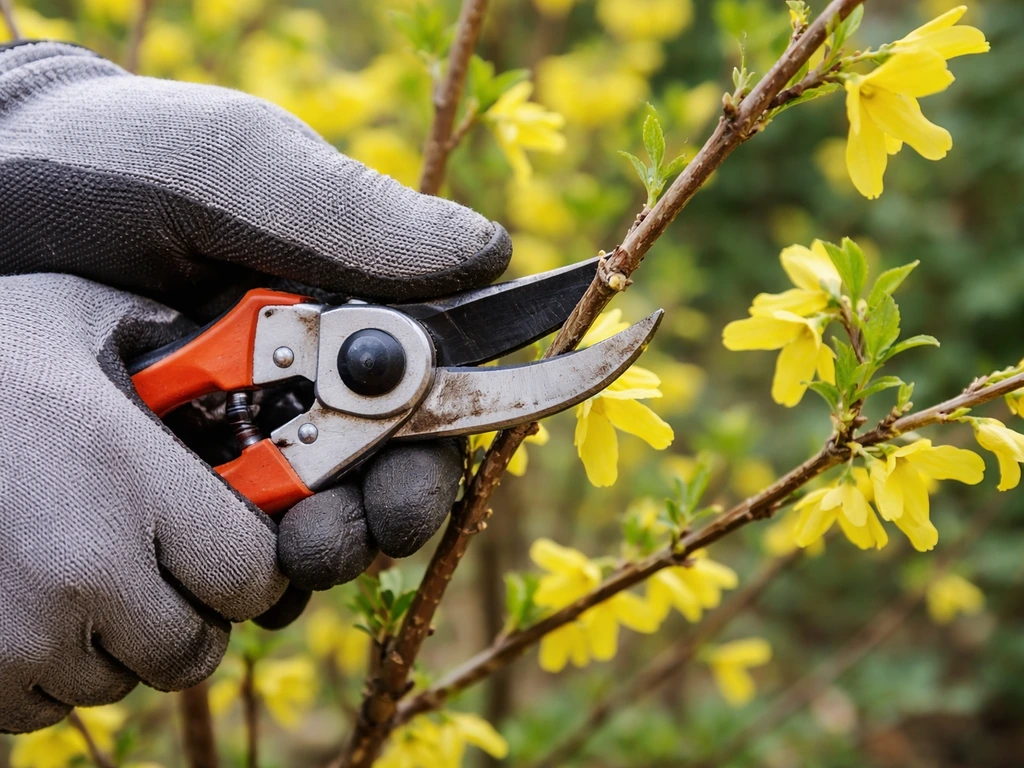
Pruning is the skill that separates a beautiful forsythia hedge from a frustrating blob that never blooms. The single most important rule: prune immediately after flowering in spring, not before, not in summer, not in fall. Forsythia sets its flower buds on stems that grew during the previous season (called old wood). If you prune in late summer, fall, or winter, you're cutting off the buds that would have given you flowers next spring. This is the number one reason forsythia hedges stop blooming.
The pruning window is roughly mid-spring, right as the flowers are fading. That's your moment. Once flowering is done, the shrubs immediately start growing new stems, and those new stems will carry next year's buds. Prune during this window and you give the plant the maximum time to produce flowering wood. Prune any later than mid-summer and you start reducing next year's display. Prune in fall or winter and you can lose most of the bloom.
Shaping a new hedge
In the first two to three years, focus on encouraging dense branching rather than immediately cutting to a precise shape. After the first spring bloom, trim the tips of all the main stems to encourage branching. Each cut tip will typically produce two or more new shoots, which is how you build that dense, filled-in look. Over successive years, you can begin shaping more formally, cutting to your desired height and width after each spring bloom.
Maintaining an established hedge
Once the hedge has the shape you want, maintain it with a post-bloom trim every year. Remove about one-third of the oldest, thickest canes right at the base each year. This encourages vigorous new growth from the base, keeps the hedge from getting woody and hollow in the middle, and ensures a steady supply of flowering stems. Don't remove more than one-third of the stems in a single season or you'll sacrifice that year's structure and stress the plant.
Rejuvenating an overgrown or neglected hedge
If you've inherited or allowed a forsythia hedge that's become a tangled, leggy mess with poor flowering, you have two options. The gentle route is phased rejuvenation: remove one-third of the oldest canes at the base each year for three consecutive years, always cutting immediately after bloom. This preserves some flowering each season while gradually renewing the plant. The aggressive route is to cut the entire hedge back to about 12 inches from the ground right after flowering. You'll lose one season of blooms, but you get a completely fresh start, and forsythia is vigorous enough to bounce back quickly. I've seen neglected hedges recover beautifully within two seasons using this approach.
Pest, disease, and troubleshooting common hedge problems
Forsythia is generally tough and low-maintenance, but a few issues do come up, especially in hedges where plants are close together and airflow is reduced.
Poor or no flowering
This is the most common complaint and almost always comes down to one of three causes: pruning at the wrong time (removing next year's flower buds), not enough sun, or winter cold killing the buds on less hardy cultivars. If your hedge is in good sun and you haven't pruned at the wrong time, check your cultivar. In Zones 4 and colder, standard Forsythia × intermedia cultivars frequently survive the winter but lose their flower buds to cold. Switching to a bud-hardy cultivar like 'Meadowlark' or 'Northern Sun' solves this.
Leggy, sparse, or uneven growth
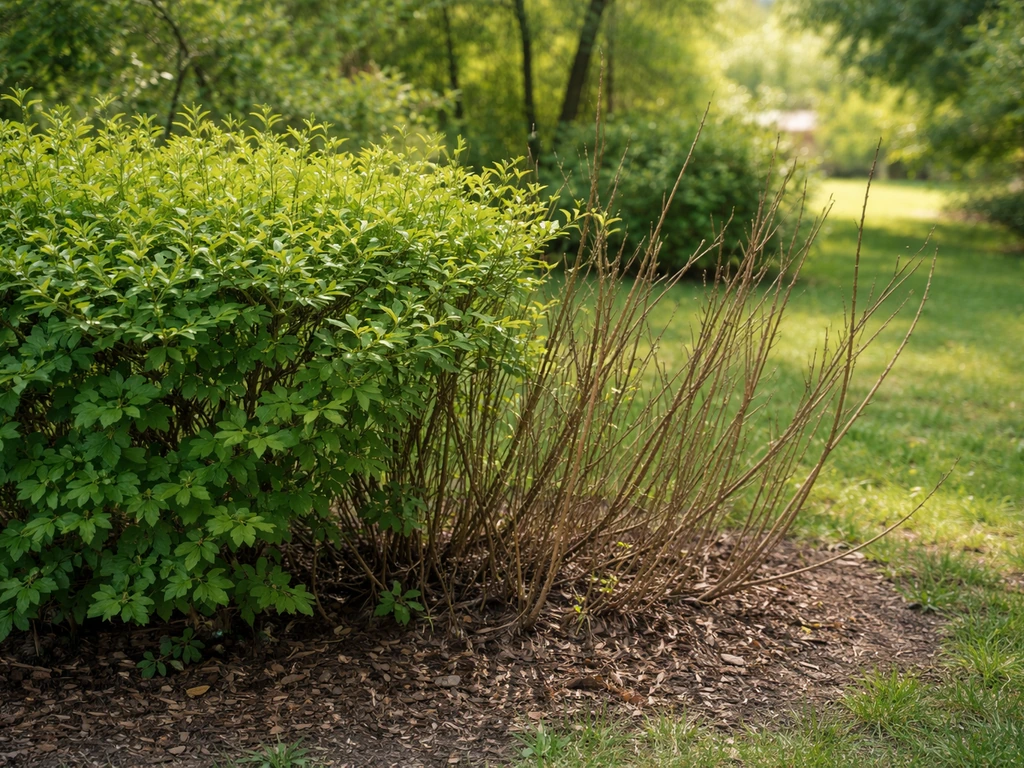
Leggy growth is almost always a light problem. Forsythia naturally reaches toward light, and if one side of the hedge is shadier, that side will be more open and straggly. Assess whether trees, buildings, or fences are blocking light to part of the hedge. You may need to reshape, open up the canopy overhead, or accept that the shaded section will always be thinner. Regular post-bloom pruning also helps: it forces branching and prevents the naturally arching stems from extending too far outward and leaving the interior bare.
Yellowing leaves
Yellow leaves mid-season often point to waterlogged soil (especially in poorly drained spots), or occasionally to a nutrient deficiency. Check drainage first. If the soil stays wet around the roots, that's the problem, and no amount of fertilizer will fix it. If drainage is fine and growth is otherwise weak, a soil test can tell you whether a specific nutrient is lacking.
Stem gall and other diseases
Two gall diseases are the most common disease problems in forsythia hedges: Phomopsis gall (caused by a fungus) and forsythia stem gall (caused by a bacterium). Both produce abnormal growths or swellings on stems. Phomopsis gall shows up as rough, corky, irregular galls on the stems. Bacterial stem gall looks similar.
Neither is typically fatal, but heavy infection weakens plants and looks bad. The management approach for both is the same: prune out affected stems well below the gall, disinfect your pruning tools with a dilute bleach solution between cuts, and don't leave infected material on the ground near the plants. Avoid wounding plants unnecessarily, especially at planting time, since bacteria often enter through root and stem wounds.
Crown gall, a related bacterial disease, can also affect forsythia at the soil line, especially in newly planted or transplanted shrubs where the roots were damaged.
Dieback and winter damage
Some dieback of stem tips in harsh winters is normal for forsythia, especially in colder zones. Prune out dead wood in early spring before or just as growth starts (this is the one time you can prune in early spring without worrying about losing blooms, because dead stems have no blooms to lose). If the majority of stems are dying back each winter, reconsider your cultivar selection for your climate zone.
Pests
Forsythia has very few serious pest problems. The shrubs are not particularly attractive to deer (though hungry deer will browse almost anything), and insect problems are rare. If you see spider mites during hot, dry spells (look for stippled, dusty-looking leaves), a strong spray of water from the hose is usually enough to knock populations back. For a hedge that stays healthy long-term, good airflow through regular pruning is the best preventive measure.
Seasonal care calendar: spring, summer, fall, and winter steps
Once your hedge is established, the annual routine is straightforward. Here's what to do and when:
| Season | Key Tasks |
|---|---|
| Spring (March–May) | Enjoy the bloom. Prune immediately after flowering: shape the hedge, remove one-third of oldest canes at the base, and cut out any dead or damaged stems. Apply a light balanced fertilizer if growth was weak last year. Renew mulch layer to 2–3 inches. |
| Summer (June–August) | Water during dry spells with a deep soak once or twice a week. Do not prune (this removes next year's flower buds). Monitor for signs of gall, dieback, or leaf problems. No fertilizer after mid-July. |
| Fall (September–November) | Do not prune. New bare-root or container plants can be installed now through early November. Water newly planted sections until the ground freezes. Replenish mulch before the first hard frost to insulate roots. |
| Winter (December–February) | No pruning of healthy stems. Check for rabbit or deer browse damage on young hedges and use wire guards or repellent if needed. Plan any rejuvenation cuts to execute right after next spring's bloom. |
One final thing worth saying: forsythia is genuinely one of the most forgiving hedging shrubs you can choose. Encore azaleas are a great low-maintenance alternative if you want repeat blooms, and they have their own care needs for watering, sunlight, and pruning. It establishes quickly, handles a wide range of soils, and recovers well from most mistakes. The one mistake it doesn't forgive easily is wrong-time pruning, because you'll wait a full year for another chance to correct it. Keep the post-bloom pruning window in your calendar every spring, and the rest of the care is easy. Your hedge will reward you with one of the best yellow flower shows of the entire gardening year.
FAQ
How can I tell if my forsythia hedge is being pruned at the wrong time, even if the flowers look okay this year?
If you prune any time after the spring bloom is finished, you’re removing stems that would have formed next year’s buds. A clue is that the hedge looks fine after pruning but then has a noticeably smaller or patchy bloom the following spring, even though the plant still leafs out normally.
My hedge blooms well, but the middle stays thin and doesn’t fill in. What should I do?
This usually happens when older, woody canes remain and new growth is mostly on the outside. After the flowers fade, remove about one-third of the thickest oldest canes right at the base, every year, and avoid trimming just the outer tips. That pushes replacement shoots up from the interior.
Can I grow a forsythia hedge in partial shade if I want low maintenance?
You can, but expect reduced flower production and a more open, leggy structure. If part of the hedge is shaded by trees or buildings, the shaded side will fill last. If you must compromise, prioritize the sunniest edge and do targeted reshaping after bloom to encourage branching where light is strongest.
What’s the best spacing for a hedge if I need it to fill in fast but I’m also worried about airflow and disease?
A good balance is typically 18 to 24 inches apart in a single row for faster density, then use regular post-bloom pruning to maintain airflow. For two rows, keep rows about 4 to 6 feet apart and stagger plants rather than lining them up, so the interior doesn’t stay stagnant and crowded.
How often should I water after the first season, and how do I know when to stop?
After establishment (often after the second full growing season), water only during dry spells with a deep soak about once or twice per week. Use the same check method as during establishment (probe 6 inches). If it’s consistently moist at that depth, you can pause watering without harming the hedge.
Do I need to fertilize every year to get lots of blooms?
Not usually. Overfeeding, especially nitrogen, can boost leaf growth while reducing flowers. If growth is already strong, skip fertilizer. If you do feed, use a light balanced slow-release option in early spring and avoid any application after mid-July to prevent soft late growth.
My forsythia leaves turn yellow mid-season. How can I tell if it’s drainage trouble versus a nutrient problem?
Start with drainage. Yellowing plus consistently damp soil around the root zone points to waterlogged conditions, which fertilizer won’t correct. If the soil drains well and growth is overall weak, do a soil test to confirm whether a specific deficiency is present before adding anything.
What should I do if my hedge looks tangled and doesn’t bloom much anymore?
Choose between phased rejuvenation and a hard reset. For phased rejuvenation, remove one-third of the oldest canes at the base each year for three years, pruning immediately after bloom. For a hard reset, cut the whole hedge back to about 12 inches right after flowering, accept one season of fewer blooms, and then rebuild with post-bloom shaping.
Is it okay to prune dead or damaged stems in early spring?
Yes. Early spring pruning is fine only for dead or winter-damaged wood, because those stems have no buds left to sacrifice. Wait until growth is starting so you can clearly distinguish dead tissue from living stems.
How do I prevent gall diseases when pruning forsythia hedges?
Prune out affected stems well below the gall, disinfect tools between cuts (a dilute bleach solution is commonly used), and don’t leave infected clippings near the plants. Also avoid unnecessary wounding during planting and early care, since bacteria can enter through stem and root injuries.
Will cutting the hedge back for size reduce next year’s flowers?
Yes, if you cut at the wrong time. Any trimming beyond the post-bloom window risks removing next year’s flower buds on old wood. If you need to control height or width, do it after the spring flowers fade, then stop until the next post-bloom period.