
You can grow climbing and trailing fuchsias successfully by choosing a variety matched to your climate, planting after your last frost date in fertile, well-drained soil, training the stems onto a trellis or wires as they grow, and giving them regular water and a balanced feed through summer. For a fuller, step-by-step guide on general fuchsia care, see how to grow fuchsias. Hardy types like Fuchsia magellanica 'Riccartonii' will come back from the roots year after year in cool temperate gardens, while tender hybrids need frost-free storage or a greenhouse over winter. The key decisions are made before you plant: get the variety, site, and soil right, and the rest of the care is straightforward.
How to Grow Climbing Fuchsia: Complete Guide & Seasonal Care

Marcus Holloway
8 Aug 2026
Why grow climbing fuchsia?
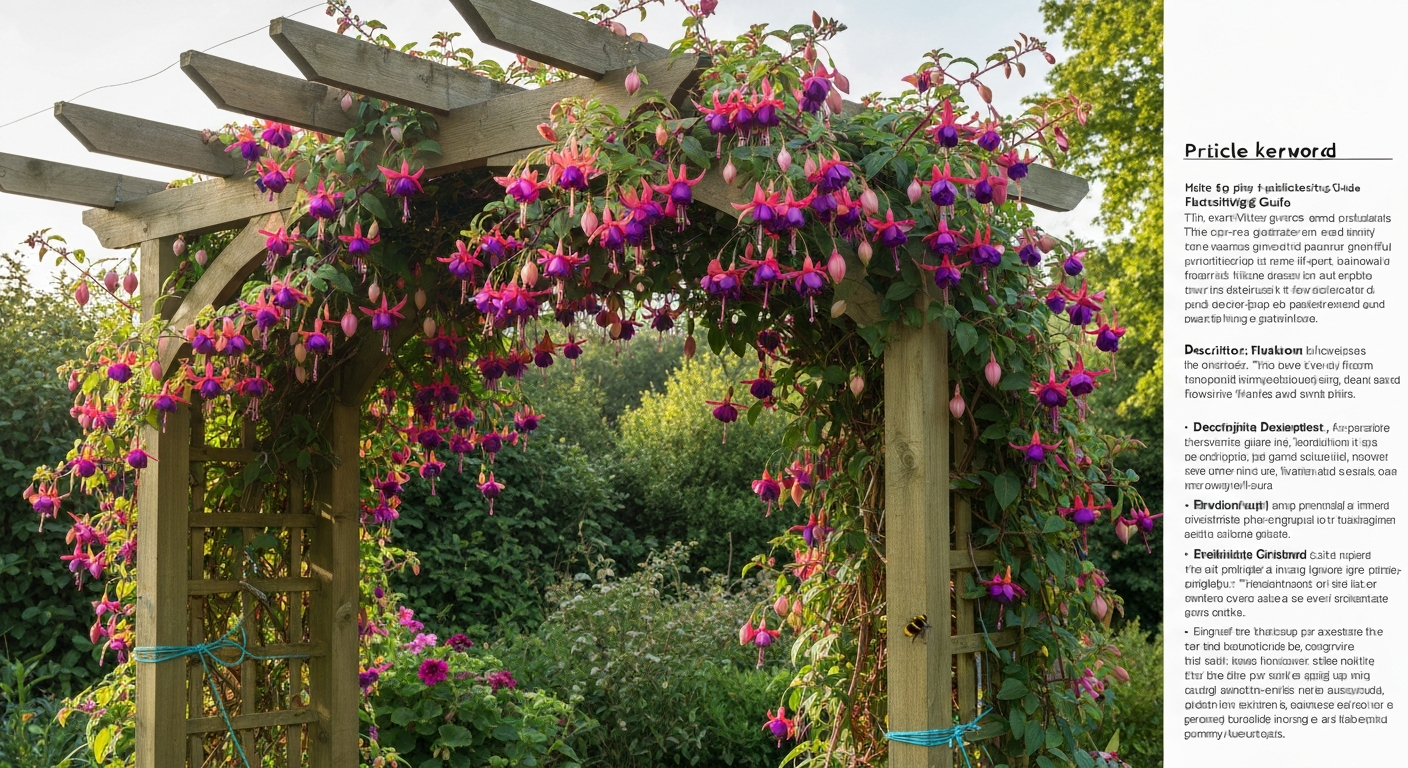
Climbing and trailing fuchsias fill a gap that very few flowering plants can match. They produce pendulous, two-toned blooms from midsummer right through to the first frosts, often with almost no gap in flowering once they get going. That makes them genuinely useful in the garden: trained against a shaded fence or north-facing wall they'll produce a curtain of colour in a spot where most sun-hungry climbers simply fail. Against a pergola or arch, a vigorous climbing type becomes a focal point from July to October.
In containers they hang beautifully from brackets and pergola beams, and a well-trained standard (the lollipop-shaped grafted form) acts as a structural centrepiece in a formal border or pot display. Fuchsias also attract bumblebees and hummingbirds where they're present, so they earn their space from a wildlife perspective too. If you've already had success growing fuchsia plants in baskets, training them as climbers is the logical next step and opens up much more of the garden.
Choosing the right type: hardy, tender, trailing and standards
The fuchsia world is enormous, and the habit of the plant varies significantly by type. Before you buy anything, it's worth understanding the four broad categories you'll encounter.
Hardy fuchsias
Hardy fuchsias, predominantly cultivars of Fuchsia magellanica, are perennials in cool temperate climates. They die back to the ground in a hard winter but regrow from the roots in spring. The RHS rates the best of them at H4 or H5 (hardy to around -10°C / 14°F with protection), and varieties like 'Riccartonii' and 'Mrs Popple' are reliable hedging plants across much of the UK and similar climates. For step-by-step advice on selecting varieties and winter care, see how to grow hardy fuchsia. In USDA zones 6-9 they're a dependable choice for permanent outdoor planting. They can reach 1.5-2.5 m (5-8 ft) in a season and respond well to being trained along wires or a trellis.
Tender and semi-hardy fuchsias
Tender fuchsias include most of the showy, large-flowered hybrid varieties you see in garden centres. They're classified H1c-H3 by the RHS, meaning they need frost protection and are best treated as summer annuals unless you have somewhere frost-free to overwinter them. Semi-hardy types sit in the middle: they may survive mild winters against a sheltered wall but are unreliable in colder spots. If you're in USDA zones 9-11, many of these can be grown outdoors year-round with minimal fuss.
Trailing and ampel fuchsias
Trailing or 'ampel' fuchsias have naturally lax, cascading stems that make them ideal for hanging baskets and tall containers. They're not true climbers in the botanical sense, but they can be guided upward and outward with support and are often labelled as 'climbing fuchsia' in retail. Training them onto a fan-shaped trellis or series of canes lets them span a large wall area while preserving their natural flow.
Standards and grafted hybrids
Standards are fuchsias trained or grafted onto a clear upright stem, producing a compact flowering head at the top. They're a specialist form rather than a climber, but they often appear in the same section of the garden centre. Grafted hybrids combine a desirable flowering top with a vigorous rootstock and are common in nursery production. Both require staking, regular tie-ins and frost protection comparable to other tender types. If you want to try training a standard yourself, the American Fuchsia Society publishes detailed guidance on building the trunk from a cutting before heading it. The AFS is the International Registration Authority for Fuchsia cultivars and maintains registration data, propagation and culture notes in its blank" rel="noopener noreferrer">REGISTRATION DATABASE | American Fuchsia Society. Hybrid fuchsias open up thousands of flower combinations, and if that breadth of choice interests you, it's worth exploring hybrid fuchsia growing in more depth alongside this guide. For step-by-step guidance on choosing and growing hybrid fuchsias, see hybrid fuchsia how to grow. For step-by-step advice on how to grow a hybrid plant, consult a focused guide on hybrid growing techniques.
Which variety suits your climate and situation
Matching variety to climate is the single decision that will save you the most frustration. Here's a practical breakdown across three broad garden types.
| Garden type | Recommended varieties | Growth habit | Hardiness (USDA) | Key notes |
|---|---|---|---|---|
| Cool temperate (UK, PNW, N. Europe) | 'Riccartonii', 'Mrs Popple', F. magellanica 'Versicolor' | Upright / arching climber | Zone 6-8 | Reliably perennial; dies back in winter but regrows strongly |
| Temperate with mild winters | 'Dollar Princess', 'Hawkshead', 'Alice Hoffman' | Upright / semi-trailing | Zone 7-9 | May survive mild winters; treat as tender in colder years |
| Warm / Mediterranean (mild frosts only) | Large-flowered tender hybrids, 'Gartenmeister Bonstedt' | Trailing / lax climber | Zone 9-11 | Grow outdoors year-round; avoid afternoon heat above 27°C |
| Container / any climate (tender hybrids) | 'Swingtime', 'Dark Eyes', 'Annabel' | Trailing / ampel | Zone 10-11 | Overwinter frost-free; ideal for hanging baskets or trained fans |
If you're in a cool climate and want a plant that looks after itself, start with 'Riccartonii'. It's tough, vigorous, and responds to training without complaint. If you're drawn to the big, ruffled flowers of tender hybrids and have a frost-free space to overwinter them, 'Swingtime' or 'Dark Eyes' are hard to beat for sheer flower impact. For those in warmer zones who want low-maintenance colour from a wall or fence, 'Gartenmeister Bonstedt' (a triphylla hybrid) tolerates more sun and heat than most.
Site selection and when to plant
Light, wind and microclimates
Most fuchsias perform best in bright, indirect light or a position that gets morning sun and afternoon shade. That north- or east-facing wall or fence that stumps many gardeners is genuinely ideal. Hardy magellanica types tolerate more direct sun in cool, cloudy climates but even they will drop buds and scorch leaves if they bake in reflected heat from a south-facing wall on a hot afternoon. Wind is a bigger problem than most people expect: strong gusts shred the soft stems and damage the flowers. A position sheltered by a fence, hedge, or neighbouring structure is worth seeking out, especially in the first season.
Microclimates matter more for fuchsias than many flowering plants. A spot on the south side of a house, tucked against a warm wall in a sheltered courtyard, can be a full USDA zone warmer than an open garden a few metres away. That extra warmth can mean the difference between a tender variety surviving winter outside and needing to come in. Equally, a frost pocket at the bottom of a slope can kill back a hardy fuchsia that would have been fine on higher ground nearby.
Planting calendar
In cool temperate climates, plant out fuchsias after your last hard frost date: typically late May to early June in the UK and similar regions. In USDA zone 7-8 that usually means late April to May. In Mediterranean or mild-winter climates (zones 9-11), autumn planting (September to October) allows root establishment before the heat returns, much as you'd time other perennials. Container-grown plants bought from a nursery can be planted at any point in the growing season as long as you water them in well and avoid the height of summer heat.
Soil, drainage and container choices
In-ground soil preparation
Fuchsias want fertile, moist but freely draining soil. The RHS 'How to grow hardy fuchsias / RHS Growing Guide' recommends fertile, moist yet freely draining soil with a neutral to slightly acidic pH. A good rule of thumb is: if water sits for more than a couple of hours after heavy rain, the drainage is insufficient and you need to address it before planting. Work in a generous amount of well-rotted compost or leaf mould, especially in sandy soils that dry out fast or heavy clay that compacts. The target pH is slightly acidic to neutral: roughly 6.0-7.0. If you're not sure about your soil pH, a basic test kit from a garden centre will confirm it in five minutes. In heavy clay, incorporating coarse grit (at least a 20-30% proportion by volume in the planting area) will meaningfully improve drainage and reduce the risk of root rot over winter.
Container mixes
For containers, avoid using garden soil on its own: it compacts, drains poorly, and often introduces pests and disease. A peat-free potting mix is the practical standard now: a mix of 2 parts coir or good quality peat-free compost, 1 part perlite, and 1 part coarse bark or additional perlite works well and is easy to make up yourself. Commercial peat-free John Innes-style mixes are a reliable shortcut if you don't want to blend your own.
Container sizing and drainage
Avoid the temptation to over-pot fuchsias. Choose a container only slightly larger than the root ball: roughly 5 cm (2 in) more diameter all round. A container that's too large holds excess moisture around the roots, which is the most common cause of root rot in container fuchsias. Multiple drainage holes in the base are non-negotiable. A 30-40 cm (12-16 in) pot is typically right for a single mature climbing or trailing fuchsia; for a fan-trained plant against a wall, a larger trough of 45-60 cm (18-24 in) gives the root run needed for vigorous growth.
Planting step by step
- Water the plant thoroughly in its original pot an hour or two before planting so the roots are hydrated and the root ball holds together.
- Dig a hole roughly twice the width and the same depth as the root ball. If planting against a wall or trellis, position the hole 20-30 cm (8-12 in) away from the structure to avoid the driest soil directly at the base.
- Fork in a good handful of well-rotted compost at the base of the hole and mix lightly with the loosened soil.
- Remove the plant from its pot and tease out any tightly circling roots gently with your fingers.
- Set the plant so the top of the root ball sits at, or very slightly below, the surrounding soil level. Planting a little deeper than it grew in the pot (1-2 cm) helps the crown stay insulated in cold spells.
- Backfill with the improved soil, firming gently with your hands as you go to eliminate large air pockets. Do not compact the soil heavily.
- Water in thoroughly: give a full watering-can of water per plant (roughly 10 litres / 2.5 gallons) to settle the soil around the roots.
- Apply a 5-7 cm (2-3 in) layer of mulch (bark chips, leaf mould or well-rotted compost) around the base, keeping it clear of the main stem by a few centimetres.
- Immediately attach the main stems loosely to your trellis or support framework with soft ties.
Propagation methods
Softwood cuttings (the most reliable method)
Softwood tip cuttings taken in spring and early summer root quickly and give you strong plants within the same season. I take mine from mid-April onwards once the parent plant has put on some new, actively growing shoots. The process is genuinely beginner-friendly, and once you've done it once you'll find yourself propagating fuchsias almost on autopilot every year.
- Select a healthy shoot tip with 2-3 pairs of leaves and cut it cleanly just below a leaf node with a sharp, clean blade. Aim for cuttings 5-10 cm (2-4 in) long.
- Remove the lowest pair of leaves, leaving at least one pair intact at the top.
- Dip the cut base lightly in rooting hormone powder or gel (IBA-based; around 500-1,500 ppm IBA is the standard range for softwood). Tap off any excess.
- Insert into a moist propagation medium: a 50:50 mix of perlite and coir works well. Use a dibber or pencil to make the hole first so you don't scrape off the hormone.
- Place the pot in a humidity dome, zip-lock bag, or propagator. Position in bright, filtered light and keep the air temperature at 18-21°C (64-70°F). Bottom heat in the 18-24°C (64-75°F) range speeds rooting noticeably.
- Check for roots after 2-3 weeks by gently tugging a cutting. Once rooted (usually 2-4 weeks), increase ventilation gradually over a few days before removing the cover entirely.
- Pot on into a standard peat-free potting mix once the plant is growing away strongly.
Hardwood cuttings and layering
Hardwood cuttings of hardy fuchsias can be taken after the first frost in autumn, when the stems are dormant. Cut pencil-thick sections about 10-15 cm (4-6 in) long, insert them upright into gritty compost, and keep them in a cool, frost-free space over winter. The American Fuchsia Society documents this Victorian-style method producing reliably rooted stock by spring. It's slower than softwood cuttings but requires almost no specialist equipment. Layering is useful for long, lax stems that reach the ground: pin a section of the stem down into moist soil with a u-shaped pin, leaving 15-20 cm of tip above ground. Roots form at the pinned node over several weeks and you can sever and lift the new plant once well established.
Growing a standard from a cutting
Training a standard from a cutting is a medium-term project: expect it to take one to two growing seasons to develop a clear, straight trunk of the height you want (mini standards at around 30 cm, full standards at 75-100 cm). Root a softwood cutting as above, then stake the main stem immediately with a cane and begin removing all side shoots from the main stem as it grows, while leaving the top two or three pairs of leaves to feed the plant. Once the stem reaches your desired height, pinch out the growing tip to force branching at the top. Grafted standards from nurseries skip the trunk-development phase but still need firm staking, regular tie-ins to the stake, and the same frost protection as any tender fuchsia.
Training and supporting climbing fuchsias
Fuchsias are not self-clinging climbers. Their stems won't attach to a wall on their own the way ivy does, so you need to provide a structure and tie stems in as they grow. The good news is they're very accommodating: they'll grow wherever you direct them and respond well to being shaped.
Trellis and wire systems
A timber or metal trellis fixed 5-10 cm (2-4 in) away from a wall gives the stems room to grow and allows air circulation, which significantly reduces fungal disease. Horizontal wires at 30-45 cm (12-18 in) intervals running parallel to a fence or wall work equally well and are less visually obtrusive. Use vine eyes (screw eyes with a hook) to hold the wires away from the surface. Tie developing stems to the horizontal wires with soft garden twine or adjustable plant clips, looped loosely enough that the stem can thicken without being cut into.
Fan training and espalier techniques
For a formal fan shape on a fence or wall, start with a young plant and select three to five main stems to form the 'ribs' of the fan. Tie these out at angles to the main horizontal wires, spacing them evenly. As the plant grows, select lateral shoots from each rib and tie those in too. Remove any stems growing directly toward or away from the wall as they appear: you want everything in roughly the same plane. An informal espalier approach with fewer main ribs is easier for beginners and still produces excellent coverage. Check and adjust ties at least once a month in the growing season as stems extend quickly.
Pruning, deadheading and shaping
When and how to prune climbers
Hardy climbing fuchsias are best pruned in mid-to-late spring, once you can see the new growth breaking from the old stems. Pruning too early risks exposing fresh growth to late frosts. Cut back all dead or frost-damaged wood to where you can see healthy green tissue, then reduce the previous season's growth by about half to encourage branching. In milder climates where stems don't die back, prune in early spring before growth begins in earnest: shorten all side shoots back to two or three buds from the main framework.
Tender climbing fuchsias brought in for winter should be pruned by roughly a third when you're bringing them back out in spring, after their period of dormancy. This removes any weak or dead material and stimulates fresh, flowering growth. Resist pruning hard in autumn before overwintering: the extra foliage helps buffer the plant through storage.
Deadheading and shaping for more flowers
Fuchsias are not heavy dead-headers in the way that petunias are, but removing spent flowers and developing seed pods does push energy back into producing new buds. Run your fingers along each shoot every week or two and pinch or snip off the faded flowers. If you want to encourage bushier, more branching growth on a newly trained climber, pinch out the growing tip of each new lateral shoot once it has produced two or three pairs of leaves. This is sometimes called 'stopping' and is a standard technique among experienced fuchsia growers for building dense coverage.
Watering, feeding and mulching
Watering schedules
Container fuchsias dry out fast in warm weather and may need watering every day during a hot, dry summer. The reliable test is to push your finger 2-3 cm into the compost: if it feels dry at that depth, water thoroughly until it runs freely from the drainage holes. In cool, wet weather back off to every two or three days, or less. In-ground plants generally need less intervention: a thorough watering once or twice a week in dry spells during the first growing season is enough to establish the roots. Once established, hardy in-ground fuchsias are reasonably drought-tolerant and often need no supplemental watering in cool, rainy climates.
Feeding through the season
Fuchsias are hungry plants, especially in containers. Feed container plants with a balanced liquid fertiliser (roughly equal NPK, such as a 10-10-10 or 14-14-14 formulation) every 7-14 days from when they start to grow in spring until mid-August. From mid-August onwards, switch to a feed higher in potassium (a tomato fertiliser works well here: something like a 4-6-8 or similar) to harden the growth and promote flower production rather than soft, sappy shoots. Stop feeding container plants entirely as you approach the end of the season and prepare for overwintering. For in-ground plants, a top-dressing of balanced slow-release granules in spring and a further top-dressing of compost as a mulch is usually sufficient. I'll be honest: Miracle-Gro and equivalent all-purpose feeds work adequately for general nutrition, but they won't substitute for the potassium boost in late summer that toughens the growth and encourages late-season flowers.
Mulching
A 5-7 cm (2-3 in) layer of mulch around the base of in-ground fuchsias does several things at once: it retains moisture, suppresses weeds, moderates soil temperature, and in winter provides meaningful insulation for the crown. Bark chips, well-rotted compost, or leaf mould are all good choices. Top up the mulch layer in late autumn before the first frosts arrive, and again in spring after pruning. Keep the mulch clear of direct contact with the main stem to avoid encouraging rot at the crown.
Pests, diseases and disorders
Aphids
Aphids, particularly the glasshouse and peach-potato aphid, cluster on new shoot tips and underneath leaves, causing distorted, curled growth. They're usually the first pest problem you'll see in spring. In most cases, a firm jet of water from a hose knocks them back effectively, especially if you catch the infestation early. If numbers build despite this, an insecticidal soap spray (repeat applications every 5-7 days) gives good control without the collateral damage of broad-spectrum insecticides on pollinators. Encourage beneficial insects by avoiding routine prophylactic pesticide use.
Vine weevil
Vine weevil grubs are one of the most destructive pests for container fuchsias. The cream-coloured, c-shaped grubs eat the roots underground during late summer and autumn, and by the time you notice the plant wilting it may already be severely damaged. The adult weevils (dark, flightless beetles) notch the leaf margins and are easier to spot. Biological control using the nematode Steinernema kraussei, applied to container compost when soil temperatures are consistently above 5°C, is effective and safe. Apply in late August to early September for best results. Checking the root ball when repotting and crushing any grubs you find is also worth doing routinely.
Fuchsia gall mite
Fuchsia gall mite (Aculops fuchsiae) is a microscopic pest that causes dramatic, distinctive symptoms: distorted, thickened, hairy-looking shoot tips and new growth, often with reddish or yellowish discolouration. It spreads quickly via contact between plants, insects and tools. Once a plant is heavily infested, the most practical response for most home gardeners is to remove and destroy affected material (do not compost it) and, if the plant is moderately affected, cut back to healthy tissue and discard the prunings in the bin. Avoid spreading it by cleaning tools between plants. Gall mite is currently spreading in the UK and parts of Europe, so if you're buying new plants inspect them carefully before bringing them into your garden.
Fungal problems
Botrytis (grey mould) is the main fungal threat, particularly on overwintered plants in humid, poorly ventilated conditions. It shows as fuzzy grey growth on stems, leaves and flowers, and spreads fast once established. Prevention is far easier than cure: ensure good air circulation around the plant, avoid overhead watering, remove spent flowers promptly, and don't overcrowd plants in storage. If botrytis appears, remove all affected material cleanly, improve ventilation, and reduce watering. Rust (orange pustules on leaf undersides) and powdery mildew occur occasionally, especially in dry spells or overcrowded plantings. Both respond to improved airflow and, if persistent, approved copper-based or sulphur-based fungicide treatments.
Troubleshooting quick guide
| Symptom | Most likely cause | What to do |
|---|---|---|
| No flowers or very few flowers | Too much shade, insufficient feeding, or over-pruning in spring | Move to brighter spot; feed with high-potassium fertiliser; prune less aggressively next season |
| Bud drop before flowers open | Sudden temperature change, very dry compost, or hot dry air | Water more consistently; move away from heat sources; improve humidity around plant |
| Yellow leaves (general) | Overwatering, waterlogged roots, or nitrogen deficiency | Check drainage; allow compost to dry slightly; apply balanced feed |
| Yellow leaves (between veins, green veins) | Lime-induced chlorosis (pH too high) | Test soil pH; apply acidifying fertiliser or sulphur; use ericaceous compost for containers |
| Leggy, sparse growth with few side shoots | Insufficient light or not enough pinching/stopping | Move to brighter position; pinch growing tips regularly to encourage branching |
| Wilting despite moist soil | Vine weevil root damage or root rot | Examine root ball for grubs or brown, mushy roots; apply nematodes or improve drainage |
| Distorted, hairy new growth | Fuchsia gall mite | Remove and destroy affected growth; clean tools; consider removing plant if heavily infested |
| Leaves with notched edges | Vine weevil adults | Check at night with a torch; hand-pick adults; apply nematode treatment to compost |
Overwintering and hardiness guidance
Hardy in-ground fuchsias
Hardy fuchsias (USDA zones 6-8, RHS H4-H5) are best left largely alone over winter. After the first frosts, resist the urge to cut the dead stems right back: leave them in place as they provide some insulation for the crown below. Apply a thick mulch of dry bark chips or straw over the crown in late autumn. In spring, once you see fresh green shoots emerging from the base (usually March to April in the UK), cut the dead top growth back to just above the new shoots. For gardeners also interested in other cold-hardy shrubs, see how to grow Chicago Hardy Fig for tips on winter care and site selection. In very cold spells (below -10°C / 14°F) you can protect the crown additionally with a layer of horticultural fleece.
Tender fuchsias in containers
Tender and semi-hardy fuchsias in containers need to come inside before the first frost. Reduce watering gradually through late August and September to slow the plant's growth. Before bringing it in, prune by no more than a third to make it manageable, and check thoroughly for vine weevil grubs and aphids. Store in a frost-free, reasonably cool space: a cool greenhouse, unheated porch or garage that stays above 2-5°C (35-40°F) is ideal. The plant can be kept barely ticking over in near-dormancy with minimal watering through winter, then brought into warmth and light gradually from February onwards to start the new season.
Fan-trained and wall plants
A tender fuchsia trained onto a trellis against a sheltered wall is harder to bring inside, so the approach is different. Wrap the stems and wall structure in several layers of horticultural fleece in late October and leave it in place until April. This will see a semi-hardy variety through mild winters in USDA zone 8-9, but it's not reliable in harder frosts. If you lose the top growth to a severe winter, don't give up: check for living wood and new crown growth in late spring before discarding the plant.
Container versus in-ground: what changes
Growing a climbing fuchsia in a container against a trellis or wall gives you portability and control over soil conditions, which is particularly valuable with tender types. The trade-offs are increased watering and feeding demands and the need to repot every one to two years as the plant outgrows its container. In-ground plants establish a much larger root system, are more drought-tolerant once settled, and generally require less intensive feeding. The differences in day-to-day care are significant enough to be worth understanding clearly before you commit.
| Aspect | Container planting | In-ground planting |
|---|---|---|
| Watering frequency | Daily in hot weather; every 2-3 days in cool weather | Once or twice a week to establish; rarely needed once established in cool climates |
| Feeding | Liquid feed every 7-14 days throughout the growing season | Slow-release granules in spring plus annual compost mulch is usually sufficient |
| Repotting | Every 1-2 years into a slightly larger container | Not needed; top-dress with compost annually |
| Overwintering | Bring indoors before first frost; store frost-free | Hardy types: mulch crown; leave; tender types on walls: wrap in fleece |
| Root restriction | Can limit size; useful for controlling vigour in small spaces | Unrestricted; plant will achieve full natural size over time |
| Disease risk | Higher risk of root rot if overwatered; good drainage critical | Lower risk if soil is well-prepared; less likely to waterlog |
| Portability | Can be moved as conditions change | Permanent; choose the site carefully before planting |
Month-by-month care calendar
This calendar is aimed at cool temperate growers (UK and similar). Adjust timing by 4-6 weeks earlier for warmer climates (USDA zones 8-9) or later for cold continental climates.
| Month | Key tasks |
|---|---|
| January-February | Check overwintering plants; water very sparingly; remove any dead or rotting material; keep frost-free |
| March | Bring container plants into warmth and light; begin watering more regularly to restart growth; order new varieties |
| April | Prune overwintered container plants by a third; start liquid feeding; take softwood cuttings from actively growing shoots; begin hardening off plants for outdoor use |
| May | Harden off tender plants outdoors during the day; plant hardy types in ground after last frost risk; pot on rooted cuttings; begin tying in stems to supports |
| June | Plant out all tender types once frost risk has passed; continue taking softwood cuttings; increase watering and feeding frequency; check for aphids; pinch shoot tips for bushiness |
| July | Peak growing and flowering season; water daily in containers as needed; feed every 7-14 days with balanced fertiliser; deadhead regularly; tie in new growth monthly |
| August | Switch to high-potassium feed from mid-August; continue deadheading; apply vine weevil nematodes to container compost; begin gradually reducing water for plants to overwinter |
| September | Reduce watering further; stop feeding; begin bringing tender container plants indoors before first frost; wrap wall-trained tender plants in fleece |
| October | Cut back and store tender fuchsias frost-free; apply thick mulch over crowns of in-ground hardy types; leave dead stems in place for insulation; check stored plants for pests |
| November-December | Minimal intervention; check stored plants monthly; water very sparingly if compost has completely dried out; plan variety selections for the following year |
Growing climbing fuchsia alongside other fuchsia forms
Once you have a climbing or fan-trained fuchsia established, it's worth knowing that many of the same techniques apply across the broader fuchsia family. The care principles here overlap with growing trailing fuchsias in baskets, where the watering, feeding and overwintering approach is nearly identical. Hardy fuchsias grown as free-standing shrubs or hedges share the same pruning calendar as the climbing types described above. If you're scaling up from a single climber to a more varied fuchsia garden, exploring the full range of hardy fuchsia cultivation and how to grow fuchsia plants as standards or specimen shrubs will extend what you can do with very little additional learning.
FAQ
Which climbing or trailing fuchsia types should I choose for my garden (hardy, tender, standard/grafted, hybrids)?
Choose by climate and purpose: - Hardy (e.g., many Fuchsia magellanica cultivars such as ‘Riccartonii’): best for cool temperate gardens where winters are frosty; leave in-ground as perennials. - Semi-hardy/tender hybrids and ampel/ampelina trailing types: showiest flowers but need frost protection or to be grown in containers and moved indoors in cold zones. - Grafted standards (tree forms): dramatic patio plants—often grafted tender tops on hardy rootstock; treat like container plants for winter. Select cultivars by hardiness rating or local trial results; prioritize magellanica types for exposed beds and tender hybrids for hanging baskets/containers in mild or protected sites.
When and where should I plant climbing fuchsias outdoors or in containers?
Timing: plant or transplant after your local last hard frost; in mild Mediterranean climates autumn planting is also good for root establishment. Site: bright, filtered light or morning sun with afternoon shade; avoid hot, reflected afternoon sun. Wind/shelter: place climbers where they have shelter from drying winds. Containers: plant in a free-draining potting mix in a container slightly larger than the rootball; ensure multiple drainage holes. Soil beds: use fertile, moist but well-draining soil amended with organic matter; avoid waterlogged sites.
What soil or potting mix should I use for climbing fuchsias?
In-ground: a fertile, moisture-retentive yet free-draining loam with added compost. Amend heavy clay with compost and grit or sharp sand to improve drainage. Containers: peat-free or loam-based mix such as 2 parts compost/coir + 1 part perlite or coarse sand + 1 part bark or grit. Use commercial peat-free John Innes–style mixes if preferred. pH: near neutral to slightly acidic. Tip: avoid overpotting—use a container just slightly larger than the rootball to reduce prolonged wetness and root-rot risk.
How do I propagate climbing fuchsias from softwood cuttings (step-by-step)?
1. Timing: take 5–10 cm (2–4 in) softwood tip cuttings in spring to early summer when new shoots are actively growing. 2. Prepare cuttings: cut just below a node, remove lower leaves (leave 2 leaves), and optionally remove any flower buds. 3. Rooting hormone: quick-dip basal end in IBA rooting powder (softwood: commonly 500–1,500 ppm) if available. 4. Insert: place cuttings into a moist, well-draining propagation medium (coir/perlite or fine compost/perlite). 5. Environment: keep under high humidity (dome or mist), bright filtered light, moderate air temps; bottom heat 18–24°C speeds rooting. 6. Care: mist and ventilate daily; roots often form in 2–4 weeks. Pot up once roots are established and harden off before planting out.
How do I root hardwood cuttings and use layering for hardy fuchsias?
Hardwood cuttings (dormant): - Take in late autumn or winter after leaf fall. Use 10–20 cm (4–8 in) healthy mature stems, cut just below a node. - Plant basal end in a free-draining medium and keep frost-free and cool until spring; many hardy fuchsia types root by spring. Layering: - In spring, select a low flexible shoot and wound the underside where it will touch soil. - Bury the wounded section 5–10 cm deep and peg in place, leaving the tip exposed. Keep moist—rooting will occur in a season. - Detach and transplant the new plant once well rooted.
How are fuchsia standards (grafted) made and cared for?
Grafted standards are created by grafting a desired flowering top onto a rootstock (or by training a single trunk from a cutting). Key care: - Ensure firm straight staking while trunk thickens and tie in regularly to prevent movement. - Keep roots in a well-draining container mix; standards are usually grown in pots and need watering and feeding like other container fuchsias. - Overwinter in a frost-free, cool spot (or provide equivalent protection) for tender standards. - Prune crown to shape and encourage flowering; remove weak shoots from the trunk. If grafting yourself, ensure clean cuts, cambial alignment and aftercare with humidity and gradual acclimation.