
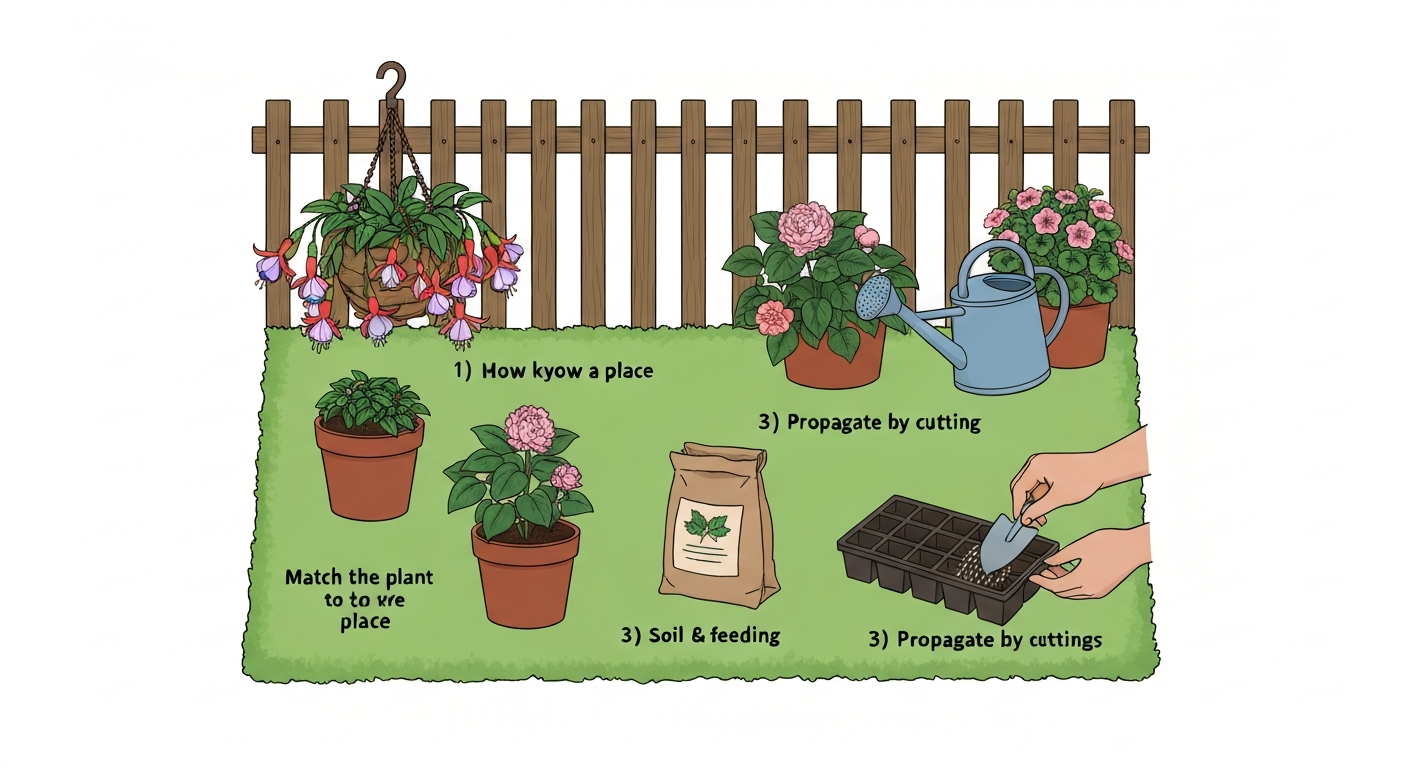
Growing a hybrid flowering plant successfully comes down to three things: understanding what 'hybrid' actually means for your garden, choosing the right cultivar for your specific site, and then treating that plant according to its true growth habit rather than just the label on the pot. Whether you're starting with a trailing fuchsia in a hanging basket or planting a climbing hybrid against a sheltered wall, the principles are the same: match the plant to the place, give it the soil and feeding it needs, and propagate it the right way when you want more.
How to Grow a Hybrid Plant: Practical Guide for Gardeners & Fuchsias

Marcus Holloway
30 Jul 2026
Who this guide is for and what you'll learn
This guide is written for home gardeners at every level, from someone planting their first hanging basket to an experienced grower looking to add a trained standard fuchsia or a cold-tolerant hybrid fig to their collection. You'll learn exactly what the word 'hybrid' means in practical terms, how to pick a cultivar that suits your space, where to source healthy plants, how to prepare soil and time your planting, and how to keep your plants performing season after season. We'll pay particular attention to hybrid fuchsias throughout, covering trailing, climbing, standard, and hardy types because they're one of the most diverse and rewarding groups of hybrid flowering plants you can grow. You'll also find a container-vs-in-ground comparison, step-by-step planting instructions, propagation guidance, and a straightforward troubleshooting section for when things go wrong.
What 'hybrid' actually means for home growers
A hybrid plant is simply the result of deliberately crossing two genetically distinct parents. The first generation produced from that cross is called an F1 hybrid, and it often shows what breeders call hybrid vigor: stronger growth, bigger flowers, and more uniform performance than either parent alone. That uniformity is exactly why so many popular ornamental plants, including most fuchsia cultivars you'll find at a nursery, are hybrids.
Here's the practical catch that trips up a lot of beginners: seed saved from an F1 hybrid will not reliably reproduce the parent plant. When you sow seed from a hybrid fuchsia, the offspring segregate genetically, meaning you'll get a range of plants, some interesting, many disappointing, but almost none identical to the cultivar you started with. This is normal and expected, not a flaw. It simply means that if you want more of a specific named cultivar, you propagate vegetatively, by cuttings or division, rather than from seed. The RHS is clear on this, and it's one of the most important things to internalize before you start spending money on plants.
For fuchsias specifically, softwood stem cuttings taken in spring and semi-ripe cuttings taken in summer are the standard propagation method. They root quickly, they clone the parent exactly, and they're far more reliable than seed. Hardy fuchsia types can also be propagated from hardwood cuttings in autumn or winter. More on this in the propagation section later.
Choosing the right hybrid cultivar for your garden
The biggest mistake I see home gardeners make is buying a plant because the flower color is beautiful in the shop, without considering whether the habit, hardiness, and light requirements match where it's going to live. With hybrid flowering plants, especially fuchsias, this matters enormously because the cultivar range is vast and the differences between types are genuinely significant.
Matching habit to your site
Hybrid fuchsias fall into four broadly useful categories for home growers: trailing types for hanging baskets and containers, climbing or long-stemmed types suitable for training against structures, standard types (trained on a single stem into a lollipop shape), and hardy shrub types for in-ground planting in cold climates. Each has different pruning, support, and overwintering requirements, which means they are genuinely not interchangeable. A trailing cultivar will not naturally become a standard; a hardy shrub type may not have the long, flexible growth needed for a climbing display.
- Trailing hybrids: ideal for 10 to 14-inch hanging baskets; popular commercially sold basket types include 'Dollar Princess' and many unnamed commercial trailing hybrids; expect pendulous stems and prolific flower production through summer
- Hardy shrub types: Fuchsia magellanica and its cultivars (such as 'Riccartonii') are the backbone of cold-climate in-ground planting; many survive winter in temperate zones with only top dieback, returning from the roots in spring
- Standard (tree) fuchsias: any cultivar with a strong, upright main stem can be trained as a standard; these need at minimum a 10-gallon container for long-term culture and are typically overwintered frost-free
- Climbing and long-stemmed types: selected triphylla hybrids and large-flowered cultivars with naturally vigorous growth suit training on wires or structures; they need sturdy support from the outset
For hardiness, the RHS and British Fuchsia Society maintain rated cultivar lists. The RHS maintains lists and guidance on hardy fuchsia cultivars and criteria (see Hardy fuchsias, RHS Plant Guide) Hardy fuchsias — RHS Plant Guide. The American Fuchsia Society is the International Cultivar Registration Authority (ICRA) for the entire genus, making their registry the definitive place to confirm a cultivar name, its breeder, and its registered characteristics. If you're buying a named cultivar, it's worth a quick check against one of these sources, particularly if you're in a colder climate and hardiness really matters.
A note for growers interested in cold-tolerant hybrids beyond fuchsia: 'Chicago Hardy' is a cultivar of common fig (Ficus carica), selected specifically for cold tolerance and widely recommended by university extension programs for USDA zones 5 and 6 with appropriate siting and winter root protection. Go figure, figs are a great addition to home gardens, Illinois Extension specifically notes that 'Chicago Hardy' (Ficus carica 'Chicago Hardy') is a cold‑tolerant common fig recommended for USDA zones 5–6 with appropriate siting and winter protection blank" rel="noopener noreferrer">Go figure, figs are a great addition to home gardens — Illinois Extension. It is not a fuchsia, but it is a good example of how a named hybrid cultivar can make a borderline-hardy plant genuinely garden-worthy in colder regions.
Where to source healthy stock and what to check at purchase
Where you buy matters as much as what you buy. A hybrid fuchsia from a specialist nursery is almost always better value than one from a general garden center, because it's more likely to be correctly labeled, properly rooted, and grown without excessive forcing.
Nursery checklist before you buy
- Check the label: the cultivar name should match the habit class (trailing, upright, hardy); if there's no cultivar name at all, be cautious
- Look at the rootball: gently tip the pot, roots should be white or cream and just beginning to circle; a solid brown rootbound mass or soggy, black roots are both red flags
- Assess vigor: stems should be sturdy and green with short internodes; etiolated, pale, or leggy growth suggests the plant has been forced under poor light
- Check for pests: inspect the undersides of leaves for whitefly eggs (tiny white specks), check stem junctions for vine weevil larvae signs (wilting with no obvious cause), and look for botrytis (gray fuzzy mold) around any damaged tissue
- Avoid flowering plants in early spring if buying for outdoor planting: a plant already in full flower has often been grown under glass and will need careful hardening off before it goes outside
Mail-order and specialist sources
For cultivar-true plants, specialist mail-order nurseries are often your best option. Logee's Plants in Connecticut (US) and Victoriana Nursery in the UK are long-established specialty growers with wide fuchsia ranges and reliable shipping information. National and regional fuchsia societies, including the American Fuchsia Society and British Fuchsia Society, maintain lists of vetted member growers and often run plant sales where you can source unusual cultivars from people who actually grow them. University extension plant sales are another underused resource for healthy, region-appropriate stock. When ordering by mail, check phytosanitary requirements for your state or country, especially for interstate or international shipments, before placing an order.
Containers vs in-ground: which is right for you
This is genuinely a decision worth thinking through before you plant, because it affects every subsequent choice including soil mix, watering frequency, feeding schedule, and how you handle winter. The table below covers the main factors side by side.
| Factor | Container | In-Ground |
|---|---|---|
| Root volume | Limited by pot size; repot to 5–10+ gal for multi-year specimens or standards | Unrestricted; plant establishes a large root system over time |
| Drainage | Entirely dependent on mix and pot drainage holes; easier to control | Depends on native soil; may need raised beds or amendment in heavy clay |
| Watering frequency | Daily in hot weather (hanging baskets can need water twice daily in peak summer) | Once established, usually every 2–3 days depending on soil and rainfall |
| Feeding | Frequent liquid feeding required (nutrients leach with watering); weekly high-potash feed from bud set | Slower-release approach works; top-dress with balanced granular fertilizer in spring |
| Overwintering | Can be moved to frost-free storage; tender cultivars survive reliably this way | Only suitable for cultivars rated hardy for your zone; mulch crowns in autumn |
| Light and microclimate control | Pots can be repositioned to chase ideal light or shelter | Fixed once planted; choose site carefully before planting |
| Moisture retention | Dries quickly; coir or moisture-retentive mixes help | Better natural moisture buffer, especially in humus-rich soils |
| Typical best use | Trailing hybrids, standards, tender cultivars, balconies, patios | Hardy shrub fuchsias, permanent border specimens, climbing hybrids on structures |
For most beginners, starting in containers is a lower-risk way to learn what a cultivar needs before committing it to a border. You can observe how quickly it dries out, how it responds to feeding, and how it handles your local summer heat, then make a more informed decision about permanent in-ground planting in subsequent seasons.
Site selection and planting timing
Most hybrid fuchsias prefer a site with morning sun and afternoon shade, or bright indirect light throughout the day. Full summer sun, particularly in warmer climates, causes flower drop and stress. Climbing and standard types generally tolerate more light than trailing basket types, but even these need shelter from scorching midday sun in zones 7 and above. Hardy shrub fuchsias grown in the ground can handle more exposure once established but appreciate a sheltered wall or fence in colder zones.
Timing by season and climate
Timing your planting around frost dates is non-negotiable for tender hybrid fuchsias. The USDA Plant Hardiness Zone Map is your starting reference, but local last-spring and first-fall frost dates from your state extension service give you the actual calendar windows. As a general rule, spring planting should happen after your average last frost date, and fall in-ground planting works best 4 to 6 weeks before the average first autumn frost, giving roots time to establish before the ground cools.
- Spring (after last frost): plant tender and half-hardy hybrids outdoors; harden off greenhouse or indoor-grown stock over 7 to 10 days before final planting
- Early summer: ideal for filling baskets and containers; plugs and young plants establish quickly in warm soil
- Late summer to early autumn: last opportunity for in-ground planting of hardy types; avoid planting tender cultivars in-ground at this stage in cold climates
- Autumn (4–6 weeks before first frost): mulch established hardy fuchsias in the ground; move container plants to frost-free storage
- Winter: rest period for overwintered tender fuchsias; minimal watering, no feeding, cool and frost-free (around 40–50°F / 4–10°C is ideal)
Soil preparation and potting mixes
Fuchsias and most hybrid ornamentals prefer slightly acidic to neutral soil, in the pH range of approximately 5.5 to 7.0. Before planting in-ground, get a basic soil test through your local cooperative extension office. It costs very little and tells you exactly what amendments you need rather than guessing. Heavy clay soils need grit and organic matter incorporated to improve drainage. Sandy soils benefit from compost to increase water and nutrient retention. Both benefit from a 2 to 3-inch layer of well-rotted compost dug into the top 12 inches of the planting area.
Container mix recipes
For containers, avoid using straight garden soil, which compacts in pots and drains poorly. A reliable general-purpose container mix for hybrid fuchsias and most hybrid ornamentals looks like this: 40 to 50 percent base material (peat or coir or pine bark fines), 20 to 30 percent aeration material (perlite or vermiculite), and 20 to 30 percent compost or organic matter. This produces a mix that drains freely but holds enough moisture between waterings. For hanging baskets, lean toward the higher end of the aeration component because baskets dry out faster and compaction is a real problem mid-season. Adding a water-retaining gel at label rate can buy you extra time between waterings without causing waterlogging, which is genuinely useful if you travel.
For long-term container culture of standards or large specimen plants, use a slightly heavier mix with more compost and consider a loam-based component (such as John Innes No. 3 in the UK, or a loam-amended mix for US growers) to provide stability in larger containers and to buffer nutrients over a longer season.
Planting step by step
Transplanting plugs and pot-grown stock
- Prepare the hole or pot: for in-ground planting, dig a hole roughly twice the width of the rootball and the same depth; for containers, choose a pot only one to two sizes larger than the current rootball to avoid overwatering risk from excess unused compost
- Check drainage: for containers, ensure holes are unobstructed; for in-ground, water the hole and check it drains within 30 minutes; if it sits, you have a drainage problem to solve before planting
- Set the planting depth: fuchsias should be planted at the same depth they were growing in their nursery pot, with the top of the rootball level with or very slightly below the surrounding soil or mix surface; planting too deep causes crown rot
- Backfill: firm the soil or mix gently around the rootball in layers to remove large air pockets, but do not compact it so tightly that drainage is impaired; for in-ground planting, incorporate your pre-amended soil into the backfill
- Water in thoroughly: give the plant a long, slow first watering immediately after planting to settle the soil and establish root-to-soil contact; for containers, water until it flows freely from the drainage holes
- Stake early if needed: standard fuchsias and climbing types need their support structure in place at planting time, not after they've started to lean; insert canes or tie to wires before growth gets established to avoid disturbing roots later
- Label and record: note the cultivar name, source, and planting date; this sounds trivial but is genuinely useful when you're troubleshooting or planning overwintering the following autumn
Sowing hybrid seed (when it's appropriate)
Most named hybrid fuchsia cultivars should not be grown from seed if you want the plant you're expecting. However, if you want to experiment with open-pollinated seedlings or you've purchased a seed packet of a hybrid annual flowering plant (such as hybrid petunias or begonias sold as F1 seed), the approach is straightforward. Sow in a fine, sterile seed-starting mix at the temperature recommended on the packet (typically 65 to 72°F / 18 to 22°C for most tender hybrids). Keep the surface consistently moist but not wet. Once seedlings have two true leaves, prick out into individual cells or small pots. Accept that the resulting plants will vary, and select the strongest and most floriferous performers for growing on. Never save seed from F1 hybrids expecting identical offspring the following year.
Watering, light, and feeding
Hanging basket fuchsias in full summer growth can need watering once or even twice daily in hot, dry weather. The test is simple: push your finger an inch into the mix, and if it feels dry at that depth, water. If it still feels damp, leave it. Overwatering is the number one killer of container fuchsias, even though it often looks identical to underwatering from the outside (both cause wilting and leaf drop). The difference is that overwatered roots smell unpleasant and look brown and mushy when you check.
For feeding, fuchsias respond well to a balanced liquid fertilizer in early growth (roughly equal nitrogen, phosphorus, and potassium) to build stems and foliage, then a switch to a high-potash feed (such as a tomato-type fertilizer) once buds begin to form. Weekly liquid feeding through the growing season is appropriate for container plants. In-ground plants respond well to a balanced slow-release granular fertilizer applied in spring and a light top-dress of compost in autumn. Avoid overfeeding with high-nitrogen fertilizers late in the season, which pushes soft growth that is vulnerable to frost damage.
Training and pruning for different habits
Trailing fuchsias in baskets need very little intervention beyond pinching growing tips once or twice early in the season to encourage branching and a fuller display. Once the basket is well-furnished, let it grow and flower. Remove spent flowers and any dead or damaged stems regularly.
Standards require a different approach from the start. You train a single main stem upward, removing all side shoots until the desired height is reached, then allow the head to branch by repeatedly pinching the tips of the top growth. See the guide to how to grow a standard fuchsia for the multi-season training process step by step. This takes time: a good standard fuchsia typically takes one to two full growing seasons to develop properly. The stem must be staked continuously because it is not self-supporting until it has lignified, which takes years.
Climbing types need horizontal wires or a trellis fixed to a wall or fence before growth starts. Tie in new growth regularly as it extends, ideally while stems are still young and flexible. Prune in early spring to remove winter-damaged wood and to reshape, but avoid cutting into old hard wood unless necessary because recovery can be slow.
Hardy shrub fuchsias in the ground are best left largely unpruned until spring, when you can cut back to the live wood once new growth is visible. Cutting back in autumn risks removing the very stems that insulate the crown from frost. In spring, work from the top downward, pruning to the first pair of healthy buds you encounter.
Overwintering and hardiness
How you overwinter your hybrid plants depends almost entirely on whether your cultivar is genuinely hardy for your zone. Hardy fuchsias, primarily Fuchsia magellanica and its cultivars like 'Riccartonii', survive in the ground in milder temperate climates, typically dying back to the crown and regenerating from roots in spring. In colder areas, mulching the crown with a thick layer (at least 3 to 4 inches) of straw or composted bark in autumn significantly improves survival rates.
Tender hybrid fuchsias (including most trailing basket types and standards) must come inside before the first frost. The goal is to keep them cool, dark, and almost dry, not to keep them actively growing. A frost-free greenhouse, cellar, or garage maintaining 40 to 50°F (4 to 10°C) is ideal. Water just enough to prevent the compost from desiccating completely, roughly once every three to four weeks. In late winter or early spring, bring plants back into light, increase watering, and begin feeding once you see new growth.
For cold-tolerant hybrid plants in other genera, the principle is the same: verify the USDA hardiness zone rating for the specific cultivar, not just the species. 'Chicago Hardy' fig (Ficus carica 'Chicago Hardy'), for example, is widely recommended for zones 5 to 6 with mulching and good siting, while other fig cultivars planted in the same location without that cold tolerance selection would not survive.
How to propagate hybrid plants correctly
Because seed from hybrids doesn't come true, cuttings are how you preserve and multiply a named cultivar. For fuchsias, the process is reliable and rewarding even for beginners.
- Take softwood cuttings in spring: select a non-flowering shoot tip 2 to 3 inches long with two or three pairs of leaves; cut just below a leaf node with a clean, sharp blade
- Prepare the cutting: remove the lowest pair of leaves cleanly; you can dip the base in hormone rooting powder or gel, though fuchsias root readily without it
- Insert into rooting medium: use a 50:50 mix of perlite and coir or peat in small cells or 3-inch pots; insert cuttings to roughly one-third of their length
- Maintain humidity and warmth: cover with a clear propagator lid or plastic bag to reduce moisture loss; keep at 65 to 72°F (18 to 22°C); avoid direct sun which will cook cuttings under a lid
- Check for rooting after 2 to 3 weeks: a gentle tug resistance and new leaf growth indicate rooting; at this point, remove the cover and begin acclimatizing to normal conditions
- Pot on into standard growing mix once roots are visible at drainage holes; feed with a dilute balanced fertilizer from this point
Semi-ripe cuttings taken in summer follow the same process but from slightly firmer growth. Hardy fuchsias can also be propagated from hardwood cuttings in autumn or winter, inserted in a sheltered cold frame and left to root over winter. Division of established hardy clumps in spring is another option, though it's less precise for maintaining a specific cultivar.
Common pests, diseases, and troubleshooting
Fuchsia whitefly (Trialeurodes fuchsiarum) is the most common and frustrating pest of greenhouse and indoor-grown fuchsias. You'll notice clouds of tiny white flies when you disturb the plant, and sticky honeydew on the foliage. Biological control using the parasitic wasp Encarsia formosa is highly effective in enclosed spaces. For outdoor plants, repeated applications of insecticidal soap targeting the undersides of leaves provide reasonable control.
Vine weevil is the pest I find most insidious because by the time you notice it, the damage is already done. The adult beetles notch leaf edges (characteristic scalloped cuts), which is the warning sign; the real damage comes from larvae eating roots through late summer and autumn. Biological nematode treatments applied to moist compost in late summer are effective and don't require chemicals. Regularly checking root health when repotting is your best early-detection system.
Botrytis (gray mold) appears in cool, humid, poorly ventilated conditions. The fix is cultural: improve air circulation, remove dead or dying plant material promptly, and avoid wetting foliage in the evening. Rust (orange pustules on leaf undersides) affects some fuchsia cultivars and spreads in wet conditions. Remove affected leaves immediately and avoid overhead watering.
| Problem | Likely Cause | Fix |
|---|---|---|
| Sudden wilting despite moist soil | Vine weevil larvae or root rot | Check roots immediately; apply nematodes for vine weevil; improve drainage for rot |
| Flower and bud drop | Heat stress or underwatering | Move to cooler site with afternoon shade; water more consistently |
| Yellowing leaves with green veins | Iron or manganese deficiency (common in alkaline soils) | Test soil pH; acidify if above 7.0; apply chelated iron feed |
| Leggy, sparse growth | Insufficient light or too much nitrogen | Move to brighter position; switch to high-potash feed |
| Gray fuzzy patches on stems or flowers | Botrytis (gray mold) | Remove affected tissue; improve ventilation; reduce humidity |
| Scalloped notches on leaf edges | Vine weevil adults feeding at night | Apply nematode biological control to compost in late summer |
| Sticky leaves with tiny white insects | Fuchsia whitefly | Use Encarsia formosa (indoors) or insecticidal soap (outdoors) |
Suggested varieties to start with
If you're new to hybrid fuchsias, 'Dollar Princess' is a reliable, widely available trailing type that produces prolific double flowers and performs well in baskets. For an in-ground hardy option, Fuchsia magellanica 'Riccartonii' is one of the most cold-tolerant cultivars available, with RHS recognition and a proven track record in cooler climates. For anyone interested in training a standard, any vigorous upright-growing single or double hybrid with good stem structure will work, but ask your nursery specifically for cultivars recommended for standard training rather than guessing from the label. Always cross-reference cultivar names against RHS or American Fuchsia Society records before purchasing, particularly for less common cultivars from small online sellers.
Going deeper: guides for specific habits and species
The principles in this guide apply across hybrid flowering plants, but each growth habit and species type has its own nuances worth exploring in detail. For a complete beginner's walkthrough, see our guide on how to grow fuchsias for step-by-step planting, feeding, and overwintering advice. For a complete step-by-step resource on cultivating this genus, see how to grow fuchsia plants. If you're planning a trailing basket display, a deep dive into growing trailing fuchsias will give you planting densities, pinching schedules, and basket-specific feeding advice. For step-by-step instructions specifically on these plants, see our hybrid fuchsia how to grow guide. If a trained tree shape appeals to you, the guide to growing a standard fuchsia walks through the multi-season training process step by step. Gardeners in colder climates wanting permanent in-ground color should look closely at growing hardy fuchsia for zone-specific advice and cultivar recommendations. For detailed, zone-specific advice and cultivar recommendations, see how to grow hardy fuchsia (resource e7fddd01-9271-4cfc-93a3-b61a25f9be48). For wall-trained displays, growing climbing fuchsia covers support structures and pruning in detail. All of these build on the hybrid-plant fundamentals covered here. For another relevant comparison, see how to grow trailing fuchsias.
FAQ
What does 'hybrid' mean for home gardeners and why does it matter for growing flowering plants like fuchsias?
Practical definition: a hybrid is the deliberate cross of two genetically distinct parent plants to combine desirable traits (flower color, vigor, habit). Most ornamental hybrids you’ll buy are F1 or selected cultivars. Why it matters: hybrids often show uniform appearance and vigor but do not breed true from seed — saved seed will segregate into varied offspring. For home growers this means: buy named cultivars for predictable results and preserve them by vegetative propagation (cuttings, layering, or grafting) rather than relying on seed. For cultivar provenance and hardiness data, consult the RHS plant pages or the American Fuchsia Society registry and cite supplier labels when purchasing.
How do I choose the right hybrid cultivar and source healthy stock (especially for fuchsias)?
Choose by: growth habit (trailing, shrub/hardy, climbing/standard), hardiness for your USDA zone, flower form and season, and disease resistance. Steps: 1) Check RHS, British Fuchsia Society or American Fuchsia Society registry for cultivar records and awards (AGM) to confirm name and hardiness. 2) Prioritize vendors with clear provenance—specialty nurseries, university extension plant sales, or society member growers. 3) Inspect stock in person or request high-resolution photos: look for firm stems, healthy roots (not pot‑bound or mushy), clean foliage (no obvious mites/aphids), and vigorous new growth. Callouts: trailing basket hybrids are sold widely as plug plant mixes; hardy types often derive from Fuchsia magellanica; use vendor cultivar pages (Logee’s, Victoriana, local societies) for availability and shipping notes.
When should I plant hybrid fuchsias and other hybrid ornamentals in my region?
Timing guidelines: 1) Use local last‑spring frost and first‑fall frost dates (USDA Plant Hardiness and local extension calendars). 2) Spring planting: after last frost when soil has warmed; transplants are less shocky if hardened off. 3) Autumn planting: feasible 4–6 weeks before average first frost in mild climates to establish roots. 4) Container plants can be moved indoors/under cover before hard freezes. Adjust based on microclimate: sheltered, south‑facing sites warm earlier in spring.
How should I prepare soil and select a site for hybrid fuchsias?
Soil/site checklist: 1) Light: bright, filtered light to part shade for many fuchsias; avoid hot, all‑day sun in warm climates. 2) Soil: slightly acidic to neutral (pH 5.5–7.0), humus‑rich, moist but well‑drained. 3) Test soil with an extension service and amend as needed: add compost (10–30%), sharp sand or grit for drainage in heavy soils, and organic matter to improve moisture retention. 4) Mulch (2–3 in) to retain moisture and moderate root temperatures. 5) For containers use a mix ~40–60% base (coir/peat/bark), 20–30% aeration (perlite), and 10–30% compost for fertility and water retention.
What are practical watering, light exposure and feeding schedules for hybrid fuchsias?
Routine guidelines: Watering: keep soil consistently moist but not waterlogged—check top 1–2 inches and water when it starts to dry; containers may require daily watering in hot weather. Light: morning sun with afternoon shade or bright dappled light suits most hybrids; trailing basket types tolerate brighter exposure if kept well watered. Feeding: apply a balanced, water‑soluble fertilizer (e.g., 10‑10‑10) every 2–4 weeks during active growth/flowering, or use a slow‑release granular feed at potting/early season per label rates. Adjust feed frequency if growth is leggy (reduce) or blooms are poor (increase slightly). Always follow product instructions.
Should I grow fuchsias in containers or in-ground? What are the pros and cons?
Short comparison (practical): Containers Pros: mobility (move for light/overwintering), better control of soil mix, good for hanging/trailing types; faster drainage reduces root rot risk. Cons: dry out more quickly, limited root volume requires larger pots for multi‑year vigour. In-ground Pros: steadier moisture, larger rooting volume, often better winter hardiness for hardy cultivars. Cons: harder to change location, may need soil improvement, less flexible for tender hybrids. Recommendation: Use containers for hanging baskets, patio specimens, and for tender hybrids you plan to protect; plant hardy F. magellanica‑derived cultivars in-ground in suitable sites. For long‑term container standards choose 10+ gallon pots.