
Growing a standard fuchsia takes patience, but the result is one of the most dramatic flowering displays you can produce in a container or border. A standard is a single-stem plant trained (or head-grafted) to carry a rounded, weeping head of blooms at the top of a clear, upright trunk, and you can realistically grow one yourself from a rooted cutting in 12 to 18 months with consistent pinching and tying. If you want to fast-track the process, nurseries sell ready-trained grafted standards in various trunk heights, and those are worth every penny if your goal is display rather than the training challenge itself.
How to Grow a Standard Fuchsia: Complete Practical Guide

Marcus Holloway
6 Aug 2026
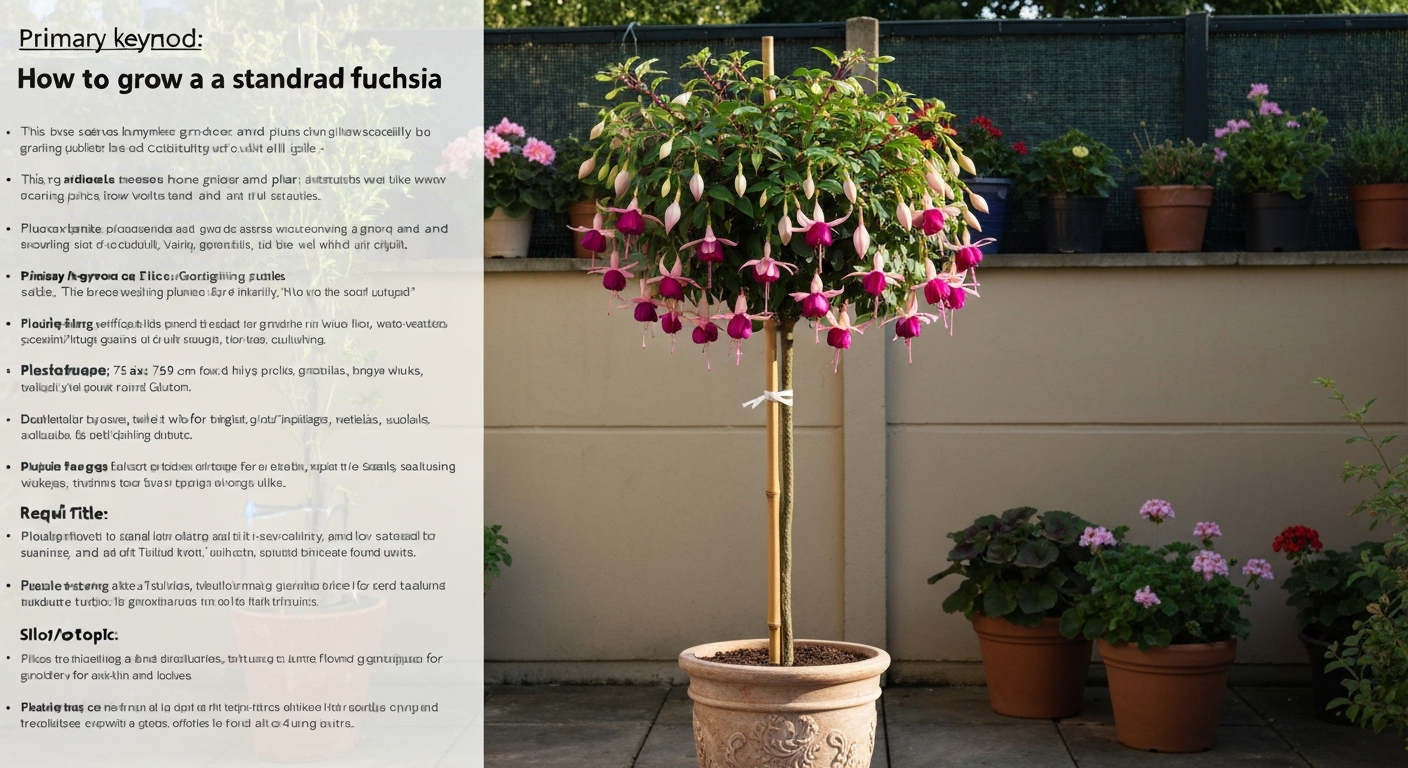
What exactly is a standard fuchsia, and is it right for you?
A standard fuchsia is simply a fuchsia plant restricted to a single vertical stem, cleared of all side shoots along that stem, with a bushy head of growth allowed to develop only at the top. There are two ways to end up with one: you train a rooted cutting yourself over 12 to 18 months of careful pinching, or you buy a head-grafted plant where a nursery has grafted a desirable flowering variety onto an established, vigorous rootstock. Either way, the end result looks the same: a lollipop shape with pendulous, often bicoloured flowers draping down from the head like a weeping chandelier.
This form of growing is particularly well-suited to gardeners who want a focal point in a patio container, a formal symmetrical display flanking a doorway, or a raised presentation that shows off pendant fuchsia flowers at eye level rather than from below. It also works beautifully for anyone with limited ground space, since a single standard in a pot takes up almost no footprint while delivering a large visual impact. The trade-off is that standards demand more attention than a bush fuchsia tucked into a border: regular watering, feeding, seasonal pruning, and frost protection are all non-negotiable.
Why choose a standard over other fuchsia forms?
The honest case for standards is mostly aesthetic and structural. No other fuchsia form gives you that clear, sculptural trunk with a floating canopy of flowers. In a pot on a patio, a pair of matching standards creates instant formality without the cost of topiary. They also elevate the bloom to a level where you can look into the flowers rather than looking down or past them, which matters a lot with fuchsias because the most spectacular part of the flower, the long corolla and stamens, faces downward.
The limitations are real, though, and I want to be upfront about them. Standards are not low-maintenance plants. The single trunk and graft union are vulnerable to wind snap, so you will need a sturdy stake and ties throughout the plant's life. The head is dense and can trap moisture, which creates conditions for Botrytis (gray mold) if airflow is poor. Most standards are tender varieties that will die if left outside in frost, so unless you have a frost-free space to overwinter them, you are committing to moving a potentially large container every autumn. If you want something you can plant and largely forget, a hardy fuchsia in a border is a far better choice. For gardeners interested in a lower-maintenance option, see our guide on how to grow hardy fuchsia for planting and overwintering advice tailored to border-grown, hardy varieties.
Standards vs. trailing, hardy, climbing, and hybrid fuchsias
Fuchsias come in genuinely different growth habits, and choosing the right one for your situation matters more than picking the prettiest flower colour. Here is how the main forms compare across the criteria that affect practical growing decisions. For specific advice on varieties and methods for hybrid fuchsias, see our guide to growing hybrid fuchsias which covers selection, culture, and troubleshooting. For advice specific to hybrids, see our concise guide on how to grow a hybrid plant which covers selection, grafting, and care tailored to hybrid cultivars.
| Type | Typical form | Best use | Hardiness | Maintenance level |
|---|---|---|---|---|
| Standard | Single upright trunk, rounded head | Patio containers, formal displays, focal points | Usually tender (USDA zones 9-11 unless hardy varieties used) | High: staking, pinching, frost protection |
| Trailing | Cascading stems, low and spreading | Hanging baskets, window boxes | Usually tender | Medium: regular watering, feeding, pinching |
| Hardy | Bushy, multi-stem shrub | In-ground borders, permanent planting | USDA zone 6 with mulch (Fuchsia magellanica types) | Low to medium: annual cutback, mulching |
| Climbing | Long, scandent stems needing support | Wall-trained specimens, pergolas | Variable by cultivar | Medium: tying in, seasonal pruning |
| Hybrid | Varies widely by parentage | Containers or borders depending on type | Variable | Depends on form and variety |
If you are interested in growing trailing fuchsias for hanging baskets, climbing types for a sheltered wall, or the tougher hardy varieties for a permanent bed, those forms each have their own distinct needs and rewards. For this guide, the focus is entirely on the standard form, but the variety selection and soil advice here overlaps significantly with general fuchsia culture.
Choosing the right variety or grafted standard
Not every fuchsia makes a good standard. You need varieties with naturally upright or semi-upright growth that will build a dense, well-branched head when pinched repeatedly. Trailing varieties, while beautiful in baskets, produce a floppy, unsatisfying head on a trunk. When choosing a plant from a nursery or catalog, look for these four things specifically. blank" rel="noopener noreferrer">The British Fuchsia Society – seedling register operates a parallel cultivar/seedling registration scheme and publishes guidance and photographic records useful for identifying standard-type cultivars and breeder records.
- Growth habit: choose upright or lax-upright varieties, not trailing or basket types. The label or catalog listing should say 'upright,' 'bush,' or 'standard' as a recommended use.
- Flower type: single and semi-double flowers hold up better in rain and high humidity than very full doubles, which can rot at the center of the head if air circulation is poor.
- Trunk height: standards come in 'quarter,' 'half,' and 'full' heights (roughly 30 cm, 45-60 cm, and 75-90 cm clear trunk respectively). Full standards are the most dramatic but need the largest containers and heaviest stakes.
- Hardiness and rootstock (for grafted plants): if you want any chance of keeping a standard outdoors year-round in a mild climate, ask specifically whether the variety used in the head is from a hardy group. Grafted standards from nurseries typically use a vigorous rootstock selected for compatibility and healthy root development, so the scion (the flowering head variety) should be your primary selection criterion.
Well-regarded standard varieties include 'Checkerboard' (reliable upright, crimson and white), 'Lady Thumb' (compact, semi-double, good for quarter standards), 'Annabel' (white and pink, very free-flowering), and 'Swingtime' (red and white double, classic show standard). For hardy-head combinations, look for cultivars derived from Fuchsia magellanica parentage, which can survive colder winters than typical tender hybrids, though even these will usually need their trunk and graft union protected in hard frosts. Fuchsia magellanica | North Carolina Extension Gardener Plant Toolbox notes Fuchsia magellanica is among the hardiest fuchsia groups, with roots often surviving frosts and winter survival reported to around USDA zone 6 with protection.
Container or in-ground: which works better for a standard?
Most standard fuchsias are grown in containers, and for good reason. A pot gives you control over the soil mix, drainage, and, critically, the ability to move the plant indoors before frost. That said, in genuinely mild climates (USDA zone 9 and above, or sheltered UK gardens in zones 8-9), planting a hardy-variety standard in the ground is entirely viable and produces a plant with a larger, more established root system that handles heat and drought better than a pot-bound specimen. For gardeners interested in an alternative hardy specimen to plant in the ground, see guidance on how to grow Chicago hardy fig for site and winter-protection tips specific to that variety.
| Factor | Container | In-ground |
|---|---|---|
| Frost protection | Easy: move indoors or into a frost-free shed | Difficult: must insulate trunk and head in situ |
| Drainage control | Excellent: you control the mix completely | Dependent on native soil; may need raised bed |
| Root development | Limited by pot size; needs repotting every 1-2 years | Unrestricted; plant establishes more vigorously over time |
| Watering frequency | High: pots dry out quickly in warm weather (daily in summer) | Lower: ground moisture buffer reduces watering needs |
| Display flexibility | High: move to best position as needed | Fixed once planted |
| Best climate | Any climate, especially where frosts occur | USDA zone 9+ or very sheltered zone 8 gardens |
If you are in a colder climate and plan to overwinter your standard in a garage or cool greenhouse, a container is the only practical choice. If you live somewhere that rarely freezes, planting into well-prepared ground with good drainage will reward you with a far stronger plant within two or three seasons. For in-ground planting, the RHS recommends planting the base of the stem around 5 cm below the soil surface to give the crown some protection and encourage resilience.
When to plant: timing by climate and staging for establishment
Timing your planting correctly makes a real difference to how well a standard fuchsia establishes. The basic rule is: plant out or move your standard into its final container after all risk of frost has passed in your area and night temperatures are reliably above 10°C (50°F). In most of the UK, that means late May to early June. In the US, it translates to after your last frost date, which ranges from late March in USDA zone 9 to late May in zones 5-6.
If you are starting from a rooted cutting with the intention of training your own standard, begin in late winter or early spring (January to March in the northern hemisphere). The first growing season is spent building the straight trunk: a single stem is tied to a cane and all side shoots below the desired head height are removed as they appear. By the second spring, the pinching of the head begins in earnest, and by the end of the second summer you should have a plant worth displaying. Starting in early spring gives the plant the maximum growing season to put on trunk height before the first winter.
For a purchased grafted standard, plant into its final pot or position in late spring. Give it two to three weeks in a sheltered spot before placing it in full display position, especially if it has been in a heated greenhouse at the nursery, since the transition to outdoor conditions needs to be gradual to avoid leaf scorch and stress-triggered bud drop.
Site selection: light, shelter, and placement
Fuchsias do best in bright, indirect light or morning sun with afternoon shade. Direct midday and afternoon sun in summer, especially in warmer climates, scorches the leaves and triggers bud drop, which is one of the most common complaints I hear from growers who put their standards in full-sun spots because the flowers look beautiful there. Aim for a position that gets four to six hours of direct sun in the cooler morning hours and is shaded from roughly 1 pm onward, particularly from midsummer through August.
Shelter from wind is non-negotiable for standards. The tall trunk acts as a lever, and a strong gust that a hardy fuchsia shrub would barely notice can snap a standard at the graft union or break the stake. A position against a wall or fence that blocks prevailing winds is ideal. If your best visual location is exposed, use a genuinely heavy stake and check ties regularly through the season. In the UK, a sheltered south- or west-facing position hits the sweet spot of enough warmth for good flowering without the summer heat stress that a south-facing wall can create in a hot summer.
For patio containers, the benefit is that you can move the plant to optimise its microclimate as the season changes. In early summer, a sunnier spot encourages good bud set. In the hottest weeks of July and August, shift it somewhere shadier and it will hold its buds and flowers far better. This flexibility is one of the real practical advantages of container growing.
Soil and potting mix: what standards actually need
The single most important thing about soil for fuchsias is drainage. Extension guides and growers consistently report that more fuchsias are lost to waterlogged roots than to cold, and I have seen this firsthand: a plant that survived a hard winter in a shed gave up the following June because it sat in a pot with a blocked drainage hole for two weeks of wet weather. Your soil or potting mix needs to hold enough moisture to prevent the plant wilting between waterings, but it must never stay soggy. For a full step-by-step guide on how to grow fuchsias, see our detailed growing guide (01ba4f8b-7420-4518-aa2b-ed5eca5a6527).
A basic potting mix recipe for container standards
This recipe produces a mix with good drainage, adequate water retention, and enough fertility to support early growth before you begin a feeding program. Mix by volume:
- 2 parts peat-free multipurpose compost (or quality loam-based compost such as John Innes No. 3)
- 1 part coarse perlite or horticultural grit (for drainage and aeration)
- 1 part coir (coconut fibre) to improve water retention without compaction
- A slow-release balanced fertiliser granule mixed in at the manufacturer's recommended rate for container plants (optional but useful for the first 6-8 weeks)
Target a slightly acidic to neutral pH of 6.0 to 7.0. Most multipurpose composts fall naturally in this range, so if you are using a quality bagged compost as your base, pH adjustment is rarely necessary. Avoid very heavy, clay-based garden soil in containers: it compacts badly when confined and drainage fails within a season. If you are planting into the ground rather than a pot, work in generous amounts of well-rotted compost and coarse grit if drainage is at all suspect, and check that water drains freely from the planting hole before you commit to a position.
Watering: getting the balance right
Container standards in active growth during summer may need watering daily in warm or dry weather. The test is simple: push your finger an inch into the compost, and if it feels dry at that depth, water thoroughly until it runs from the base of the pot. Never let the root ball dry out completely between waterings, as this stresses the plant and causes bud drop within 24 to 48 hours. Equally, if your pot is sitting in a saucer of standing water, empty the saucer after each watering to prevent root rot.
In cooler, overcast weather or when the plant is semi-dormant in winter storage, reduce watering dramatically. Overwintering plants in a frost-free shed need just enough water to stop the compost desiccating completely, maybe once every two to three weeks. The roots should be kept barely moist, not wet. This is where many people go wrong in winter: they continue to water at summer frequency, the roots sit in cold, wet compost, and Phytophthora or other root rots move in quickly.
Feeding your standard through the season
Fuchsias in containers are heavy feeders during the growing season because regular watering leaches nutrients from the compost quickly. Start feeding with a balanced, high-nitrogen liquid fertiliser (NPK ratio roughly 2:1:1 or similar) when you see active new growth in spring, typically from April onward in the UK and northern US. This supports leaf and stem development and, critically, the trunk growth you need for training.
From midsummer onward, once the head is well established and the plant is in full flower, switch to a fertiliser with higher potassium relative to nitrogen, such as a tomato feed (roughly 1:1:3 ratio). Potassium promotes flower production and helps harden the growth before winter. Feed at the frequency recommended on the label, usually every one to two weeks for a liquid feed. Stop feeding entirely by late August to early September in temperate climates, to allow the plant to begin hardening off before you bring it in for winter. Continuing to push leafy growth into autumn with high-nitrogen feed leaves the plant soft and much more susceptible to cold damage.
Pruning and training: building and maintaining the standard shape
Training a standard from scratch is genuinely one of the most satisfying things in container gardening, but it requires consistency. The American Fuchsia Society's culture notes describe the process clearly: allow one strong, upright shoot to become the leader, tie it to a cane as it grows, and remove every side shoot that emerges along the stem below the point where you want the head to begin. Do not rush the trunk height by letting it bolt unchecked: let a few leaves remain on the stem while it is growing, since the leaves feed the plant and help thicken the trunk, but keep removing side shoots promptly.
When the leader reaches about 3 to 4 pairs of leaves above your target head height, pinch out the very tip. This forces the plant to branch at the top. Allow those branches to grow two to three pairs of leaves, then pinch again. Repeat this process throughout the growing season. Each pinch doubles the number of growing tips, and over two to three rounds of pinching you build the dense, rounded head that defines a good standard. Thompson and Morgan grower guides estimate this full process realistically at 12 to 18 months for a proper, substantial head, so if someone promises you a full standard in a single summer from a cutting, be skeptical.
For a purchased standard or an established one you are maintaining, the annual pruning routine is straightforward. In late winter (February to March), cut the head back hard, reducing all branches by around half to two-thirds of their length. This removes the previous year's old, woody growth and encourages vigorous new shoots that will carry the season's flowers. Remove any dead or crossing branches entirely. Once growth resumes in spring, begin pinching the new shoots once or twice to encourage branching, then leave the plant to flower from early summer onward.
Propagation: growing your own standard from cuttings
Softwood tip cuttings are the fastest and most reliable way to propagate fuchsias at home. Take 5 to 10 cm (2 to 4 inch) non-flowering tip cuttings in spring or autumn. Both seasons work: spring cuttings benefit from the long growing season ahead, while autumn cuttings, as the American Fuchsia Society notes, root readily if handled well and kept in appropriate conditions over winter. Remove the lower leaves, leaving two to three pairs at the tip. You can dip the cut end in rooting hormone powder or gel, though it is not strictly necessary since fuchsias root willingly.
Insert the cuttings into a moist propagation mix (equal parts perlite and coir works well) and cover with a propagator lid or clear plastic bag to maintain humidity. Keep them at 15 to 21°C (59 to 70°F) and in bright but indirect light. Roots commonly form within 2 to 4 weeks. Once rooted and potted into individual small pots, the training process described above begins immediately: select the strongest upright shoot and start tying it to a cane from the outset.
A note on grafted standards
Commercially produced grafted standards are created by grafting a chosen flowering cultivar (the scion) onto an established, vigorous rootstock. Successful grafting depends on cambial alignment between the cut surfaces of rootstock and scion, the formation of a callus bridge, and eventually full vascular reconnection between the two. Nurseries carrying out this work use compatible, disease-free rootstocks grown the previous season, clean cuts, secure wrapping, and controlled temperature and humidity during callus formation. For home gardeners, this is a specialist technique that requires practice and equipment, and for most people buying a grafted standard is the practical route rather than attempting to produce one at home.
Seasonal care calendar
| Season / Month (northern hemisphere) | Key tasks |
|---|---|
| Late winter (Feb-Mar) | Prune head back by half to two-thirds. Check roots, repot if pot-bound. Begin watering cautiously as growth resumes. |
| Spring (Mar-May) | Increase watering as new growth appears. Start high-nitrogen feeding. Pinch growing tips once or twice to encourage branching. Harden off before moving outside. |
| Early summer (May-Jun) | Move outside after last frost. Position in bright, sheltered spot. Monitor daily for watering needs. Switch to balanced feed. |
| Midsummer (Jul-Aug) | Shift to high-potassium feed. Check for pests weekly. Water daily in hot weather. Deadhead to extend flowering. |
| Late summer (Aug-Sep) | Stop feeding by end of August. Begin reducing watering slightly. Watch for early signs of Botrytis as temperatures drop. |
| Autumn (Sep-Oct) | Bring indoors before first frost. Clean up any diseased or damaged growth. Move to frost-free, bright but cool location. |
| Winter (Nov-Jan) | Keep barely moist in frost-free storage (5-10°C ideal). Minimal watering every 2-3 weeks. Check occasionally for rot or pest activity. |
Overwintering: protecting your standard through cold months
Most standard fuchsias are tender plants that will not survive frost. The graft union at the top of the trunk is especially vulnerable because it sits exposed rather than at or below soil level. In climates with any regular frost, you need to bring container standards indoors before temperatures drop below about 5°C (40°F). A frost-free garage, cool greenhouse, or unheated spare room with a window all work. The goal is to keep the plant cool enough that it stays semi-dormant (so it does not produce soft, weak growth) but warm enough that the roots never freeze. A range of 5 to 10°C (40 to 50°F) is ideal.
For in-ground standards in mild climates where occasional light frosts occur, you can attempt to overwinter in situ by wrapping the trunk and head with horticultural fleece, banking up dry mulch around the base, and accepting that you will lose the top growth in a hard winter even if the roots survive. This is only viable if the variety used in the head has some hardiness, so this approach works better when hardy Fuchsia magellanica types are used. The clear trunk and graft union of a standard make this riskier than protecting a hardy fuchsia shrub, so honest advice here is: if you are not in zone 9 or above, a container that comes indoors is the safer long-term approach.
Troubleshooting the most common problems
Bud drop
Bud drop is the fuchsia problem I get asked about most often, and the causes are almost always environmental rather than a disease. The three main triggers are: sudden changes in temperature (moving the plant from a warm greenhouse to a cool exposed patio), allowing the compost to dry out completely between waterings, and direct afternoon sun in summer heat. Fix the environment and the buds hold. If you have corrected all of these and still have bud drop, check for fuchsia gall mite (see below), which can also cause distorted bud development.
Yellowing leaves
Yellow leaves on a standard fuchsia usually mean one of three things: overwatering and poor drainage leading to root stress, magnesium or iron deficiency (common in containers where nutrients are depleted), or natural lower-leaf drop as the plant matures. Check the drainage first. If the roots smell earthy but the soil is persistently wet, reduce watering frequency and check drainage holes are clear. If the plant is watering correctly but leaves are still yellowing, apply a liquid feed that includes trace elements, or use a specific magnesium supplement such as Epsom salts at around 10 grams per litre as an occasional drench.
Root rot
Root rot caused by Phytophthora and other pathogens is usually the result of persistent overwatering or poor drainage, not an unavoidable disease. If a plant collapses rapidly despite apparently correct care, knock it out of its pot and examine the roots. Healthy roots are white or cream and firm. Rotten roots are brown or black, soft, and often smell unpleasant. If only part of the root system is affected, remove all the rotten tissue with clean scissors, treat the remaining roots with a proprietary fungicide drench, repot into fresh, well-draining mix, and reduce watering dramatically while the plant recovers. If the majority of roots are gone, the plant is unlikely to recover.
Pests and diseases: identification and control
Fuchsia standards face a predictable set of pest threats. The most significant by far is the fuchsia gall mite (Aculops fuchsiae), a microscopic eriophyid mite that causes distorted, felt-like, or grotesquely swollen new growth, particularly in the head where new shoots are concentrated. Gall mite damage is distinctive and ugly: the emerging growing tips look twisted and abnormal, with a rough or hairy texture. There is no cure for infested tissue. Your response must be to cut out and destroy all affected growth immediately, well below the point of visible distortion, and to follow up with a program of narrow-range horticultural oil or insecticidal soap sprays applied to the remaining growth at regular intervals. Oregon State University's nursery pest guidance and UC IPM both emphasise prevention as the primary strategy: only buy from reputable sources, quarantine new plants for several weeks before placing them near your collection, and never propagate from material showing any distortion.
Aphids and whitefly are common on the soft new growth of the head and respond well to early intervention. A strong jet of water dislodges both, and insecticidal soap or neem oil applied at the manufacturer's rate provides effective control for moderate infestations. Spider mites typically become a problem in hot, dry conditions and cause a fine speckling on leaves followed by webbing; improving humidity around the plant and keeping it well-watered reduces their impact significantly. Thrips cause silver streaking on petals and leaves and are most effectively managed with sticky yellow traps combined with insecticidal soap sprays. Scale insects occasionally colonise older woody trunk sections and can be treated with a dilute neem or horticultural oil application.
On the disease side, Botrytis (gray mold) is the primary fungal threat, especially in humid conditions or when spent flowers fall into the dense head and are not removed. It presents as grey, dusty mold on petals, stems, or leaves. The best control is cultural: remove spent flowers regularly, ensure good airflow through the head by keeping it well-pruned, and avoid wetting the foliage late in the day. If Botrytis takes hold, remove all affected tissue immediately and improve ventilation. Good drainage and avoiding crown waterlogging, as extension guidance consistently advises, remain the foundation of disease prevention.
Planting checklist for your standard fuchsia
- Choose an upright or bush variety suitable for standard training, not a trailing type.
- Select a container at least 30 cm (12 inches) in diameter with multiple drainage holes.
- Prepare a free-draining potting mix (2 parts compost, 1 part perlite, 1 part coir).
- Insert a sturdy cane at least as tall as the intended trunk height plus head at potting time.
- Plant after all frost risk has passed and night temperatures are reliably above 10°C.
- Position in a sheltered spot with morning sun and afternoon shade.
- Tie the main stem to the cane loosely every 10 to 15 cm using soft ties.
- Water in thoroughly and check drainage holes are clear.
- Begin a high-nitrogen liquid feed as soon as new growth is actively developing.
- Remove all side shoots below the intended head height as they appear.
Monthly care checklist (growing season)
- Check soil moisture daily in warm weather; water when the top inch of compost is dry.
- Feed every 7 to 14 days with appropriate liquid fertiliser (high-N in spring, high-K from midsummer).
- Check stake and ties, adjusting any that are too tight or have loosened in wind.
- Pinch growing tips of the head monthly in spring to maintain dense branching.
- Remove spent flowers and fallen petals from the head to prevent Botrytis.
- Inspect new growth in the head weekly for gall mite distortion, aphids, or whitefly.
- Empty saucer of any standing water after watering.
- Note any leaf colour changes or abnormal growth and investigate promptly.
Growing a standard fuchsia well is genuinely achievable at any skill level: the techniques are straightforward, the feedback from the plant is immediate and clear, and the result is a plant that stops people in their tracks on a summer patio. For broader guidance on how to grow fuchsia plants, see the companion guide (reference ID 32327b6f-7cbd-468d-adc8-c3612ca909db) for general culture, variety selection, and extended troubleshooting. The key is consistency rather than complexity. Keep the drainage right, keep the water and feed on schedule during the growing season, protect the plant before frost catches it, and deal with pests the moment you see them rather than waiting to see if they sort themselves out. Do those things reliably, and a standard fuchsia will reward you generously.
FAQ
What is a 'standard' fuchsia and how does it differ from trailing, hardy or climbing types?
A 'standard' fuchsia is a head‑grafted or trained single‑stem plant with a rounded canopy (a single upright trunk topped by a head of shoots and flowers). Trailing fuchsias have cascading stems for baskets, hardy types (eg. Fuchsia magellanica group) are cold‑tolerant and often multi‑stemmed, and climbing forms produce longer canes that can be trained on supports. Standards are grown mainly for their formal single‑stem silhouette and showy head of flowers; culture and training needs differ (standards need repeated pinching and trunk care).
How do I choose the right variety or a grafted standard for my garden?
Decide by ultimate use (show specimen, patio feature, shelterable specimen), climate and hardiness. Choose named cultivars from reputable growers or nursery‑registered sources; consult hardiness notes — Fuchsia magellanica hybrids are best for colder sites, many tender varieties need protection or overwintering indoors in cool zones. For grafted standards, buy from experienced nurseries and check graft union health, trunk straightness and scion variety. Also consider flower colour, bloom time and disease resistance (if listed).
Should I buy a grafted standard or train my own from cuttings?
Buy grafted standards if you want an instant, mature look and don't want a year of training; ensure nursery reputation and a sound graft union. Train your own if you want specific scion genetics, lower cost, or to avoid graft issues — expect 12–18 months of pinching, removing side shoots and staking to produce a strong single trunk and a rounded head. Both methods work; grafting speeds appearance, training gives control and avoids graft compatibility concerns.
When is the best time to plant a standard fuchsia and how do I pick the planting site?
Plant in spring after all danger of frost for tender varieties; hardy fuchsias can be planted earlier in mild climates. Choose a site with morning sun and afternoon shade or dappled shade (bright indirect light is ideal). Ensure excellent drainage and shelter from hot afternoon sun and strong winds that can shred the head. For containers, use a high‑quality free‑draining potting mix and a pot with large drainage holes.
What is a reliable potting‑mix recipe for a container standard fuchsia?
Mix: 50% high‑quality peat‑free (or coir) composted substrate + 25% coarse horticultural perlite or grit + 25% well‑rotted compost or garden loam. Add a slow‑release balanced fertilizer per label and a handful of horticultural grit to top for stability. Ensure the final mix is free‑draining but moisture‑retentive; adjust proportions for very fast drainage in hot climates (increase water‑holding component).
How often and how much should I water a standard fuchsia?
Keep soil consistently moist but not waterlogged. Water deeply when the top 2–3 cm (1 inch) of compost feels dry — frequency will vary by container size, temperature and season (daily in hot weather for small pots; every few days in mild conditions). Avoid wetting the crown repeatedly; ensure excellent drainage to prevent 'wet feet' and root rot. Mulch containers lightly to reduce evaporation.