
For most hanging baskets, use water-soluble Miracle-Gro (the classic 24-8-16 powder) at 1 tablespoon per gallon every 7 to 14 days during active growth. That single schedule covers the majority of common basket plants like petunias, geraniums, and begonias from late spring through early fall. The exact interval shifts depending on which Miracle-Gro product you are using, how fast your basket dries out, and which plants you are growing, so the rest of this guide breaks it all down precisely.
How Often Should I Use Miracle‑Gro on Hanging Baskets?

Marcus Holloway
12 Jul 2026
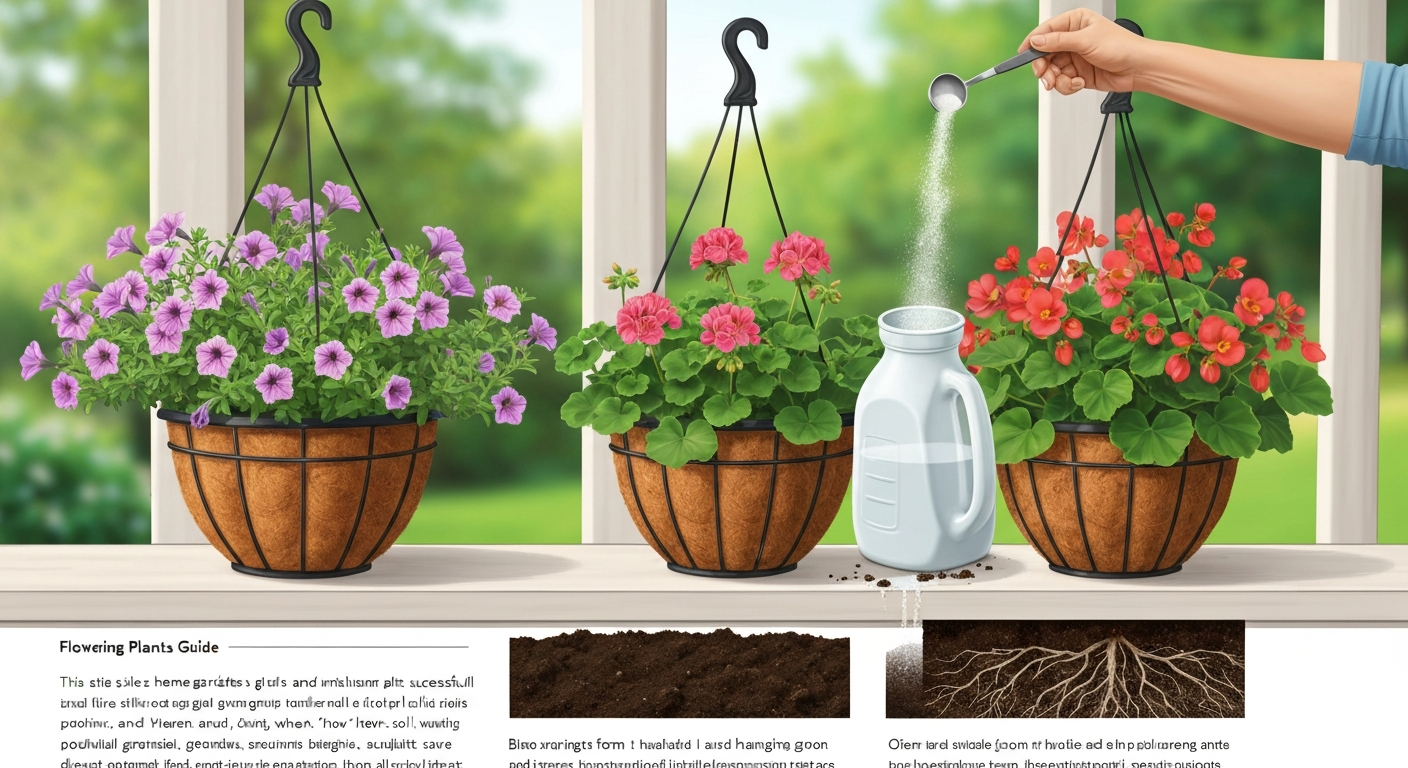
Why hanging baskets need their own feeding plan
A hanging basket is not just a smaller version of a garden bed. It is a fundamentally different growing environment, and that changes everything about how you fertilize. Most baskets hold somewhere between 6 and 14 inches of growing medium in a volume that ranges from about 1 quart (a tiny 6-inch basket) up to 3 or 4 gallons for a generous 14-inch planter. That small soil volume means there is very little reservoir of nutrients to draw from in the first place.
The bigger issue is water. Hanging baskets dry out fast, especially in full sun and summer heat. Many gardeners water their baskets once a day, sometimes twice. Every time you water, a portion of soluble nutrients drains straight through the drainage holes and out of reach of the roots. Research on container plants consistently shows that small volumes combined with frequent irrigation flush nutrients much faster than garden soil does. You are essentially starting from a near-empty nutrient tank every week or two. If you fertilize on the same schedule you would use for an in-ground flower bed, your basket plants will be quietly starving.
The flip side is also true. Because the volume is small, concentrated fertilizer builds up quickly if you overdose or if drainage is poor. Salt accumulation is a real risk in hanging baskets, and it causes more problems than most gardeners realize. The sweet spot is regular, correctly diluted feeding, matched to how often you water and what plants you are growing.
Which Miracle-Gro product are you using?
Miracle-Gro is not one product, it is a family of them, and the type you are using completely changes your feeding frequency and dilution. The three main categories you will encounter for hanging baskets are the classic water-soluble powder, a liquid concentrate, and slow-release granular formulas. Each one works differently, and mixing their schedules up is one of the most common mistakes I see.
| Product Type | N-P-K | Mixing Rate (Baskets) | Feeding Frequency |
|---|---|---|---|
| Water-Soluble All Purpose (powder) | 24-8-16 | 1 tbsp per gallon | Every 7–14 days |
| Liquid All Purpose Concentrate | 12-4-8 | 1 tsp per gallon (containers) | Every 7–14 days |
| Shake 'N Feed (slow-release granular) | Varies (e.g. 10-10-10 or 12-4-8) | Sprinkle on soil surface per label | Every ~3 months (re-apply) |
The water-soluble powder is the most concentrated (24-8-16 NPK) and is what most people picture when they think of Miracle-Gro. The liquid concentrate (12-4-8) is roughly half the nitrogen strength and is convenient if you prefer a pour-and-go approach. The manufacturer's Safety Data Sheet for Miracle‑Gro All Purpose Concentrated Liquid Plant Food documents the product formulation (commonly listed as 12-4-8 for the liquid concentrate) and provides hazard, handling, and precautionary statements for safe use Manufacturer Safety Data Sheet for Miracle‑Gro All Purpose Concentrated Liquid Plant Food — Safety Data Sheet (CCS/hosted copy of manufacturer SDS).. Slow-release granules are a completely different mechanism: they break down over weeks and months rather than delivering a single dose. Understanding which one you have will determine everything that follows.
Water-soluble Miracle-Gro: dilution and feeding schedule for baskets
The Miracle-Gro Water Soluble All Purpose Plant Food label gives you two mixing rates. For indoor plants or sensitive specimens, the instruction is half a teaspoon per gallon applied every two weeks. For outdoor containers, including hanging baskets, the label rate is 1 tablespoon per gallon, reapplied every 7 to 14 days. For most flowering baskets in the peak of summer, I default to the 7-day interval when the basket is being watered daily in heat. If you are in a cooler spell or the basket is only getting watered every other day, stretch to every 14 days.
The practical process is straightforward. Mix 1 tablespoon of the powder into a full gallon of water and stir until the crystals are fully dissolved. Pour the solution slowly and evenly over the soil surface, not onto the foliage, until you see some liquid begin to drain from the bottom. For a 10-inch basket, a full gallon is usually just right. For a smaller 6-inch basket, half a gallon is plenty. You want the entire root zone to receive the feed, not just the top inch.
One thing I always tell newer gardeners: do not feed a dry basket. If the soil is bone dry, the concentrated fertilizer solution can shock the roots. Water the basket lightly with plain water first, wait 10 or 15 minutes, then apply your feed solution. This simple step prevents a lot of tip burn and root stress.
Seasonal adjustments for water-soluble feeding
In early spring when basket plants are just getting established and temperatures are still cool, back off to every 14 days at the outdoor label rate. Once temperatures consistently reach the mid-60s Fahrenheit and your plants are actively producing new growth and buds, move to the 7-day schedule. As summer winds down in late August and early September, begin spacing feeds to every 10 to 14 days again. By mid to late fall, most hanging basket annuals are finishing their season and do not need heavy feeding.
Liquid-concentrate Miracle-Gro: dilution, frequency, and when to cut the dose
The Miracle-Gro Liquid All Purpose Plant Food concentrate (12-4-8) is a ready-to-dilute format that many gardeners prefer for its convenience. For containers and hanging baskets, the label calls for 1 teaspoon of concentrate per gallon of water, applied every 7 to 14 days. That is roughly the same interval as the powder, but you are working with a lower nitrogen concentration, so do not assume you can double the dose to make up for it. Stick to the labeled rate.
For plants that are known to be salt-sensitive, including impatiens and begonias, I recommend the lower end of the dilution scale: 1 teaspoon per gallon, no more, applied every 14 days rather than every 7. New Guinea impatiens in particular can show growth suppression and leaf edge burn at surprisingly modest fertilizer concentrations. Research has shown these plants can experience stress at media electrical conductivity levels as low as 1.5 dS/m, which means regular full-strength liquid feeding can tip them into trouble faster than you might expect. For these species, consistency at a lower dose beats irregular heavy doses every time.
The liquid concentrate is a good choice if you are managing several baskets of different plant types and want the flexibility to adjust strength quickly. You can make a half-strength mix (half a teaspoon per gallon) for a newly potted or recently transplanted basket that is still getting established, then step up to full strength once you see active new growth over the first two to three weeks.
Slow-release and granular Miracle-Gro: how to apply and when to top-dress
Shake 'N Feed and other granular Miracle-Gro products work on a completely different timeline. The granules are coated to release nutrients gradually as water passes through them, and the marketing claim of feeding up to 3 months is roughly accurate for in-ground or large container applications. In a hanging basket with daily watering, however, I have found the release often runs faster, closer to 6 to 8 weeks before plant performance starts to dip again.
To apply, sprinkle the granules evenly over the soil surface according to the label rate for your basket size, then lightly rake or scratch them into the top half-inch of growing medium. Water thoroughly after application so the coating begins to activate. Do not pile them in the center of the basket or leave them against the crown of the plant, as concentrated granules sitting against stems can burn.
Reapply every 3 months as the label directs, but in a hanging basket context, monitor your plants starting around the 6 to 8 week mark. The product page and label for Miracle‑Gro Shake 'N Feed All Purpose state it "feeds up to 3 months" and instruct users to sprinkle the granules evenly on the soil surface, lightly rake them in, and water after application Miracle‑Gro Shake ’N Feed All Purpose — product page / label summary (Miracle‑Gro).. If you notice bloom production slowing, leaves lightening in color, or growth generally stalling, the granules may be running out faster than expected. You can top-dress with a small additional amount or supplement with one or two liquid feeds at half-strength to bridge the gap.
A practical approach I recommend for busy gardeners is to use slow-release granules at planting to build a steady nutrient baseline, then supplement with the water-soluble powder or liquid concentrate once a month during peak bloom season. This combination, sometimes called a CRF-plus-liquid program in extension horticulture, tends to produce more consistent results than relying on either method alone.
Safe dosages by basket size and plant age
The label rates on Miracle-Gro products are calibrated for average outdoor containers, which may be larger than your actual basket. Translating those rates to your specific situation matters, especially when you are working with a small 6-inch basket or very young transplants.
| Basket Diameter | Approx. Soil Volume | Water-Soluble Feed per Application | Liquid Concentrate per Application | Granular per Application |
|---|---|---|---|---|
| 6 inch | ~0.5–0.75 qt | 0.5 tbsp in 0.5 gal water | 0.5 tsp in 0.5 gal water | ~0.5 tsp sprinkled on surface |
| 8 inch | ~1–1.5 qt | 0.75 tbsp in 0.75 gal water | 0.75 tsp in 0.75 gal water | ~1 tsp sprinkled on surface |
| 10 inch | ~1.5–2 qt | 1 tbsp in 1 gal water | 1 tsp in 1 gal water | ~1.5 tsp sprinkled on surface |
| 12–14 inch | ~2.5–4 qt | 1.5 tbsp in 1.5 gal water | 1.5 tsp in 1.5 gal water | ~2 tsp sprinkled on surface |
For newly transplanted baskets in their first two to three weeks, cut the water-soluble or liquid concentrate dose to half-strength regardless of basket size. Young roots are more susceptible to fertilizer burn, and the priority in those early weeks is root establishment rather than pushing top growth. Once you see clear signs of new leaf and shoot development, move to the full outdoor container rate.
Plant-by-plant recommendations for common basket flowers
Different plants in hanging baskets have meaningfully different fertilizer tolerances. What works perfectly for a petunia can set back an impatiens or burn a begonia if you are not paying attention. Here is how I approach the most common basket species.
Petunias
Petunias are heavy feeders and respond very well to the full outdoor label rate of 1 tablespoon of water-soluble Miracle-Gro per gallon every 7 days during peak summer. If you’re asking whether Miracle-Gro is good for petunias, the short answer is yes, petunias respond well to the standard water‑soluble Miracle‑Gro at the outdoor label rate when applied responsibly is Miracle-Gro good for petunias. Research on petunia production confirms strong interactions between irrigation frequency and fertilizer rate, petunias grown with frequent watering need more frequent feeding to compensate for leaching. If your petunias are producing few blooms or lots of leaves without flowers, under-feeding combined with a phosphorus deficit is often the culprit. The 24-8-16 formula supports flowering well. Deadhead regularly alongside feeding for the best results.
Geraniums (Pelargonium)
Geraniums are fairly tolerant of higher nutrient levels but are sensitive to actual salt accumulation, which is a subtle but important distinction. University extension production guidance recommends targeting around 200 to 250 ppm nitrogen for active geraniums, which translates well to the full outdoor label rate every 7 to 10 days. The key is making sure you water thoroughly enough each time to flush any salt buildup through the drainage holes. For more details on feeding geraniums with Miracle-Gro, see Is Miracle-Gro good for geraniums. Geraniums that sit in concentrated fertilizer residue will show leaf margin yellowing even though they are being fed regularly.
Impatiens and New Guinea impatiens
Standard impatiens are workhorses in baskets but are notably salt-sensitive. For detailed guidance on using Miracle-Gro with impatiens, including safe dilutions and schedules to avoid salt damage, see can you use Miracle-Gro on impatiens. Feed at half to three-quarter strength (half to three-quarters of a teaspoon of liquid concentrate per gallon, or about half a tablespoon of powder per gallon) every 14 days. New Guinea impatiens are even more sensitive. Studies have documented growth suppression at media EC levels of around 1.5 dS/m, so keep your rates conservative: half-strength liquid concentrate every 14 days is a safe starting point, stepping up only if you see clear signs of nutrient deficiency with no sign of salt stress.
Begonias
Tuberous and wax begonias both do well in baskets but prefer moderate rather than high fertilizer concentrations. Full-strength liquid concentrate (1 tsp per gallon) every 14 days is a reliable approach. Pushing to a 7-day cycle at full strength can cause the salt-related tip burn that begonias are prone to, especially in hot weather when evaporation is concentrating the growing medium. If you notice crispy brown petal edges combined with leaf tip burn, scale back the frequency before you scale back the strength.
Dwarf hibiscus in baskets
Compact hibiscus varieties grown in baskets benefit from steady feeding during their blooming season. If you’re asking 'is Miracle-Gro good for hibiscus', the short answer is generally yes for compact varieties when used at the recommended container rate and frequency, but avoid overwatering and watch for salt buildup. The full outdoor container rate of water-soluble Miracle-Gro every 10 to 14 days works well. Hibiscus are relatively tolerant of fertilizer but respond noticeably to potassium levels for flower development, so the 24-8-16 formula's higher potassium is an advantage here. Do not over-water and over-feed simultaneously with hibiscus in baskets as root rot becomes a compounding issue.
Hoya in hanging baskets
Hoya is not a traditional flowering annual, it is a semi-succulent vining houseplant that is often grown in decorative hanging baskets indoors or on covered porches. It has much lower fertilizer needs than the other plants on this list. If you are using Miracle-Gro on a hoya, use the indoor rate: half a teaspoon of water-soluble powder per gallon, applied every two weeks at most, and only during the active growing season from spring through late summer. In winter, stop feeding entirely.
Nasturtiums
Nasturtiums are genuinely one of the plants where Miracle-Gro can do more harm than good. They are famous for preferring lean soil, and feeding them with a nitrogen-heavy fertilizer like the standard Miracle-Gro powder typically produces lush green leaves with almost no flowers. If you grow nasturtiums in a basket, either use no fertilizer at all or limit yourself to a very diluted application (half a teaspoon of powder per gallon) once a month. Letting them run slightly hungry produces far better blooms. For more detail on common nasturtium problems, see why won't my nasturtiums grow.
A note on peonies
Peonies are not typical hanging basket plants, they are deep-rooted perennials that perform best in the ground. If you are growing a dwarf peony in a very large container (15 gallons or more), the feeding principles for container plants apply, but that is a very different situation from a standard hanging basket. For specific guidance on feeding peonies in containers, see is miracle grow good for peonies. For container peonies specifically, the larger soil volume changes the salt accumulation dynamics considerably.
Spotting over-feeding and under-feeding
The symptoms of too much and too little fertilizer can look surprisingly similar at first glance, which is why I always look at the whole picture rather than one symptom in isolation. Here is what to watch for.
Signs you are over-feeding
- White or crusty deposits forming on the rim of the basket or on the soil surface (salt accumulation)
- Brown, crispy leaf tips and margins that appear suddenly after feeding
- Wilting even when the soil feels moist (osmotic stress preventing water uptake)
- Yellowing leaves that are not consistent with a nitrogen deficiency pattern
- Roots appearing dark, mushy, or shrunken at the edges of the root ball
- Stunted new growth despite regular watering and feeding
Signs you are under-feeding
- Pale green or yellow-green leaves across the whole plant, starting with older leaves (nitrogen deficiency)
- Very slow growth in warm weather when the plant should be actively growing
- Few or no blooms despite good light and watering
- Small leaves and thin, weak stems
- Overall lackluster appearance even after watering
The clearest way to distinguish between the two is the white crust test. If you see white deposits on the soil or pot rim, you are almost certainly dealing with salt buildup from over-feeding, not a deficiency. If the soil surface looks normal and clean but the plant is pale and slow, under-feeding is the more likely culprit.
How to fix salt buildup and flush your basket
Salt buildup is the most common consequence of regular fertilizer use in small containers. Extension research consistently recommends flushing as the remediation method, and the protocol is simpler than many gardeners expect. The goal is to pass enough plain water through the basket to dilute and carry away the accumulated salts.
- Move the basket to a location where drainage water is not a problem, over a lawn, a drain, or outdoors.
- Water slowly with plain, unfertilized water until water runs freely from the drainage holes.
- Wait 10 to 15 minutes, then repeat with another slow pass of plain water.
- Do this two to three times in succession. Extension guidance from Michigan State recommends passing two to three times the pot volume in water through the container to achieve meaningful leaching.
- Stop all fertilizer for one week and observe the plant. If the wilting or burn symptoms are improving, resume feeding at half-strength for the next two applications before returning to normal.
- If the white crust persists after flushing, gently scrape it off the soil surface before the next watering.
In severe cases, a full flush may need to be repeated over two to three consecutive days. The important thing is not to panic and repot unnecessarily. Most baskets recover well from salt stress once you flush and give the roots a break. If you want to be more precise, a simple pour-through leachate EC test using an inexpensive conductivity meter can tell you whether the salt levels have come down to an acceptable range (most ornamentals prefer a media EC below about 3.0 dS/m on a saturated media extract basis, and salt-sensitive plants like impatiens and begonias prefer it below 1.5 dS/m).
Troubleshooting: poor blooms, leggy growth, and yellowing
Poor blooming in a well-fertilized basket is almost always one of three things: not enough direct light, too much nitrogen relative to phosphorus and potassium, or the plant has been over-stressed by erratic watering. Miracle-Gro's standard formulas are not specifically bloom-boosting products. The 24-8-16 NPK is weighted toward nitrogen, which is excellent for establishing leafy, vigorous growth but not always ideal for pushing maximum flower production on its own. If your basket is leafy and green but sparse on blooms, consider alternating your regular Miracle-Gro feeding with a high-phosphorus bloom fertilizer (something in the range of 10-52-10 or similar) once a month.
Leggy growth with long, stretched stems and small leaves usually points to insufficient light combined with moderate over-feeding with nitrogen. Fertilizer will not substitute for sunlight. Most common basket flowers (petunias, geraniums, impatiens, begonias) need at least 4 to 6 hours of direct sun to grow compactly and bloom well. If your basket is in deep shade and you are feeding it weekly, you will get leggy, weak growth regardless of the fertilizer quality.
Yellowing on the lower leaves of an actively growing basket usually indicates nitrogen is being leached before the plant can use it, which means your feeding frequency may need to increase slightly or your watering amount needs adjustment. Yellowing that starts at the tips and margins of leaves across the whole plant, on the other hand, is more likely a salt or pH issue. Hanging basket growing medium can drift acidic over a season of heavy watering, which locks out certain nutrients even when they are present in the soil.
When to choose something other than Miracle-Gro
Miracle-Gro is a genuinely effective, well-researched product and I use it regularly myself. But it is not always the best tool for the job. Here are the situations where I would recommend looking at alternatives.
- Nasturtiums and other low-nutrient plants: use no fertilizer or a very diluted organic option like fish emulsion at quarter-strength once a month
- Salt-sensitive plants (New Guinea impatiens, certain begonias): consider a slow-release, lower-salinity fertilizer specifically labeled for sensitive ornamentals
- Baskets going into drought stress periods or heat waves: hold all fertilizer until plants are actively growing and drinking again, then resume at half-strength
- Baskets where you suspect soil pH has drifted: fertilizer additions will not fix a pH problem; address soil pH first before resuming a feeding program
- Overwintered or dormant plants indoors: cease all Miracle-Gro feeding until you see clear signs of new growth in spring
For experienced growers who want more precise control, a combination approach works well: slow-release granules at planting for a steady nutrient baseline, supplemented by liquid Miracle-Gro once or twice a month at half-strength. This avoids the feast-or-famine cycle that comes with relying entirely on weekly water-soluble feeding. It also reduces the risk of salt spikes after application, which is especially useful if you are growing salt-sensitive species alongside more tolerant ones in the same garden space.
One last honest note: Miracle-Gro is a tool, not a cure. If your hanging basket is getting insufficient light, rootbound in a pot that is too small, or being watered so inconsistently that the roots are bouncing between drought and saturation, no fertilizer schedule is going to produce the blooms you are hoping for. Feed your plants well, but make sure the fundamentals of light, water, and pot size are in good order first.
FAQ
What is the short answer: how often should I use Miracle‑Gro on hanging baskets?
Use a product appropriate for container culture and follow the label: for water‑soluble Miracle‑Gro (all‑purpose) feed every 7–14 days at the outdoor/container label rate or every 14 days at the indoor/houseplant (weaker) rate; for liquid concentrate follow the container/houseplant label (typically 1 teaspoon per gallon) about every 2 weeks; for Shake 'N Feed/slow‑release apply at planting and expect ~8–12 (label says up to 3) weeks of feeding and reapply per label. Because hanging baskets are small and leach quickly, many gardeners use either weekly weak liquid feeds (half‑strength) or the label strength every 7–14 days, or a CRF at planting plus light liquid top‑ups.
Exact dosages to use for common Miracle‑Gro product types in hanging baskets
Water‑soluble all‑purpose (Miracle‑Gro water‑soluble): outdoor/container mix on the label ≈ 1 tablespoon per gallon, reapply every 7–14 days; indoor/houseplant dilution ≈ 1/2 teaspoon per gallon, reapply every 14 days. Liquid concentrate (Miracle‑Gro liquid): container/houseplant label is ≈ 1 teaspoon per gallon applied about every 2 weeks (follow the product cap markings for outdoor mixes on bottle). Shake ’N Feed / slow‑release granular: apply at planting to the soil surface per label rate (product variant dependent), feeds up to ≈ 8–12+ weeks (label often says up to 3 months); do not double up rates in small baskets. When in doubt, follow the product label on the bottle/box — it is the legal and safety guidance.
How should I adjust frequency and strength for small hanging baskets and frequent watering?
Small volumes + frequent irrigation leach nutrients faster. Two safe approaches: (A) weak, frequent feeding: use half the label concentration of a water‑soluble or liquid product and feed weekly (this keeps soluble N around the 100–150 ppm range favored for many bedding plants); or (B) standard label strength every 7–14 days. Alternatively, use a controlled‑release fertilizer (CRF) at planting at the label rate (lower rate for very small baskets) and supplement with light liquid feeds only if growth or color lags. Avoid heavy, infrequent dosages because they increase salt buildup and risk burn.
How should I change feeding through the seasons?
Spring/early growth: feed at label rate or use weak weekly feeds as plants establish. Peak bloom (late spring–summer): maintain the same schedule; some heavy‑flowering crops (petunias, geraniums) benefit from slightly higher N within recommended ranges (use label and avoid overfertilizing). Heat/drought stress: reduce or pause feeding until plants recover—high salts worsen stress. Fall: taper feeding as flowering declines (stop feeding 4–6 weeks before bringing tender plants indoors). Winter/indoor: use the houseplant dilution and feed less often (every 2–4 weeks) depending on growth rate and light.
Species‑specific recommendations (petunias, geraniums, impatiens, begonias, dwarf hibiscus, hoya, nasturtiums, peonies in containers)
Petunias: vigorous feeders—use label strength every 7–14 days or half‑strength weekly; leach occasionally to avoid salt build‑up. Geraniums (Pelargonium): like steady feed; target higher end of bedding ppms (≈150–250 ppm N in production), but in baskets use label rates and flush occasionally—they can be salt‑sensitive so avoid over‑concentrating. Impatiens (esp. New Guinea): salt‑sensitive—use gentler program (half‑strength weekly or houseplant dilution every 2 weeks), avoid CRF high rates without leaching. Begonias: salt‑sensitive—low/less frequent feed, use houseplant dilution or low‑N formulas. Dwarf hibiscus (container): moderate feeder—label strength every 7–14 days or CRF at planting + light liquid feed in summer. Hoya (vining houseplant often used in hanging baskets): slow‑growing—feed lightly (houseplant dilution) every 4–6 weeks during active growth; do not overfertilize. Nasturtiums: prefer leaner soil—use minimal feeding; too much N reduces flowers. Peonies: generally do not perform well in small hanging baskets; they prefer deep, in‑ground soil and cooler root temps—if container‑grown, use conservative feeding and larger containers with CRF at planting.
How do I recognize over‑fertilization or salt buildup and what immediate steps should I take?
Signs: white crust on soil or pot rim, brown leaf tips, marginal scorch, stunted growth, wilting despite moist soil, leaf chlorosis. Immediate steps: stop fertilizing; flush with plain water to leach salts—apply 2–3× pot volume of water slowly in several passes so water drains from the bottom (some extension sources recommend up to 3–5× for severe build‑up). Repeat flushing if needed; allow to drain and recover. After flushing, resume feeding at lower strength or switch to gentler program. If severe root damage is suspected (soft black roots), consider repotting into fresh media.