
Magnolia stellata, the star magnolia, is one of the most rewarding small trees you can plant in a home garden. It tops out at 10–20 feet tall with a spread of 8–15 feet, blooms on bare stems in late winter to early spring with fragrant 3–4 inch flowers carrying 12–18 narrow white or pink tepals, and it fits into yards where a Southern magnolia would simply eat the house. Plant it in moist, well-drained, slightly acidic soil in a spot with full sun to part shade, keep it consistently watered through its first two seasons, and you will have a tree that flowers reliably for decades. This guide walks you through every decision from cultivar selection to soil prep to pruning timing, whether you are putting your first tree in the ground this autumn or troubleshooting a mature plant that suddenly refuses to bloom.
How to grow Magnolia stellata & care calendar

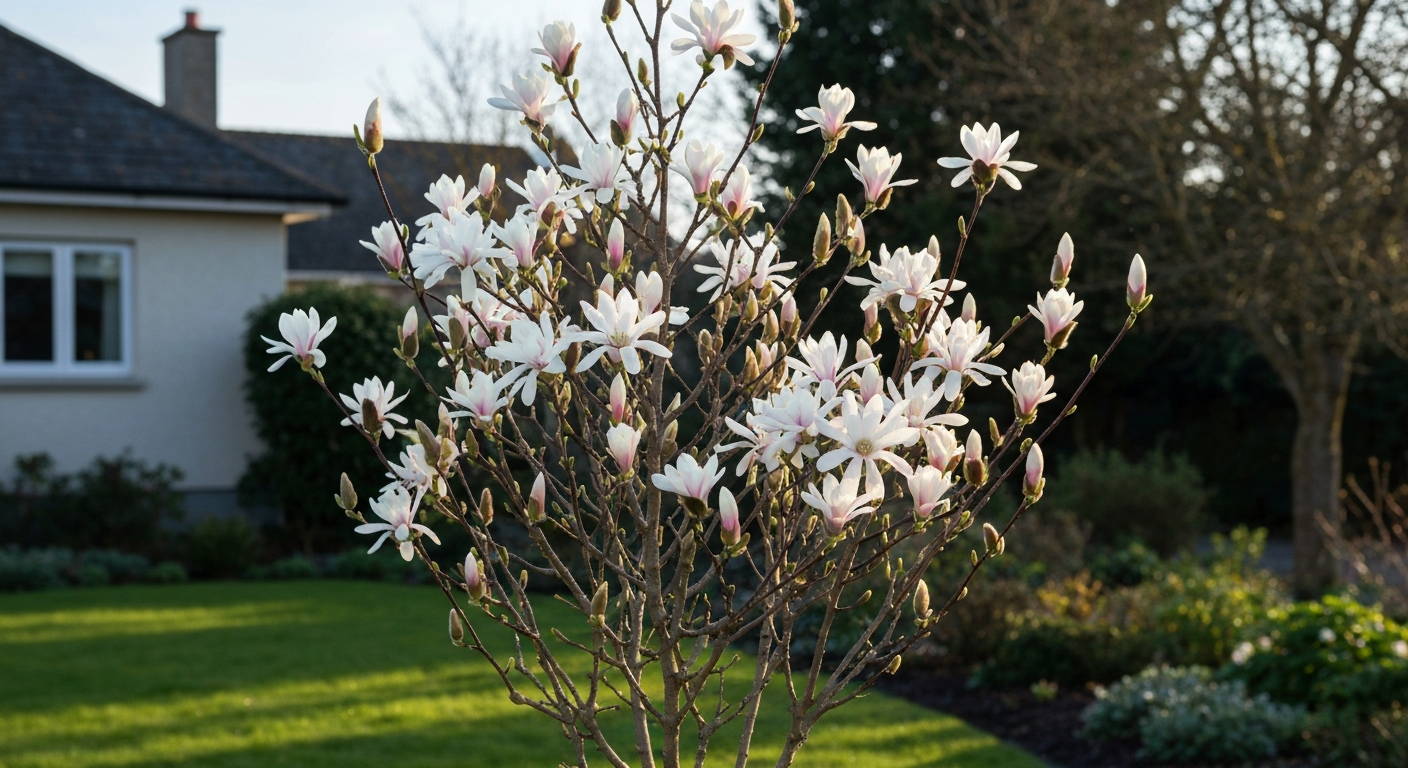
What Magnolia stellata is and why it earns a spot in your garden
Star magnolia is a deciduous, multi-stemmed tree or large shrub native to Japan. Unlike the large, evergreen magnolias many gardeners picture, this species stays genuinely compact and fits on an average residential lot without crowding. Flowers open before the leaves emerge, which gives the whole plant a spectacular bare-branch display every spring. The blooms are often faintly fragrant, and the show typically lasts two to three weeks depending on your weather. The caveat that every grower learns quickly: those early flowers are vulnerable to late frosts. Part of growing star magnolia well is choosing the right site and the right cultivar to minimize that heartbreak. This guide is written for home gardeners at all levels, from first-time tree planters to experienced growers who want to dial in timing and technique.
Choosing the right cultivar before you buy anything
The Register of Magnolia Cultivars documents more than 25 named Magnolia stellata selections, and the differences between them are real enough to change your experience significantly. The main variables to weigh are mature size, flower color and tepal count, bloom timing, and cold or heat tolerance. Bloom timing is the factor most beginners overlook, and it matters enormously if late frosts are common in your area.
| Cultivar | Flower color/form | Bloom timing | Mature height | Frost-loss risk | Best for |
|---|---|---|---|---|---|
| 'Royal Star' | White, double, from pink buds | Early (species-typical) | 8–15 ft | Higher in cold zones | Small gardens, containers, beginners |
| 'Waterlily' | White, many tepals, waterlily-like | 1–2 weeks later than species | 10–20 ft | Lower than most | Frost-prone sites, specimen use |
| 'Jane Platt' | Pink, 20–30 tepals, pale | Mid-season | Moderate (10–15 ft) | Moderate | Specimen, pink-flowering accent |
| Species type | White, 12–18 tepals | Earliest | 10–20 ft | Highest | Mild-winter climates only |
'Waterlily' is often my first recommendation for gardeners in Zones 5–7 who have been burned by late frosts. Its bloom opens one to two weeks later than the straight species, which in many regions puts it past the last hard freeze. 'Royal Star' is the most widely available cultivar and is a fine choice if you can site it on a north-facing or sheltered slope that delays bud break naturally. 'Jane Platt' is worth seeking out if you want pink flowers with an unusually high tepal count. All three perform in USDA Zones 4–8, though Zone 4 gardeners should pick sheltered sites and favor later-blooming selections.
Hardiness, climate, and knowing your zone
Magnolia stellata is rated for USDA Hardiness Zones 4–8, and the 2023 USDA Plant Hardiness Zone Map is the reference worth bookmarking for your specific address. The plant itself is cold-hardy through Zone 4 winters, meaning the woody stems and roots survive without issue. The real threat is a late frost in March or April that catches open or swelling buds. Virginia Cooperative Extension specifically flags this as one of the main performance variables for star magnolia: in some years you get a full flower display, and in others a single night below freezing wipes it out. That is not a disease or a care failure, it is just the nature of an early-blooming tree.
If you are in Zone 8, the concern flips slightly. Summer heat and drought stress become bigger issues than cold, and you will need to be more attentive to consistent irrigation and afternoon shade. In Zone 4, focus on microclimate. A north-facing slope, a position on the east side of a building, or a spot shielded from the warming southwest sun can delay bud break by a week or two and dramatically improve flowering consistency. Avoid south and southwest exposures in cold-climate gardens unless you have a particularly late-blooming cultivar, because those sunny walls warm buds early and set them up for frost damage.
Picking the right site in your garden
Star magnolia grows best in full sun to part shade. Full sun means six or more hours of direct light daily and will give you the heaviest flowering. Part shade (three to six hours) is workable and often preferable in Zone 7–8 where afternoon heat is intense. What you want to avoid is deep shade, which reduces bloom significantly, and exposed sites where strong winds can desiccate the fleshy tepals and shorten the display to just a few days.
Frost pockets are a critical planning factor. Cold air drains downhill and pools in low spots, so a tree planted at the bottom of a slope will experience colder spring nights than one planted mid-slope or near the top. If your garden has a known frost pocket, plant your star magnolia on higher ground or near a structure that radiates stored heat. Give the plant enough room for its eventual spread: plan for at least 8–15 feet of clearance from structures, sidewalks, and other large shrubs. Star magnolia is not particularly aggressive with its roots, but it resents being crowded as it matures.
Soil requirements and how to prepare your planting site
Magnolia stellata wants moist, organically rich, well-drained loam with a slightly acidic pH, ideally between 5.5 and 6.5. It is genuinely intolerant of waterlogged conditions, so if your soil stays wet after rain, address that before you plant rather than hoping for the best. Equally, it struggles with prolonged drought and very compacted or alkaline urban soils. If you have heavy clay, amend the planting area broadly and consider raising the planting site a few inches to improve drainage. For gardeners also interested in evergreen flowering shrubs, see our guide how to grow pink perfection camellias for site and soil tips tailored to camellias.
Before planting, test your soil pH with an inexpensive test kit or through your local cooperative extension service. If your pH is above 6.5, work granular sulfur into the top 12 inches of the planting area according to the product rate for your soil type. If the soil is below 5.5, a small amount of lime will help. For organic matter, you do not need to replace the entire planting hole with amended soil. Research from university extension programs consistently shows that backfilling with mostly native soil leads to better long-term establishment than creating a pocket of rich, loose compost that the roots never want to leave. A practical blend is roughly one part compost mixed into four to nine parts native soil, incorporated into the wider planting area.
When to plant Magnolia stellata
The best planting window depends on how your tree was grown. Bare-root star magnolias should go in the ground while they are fully dormant, which means late winter before bud swell begins. This is the most economical form to buy and establishes well if planted at the right time. Container-grown plants, which are what you will find at most garden centers, can technically be planted any time the soil is workable. That said, the practical sweet spots are early spring (before hot weather) and fall (after summer heat breaks, roughly six weeks before your first hard freeze). Fall planting allows root establishment over winter without the stress of summer heat and drought. Avoid planting into frozen ground or during a summer heat wave, and if you plant in summer, accept that you will be watering heavily for the rest of the season.
How to plant Magnolia stellata, step by step
Getting the planting depth right is the single biggest factor in long-term success. Planting too deep is one of the most common causes of slow decline in magnolias and woody plants generally, and it is entirely avoidable. Here is the process to follow:
- Dig your hole only as deep as the rootball and two to three times as wide. A wide, shallow hole is always better than a narrow, deep one.
- Set the tree in the hole and check that the root flare (the point where the trunk begins to widen and flare outward at the base) is at or very slightly above the finished soil grade. Never bury the root flare.
- Remove any burlap, wire baskets, or container material. Loosen circling roots gently with your hands or a pruning knife. Circling roots left intact can girdle the trunk over years.
- Backfill with mostly native soil, blended with up to 20% compost by volume if your native soil is very poor. Fill in stages and tamp gently with your foot or hands to eliminate large air pockets. Do not compact heavily.
- Build a shallow watering berm at the outer edge of the planting hole to direct irrigation water toward the rootball.
- Water in thoroughly immediately after planting, soaking the rootball and surrounding soil. This is not optional — it settles the soil and initiates root-to-soil contact.
- Apply 2–4 inches of organic mulch (shredded bark or wood chips work well) over the entire root zone, spreading it out to the drip line or beyond. Pull the mulch back 2–3 inches from the trunk. Do not create a mulch volcano against the bark.
- Stake only if the tree is in a very exposed, windy site or if the rootball is unstable after planting. Use two low stakes and a flexible tie, and remove stakes after one year.
On spacing: if you are planting more than one tree, allow at least the full expected spread between canopy centers. For a cultivar like 'Royal Star' at a mature spread of 8–12 feet, that means at minimum 10–12 feet center to center. Crowding star magnolias causes reduced air circulation, which invites fungal problems, and limits light penetration, which suppresses flowering.
Planting day checklist
Print this checklist and take it to the garden with you on planting day. Going through it in order saves you from the most common mistakes.
- Tools gathered: round-point spade, garden fork, hand pruners, measuring tape, garden hose or watering can, wheelbarrow
- Materials on hand: compost, native backfill, organic mulch (shredded bark or wood chips), flexible tree ties if staking is needed
- Soil pH tested within the past 12 months and adjusted if needed
- Planting site confirmed: adequate sun, no frost pocket at the lowest point, good drainage verified after a rain event
- Hole dug to rootball depth only, two to three times the rootball width
- Hole bottom firm (not loosened below rootball depth, which causes settling)
- Root flare identified on tree and marked before lowering into hole
- Tree placed in hole with root flare at or just above grade
- All container material, burlap, or wire removed
- Circling or girdling roots loosened or lightly pruned
- Backfill blended (native soil plus up to 20% compost), filled in layers, air pockets eliminated
- Watering berm formed at hole perimeter
- Watered in deeply immediately after backfilling
- Mulch applied 2–4 inches deep, pulled back 2–3 inches from trunk
- Stakes installed only if needed, with flexible non-abrasive ties
- Planting date, cultivar name, and source nursery recorded in your garden journal
Watering, mulching, and feeding after planting
For the first full growing season, aim to deliver the equivalent of 1–2 inches of water per week across the root zone, including rainfall. Deep, infrequent soaking is better than frequent shallow sprinkling. A slow trickle from a hose left at the base for 30–45 minutes every five to seven days during dry spells works well and encourages roots to grow outward into the surrounding soil. Star magnolia has low to moderate drought tolerance and genuinely needs consistent moisture, especially through summer. Magnolia stellata, Oregon State University Landscape Plants reports that star magnolia has low to moderate drought tolerance and requires consistent summer moisture, so avoid prolonged dry spells especially during establishment blank" rel="noopener noreferrer">Magnolia stellata — Oregon State University Landscape Plants. Do not assume established mulch makes drought irrelevant. Selecting, Planting and Caring for a New Tree, Oregon State University Extension (mulch guidance) recommends applying 2–4 inches of organic mulch over the root zone and keeping mulch pulled back 2–3 inches from the trunk to avoid collar rot and rodent damage blank" rel="noopener noreferrer">Selecting, Planting and Caring for a New Tree — Oregon State University Extension (mulch guidance). Check the soil 3–4 inches down with your finger. If it feels dry, water.
Feeding is less critical than watering and soil preparation, and I would be cautious about over-fertilizing. A light application of a balanced, slow-release granular fertilizer formulated for acid-loving plants in early spring (before growth begins) is all most star magnolias need. Scatter it over the root zone, do not dig it in, and water it well. Avoid high-nitrogen feeds in summer, which push soft, frost-vulnerable growth late in the season. After the first two or three years, many established star magnolias in reasonably fertile soil need no feeding at all. Top-dressing with compost in autumn accomplishes more than a bag of Miracle-Gro applied at the wrong time.
Pruning: when to do it and what to avoid
The single most important pruning rule for star magnolia is timing. Prune immediately after flowering finishes in spring, before the tree sets next year's flower buds. Pruning in late summer, autumn, or winter cuts off the buds that are already formed and waiting for the following spring. This is the most common reason gardeners complain that their star magnolia stopped blooming: someone pruned it at the wrong time of year.
Star magnolia needs relatively little pruning compared to many flowering shrubs. Remove dead, damaged, or crossing branches, and lightly shape if needed to maintain structure. Avoid heavy pruning that removes more than about a quarter of the canopy at one time. The plant responds to significant pruning with vigorous but late-season regrowth that is prone to cold damage. If you want a cleaner single-trunk form rather than a multi-stemmed shrub, you can gradually remove the lower stems over several years, but the multi-stem form is natural and attractive and you do not need to fight it.
Growing Magnolia stellata in containers
Container growing is possible but comes with real trade-offs. Star magnolia in a large pot (minimum 25–30 gallon to accommodate mature root mass) can work on a patio or terrace, especially for cultivars on the more compact end like 'Royal Star'. Use a well-draining, slightly acidic potting mix, and be prepared to water much more frequently than you would an in-ground tree. Containers dry out fast in summer, and star magnolia will show leaf scorch quickly under drought stress. The bigger challenge is winter cold: a container provides very little insulation, and in Zone 5 or 6, the rootball of a pot-grown tree can freeze solid and kill the plant even when the same cultivar would survive in the ground. In Zone 6 and colder, move containers to an unheated garage or shelter from late autumn through late winter, or wrap the pot in insulating material. In Zone 7–8, container growing is more straightforward and the trees can stay outside year-round.
Transplanting an established star magnolia
Magnolias are not the easiest trees to transplant once established, largely because they have fleshy, brittle roots that do not regenerate as readily as fibrous-rooted species. That said, younger trees (up to 5–6 feet tall, established for three years or less) can be moved successfully in early spring before growth begins or in early autumn. Water the tree deeply two days before transplanting, dig the largest rootball you can manage, and replant immediately using the same technique described in the planting section. Keep irrigation consistent for at least two full growing seasons after the move. Transplanting a large, long-established star magnolia is genuinely risky and usually not worth attempting without professional equipment and help.
Propagation options for the patient gardener
Most named cultivars like 'Royal Star' and 'Waterlily' are propagated by cuttings or grafting to preserve their exact characteristics. If you're also looking for guidance on sourcing a particular vine, consult a short guide on how to get 744t honeysuckle in grow a garden. Growing from seed is possible but will produce variable offspring that may look quite different from the parent. If you want to try it, collect seed in autumn when the seed pods open and the red-coated seeds become visible. Clean off the red coating (it contains germination inhibitors), cold-stratify the seed in moist peat in the refrigerator for 3–4 months, and sow in spring. Germination is unreliable and seedlings take several years to reach flowering size.
Softwood cuttings taken in early summer (just after the first flush of new growth has partially hardened) have a reasonable success rate with bottom heat and a humidity tent or mist system. Take 4–6 inch cuttings with a heel, treat with rooting hormone, and insert into a well-draining propagation mix. Expect rooting in 6–10 weeks. Air layering in late spring or early summer is another option that works well for home gardeners without mist facilities: select a healthy branch, wound the bark, dust with rooting hormone, wrap with moist sphagnum moss, and seal in plastic. Roots typically form within 8–12 weeks. Grafting onto Magnolia kobus rootstock is the commercial standard for named cultivars but requires some practice to do well and is typically only worth attempting if you want to propagate a specific cultivar in quantity.
Seasonal care calendar
| Season | Key tasks |
|---|---|
| Late winter (Zones 4–6) | Monitor for bud development; protect from late frosts with frost cloth if buds are at risk; plant bare-root stock while dormant |
| Early spring | Apply slow-release, acid-formulated fertilizer before growth begins; replenish mulch to 2–4 inches; begin irrigation monitoring |
| Spring (at bloom) | Enjoy flowering; note any frost damage for future site or cultivar decisions; avoid all pruning while flowering |
| Post-bloom (late spring) | Prune dead, crossing, or unwanted branches immediately after flowering finishes; this is your only reliable pruning window |
| Summer | Water deeply every 5–7 days during dry spells; check mulch depth; watch for aphids or scale on new growth; avoid high-nitrogen feeding |
| Early autumn | Plant container-grown stock; water container-grown plants to prepare for dormancy; top-dress with compost if desired |
| Late autumn | Reduce watering as temperatures drop; protect container plants in cold zones; avoid pruning |
| Winter | No active care needed for in-ground plants in Zones 4–8; insulate container rootballs in Zone 5 and colder |
Troubleshooting common problems
| Problem | Likely cause | What to do |
|---|---|---|
| Flowers turn brown overnight in spring | Late frost damage to open blooms | No fix for current year; plant later-blooming cultivar or improve site for next year |
| No flowers despite healthy growth | Pruning at wrong time of year (summer/autumn/winter) | Prune only right after flowering; wait for next spring's bloom |
| Yellowing leaves during growing season | Chlorosis from high soil pH or waterlogging | Test pH and amend; improve drainage if soil stays wet after rain |
| Leaves wilting in summer despite watering | Root rot from poorly drained soil, or heat stress in container | Check drainage; reduce watering frequency and improve drainage; move containers to afternoon shade |
| Buds present but fail to open (bud drop) | Late frost, drought stress during bud development, or root damage | Increase irrigation from late winter; protect buds during frost events; check root zone for damage |
| Scale or sooty mold on stems | Scale insect infestation | Apply horticultural oil in late winter before buds open; repeat if needed |
| Sparse, leggy growth with few flowers | Insufficient sunlight or competition from nearby trees | Prune competing canopy or relocate tree to a sunnier position |
Star magnolia dos and don'ts
- Do plant in moist, slightly acidic, well-drained soil and test pH before planting
- Do place the root flare at or just above grade — planting too deep is the most preventable cause of slow decline
- Do choose a later-blooming cultivar like 'Waterlily' if late frosts are a regular problem in your garden
- Do mulch broadly over the root zone and keep mulch away from the trunk
- Do prune only right after flowering finishes in spring
- Do water consistently through the first two growing seasons and during summer dry spells
- Don't plant in a frost pocket or against a south-facing wall that will force early bud break in cold climates
- Don't backfill the planting hole with pure compost or potting mix — use mostly native soil
- Don't prune in summer, autumn, or winter unless removing dead or damaged wood only
- Don't allow soil to stay waterlogged — star magnolia will decline quickly in poorly drained spots
- Don't over-fertilize with high-nitrogen products, especially in summer
How star magnolia compares to related species
If you are deciding between Magnolia stellata and other ornamental magnolias, the scale of the plant is the most practical differentiator. Star magnolia at 10–20 feet is far more manageable than most landscape magnolias and fits small gardens naturally. Magnolia Little Gem, a compact evergreen form of Southern magnolia, offers year-round foliage and larger blooms but grows in a narrower climate range and needs more heat. Michelia alba and Michelia champaca (both now reclassified within the Magnolia genus) are frost-tender options better suited to warm, frost-free climates. For specific cultivation details, see how to grow michelia champaca for guidance on the climate, soil, and care that species needs. For gardeners in warm climates, see guidance on how to grow michelia alba (ab0fc06b-ae19-4ae8-83c9-53a3c0dd63c7) for species-specific cultivation advice. If you are in a milder zone and want a different flowering tree in the same size range, those species are worth considering, but for Zones 4–7, Magnolia stellata is genuinely hard to beat for spring impact in a compact space. For gardeners interested in similar compact, early-flowering shrubs, see how to grow Miss Kim lilac for guidance on site, soil, and pruning tailored to that plant. For seasonal vertical interest, see a concise guide on how to grow kiss-me over the garden gate. Gardeners in the American South who want a small-garden camellia companion for a winter-to-spring color sequence will find that star magnolia and camellias bloom sequentially and pair beautifully in a mixed border.
The honest long view
Star magnolia rewards patience. The first few years are mostly about establishment, and you may get modest flower displays while the root system develops. By year three to five, a well-sited and properly planted tree will put on a spring show that stops people in the street. The frost risk never fully goes away, and some years the weather will win. But when conditions align and you catch that first week of perfect spring weather with every tepal open and slightly fragrant in the morning air, it is one of those plants that justifies everything. Get the site right, get the planting depth right, and keep the water consistent. Everything else follows from those three things.
FAQ
What is Magnolia stellata and is it suitable for my garden?
Magnolia stellata (star magnolia) is a small deciduous multi-stem tree or large shrub (commonly 8–20 ft tall and 8–15 ft wide) with fragrant 3–4 in white or pink star‑shaped flowers in late winter to early spring. It’s suitable for home gardens in USDA Zones 4–8. Choose it for a spring focal point, small‑space specimen, or foundation planting; protect from late freezes and strong drying winds to reduce flower damage.
How do I choose the best cultivar and planting site?
Pick a cultivar for bloom timing and flower color: 'Royal Star' (compact, white), 'Waterlily' (many tepals, blooms ~1–2 weeks later), and 'Jane Platt' (pink). Prefer full sun to light afternoon shade—full sun yields heavier flowering but increases risk of early bud break; part‑shade is safer in cold climates. Site needs well‑drained, organically rich, slightly acidic loam, sheltered from strong winds and late cold blasts. Match your USDA zone to cultivars (Zones 4–8 recommended).
When and how should I plant Magnolia stellata?
Timing: plant bare‑root in late winter while dormant; container plants anytime soil is workable (avoid frozen ground or heat extremes). Hole: dig only as deep as the rootball and 2–3 times as wide. Set the root flare at or slightly above finished grade. Backfill primarily with native soil, mixing in no more than ~10–20% compost if needed. Tamp lightly to remove large voids. Mulch 2–4 inches over the root zone, keeping mulch 2–3 inches from the trunk. Water deeply after planting.
What is a simple, actionable planting checklist?
Planting checklist: 1) Confirm site sunlight, drainage, and hardiness zone. 2) Choose cultivar (bloom time/color) and healthy nursery stock. 3) Dig hole same depth as rootball × 2–3 times wider. 4) Set root flare at/above grade; remove burlap/wire from container/bare‑root. 5) Backfill with mostly native soil; mix ≤10–20% compost if poor. 6) Water thoroughly to settle. 7) Apply 2–4 in organic mulch, pulled back 2–3 in from trunk. 8) Stake only if needed; plan for watering 1–2 in/week first season.
How much and how often should I water?
During establishment (first growing season) aim for the equivalent of 1–2 inches of water per week (rain + irrigation). Use deep, infrequent soakings to wet the rootball and soil to encourage outward rooting. After established, maintain consistent moisture—Magnolia stellata has low to moderate drought tolerance and suffers in prolonged dry spells. Avoid waterlogging; they dislike sustained saturated soils.
What soil and mulching practices work best?
Soil: well‑drained, organically rich loam with slightly acidic pH is ideal; avoid heavy, compacted clay or permanently waterlogged sites. Mulch: apply 2–4 inches of shredded bark, wood chips, or well‑composted material to conserve moisture and moderate temperature; keep mulch 2–3 inches from the trunk to reduce collar rot and vole habitat.