
Kiss-me-over-the-garden-gate (Persicaria orientalis) is a fast-growing annual that regularly hits 4 to 5 feet tall, throws out long, drooping tassels of deep-pink flowers from midsummer right through the first hard frosts, and will quite happily scramble over a garden gate if you give it something to grab onto. The trick is simple: cold-stratify the seed for about three weeks, direct-sow after your last frost date (or fall-sow to let winter do the chilling for you), keep the soil consistently moist while seedlings establish, and tie the stems loosely to a trellis or horizontal wires as they climb. Get those basics right and this plant will reward you with one of the showiest floral curtains you can grow in a single season.
How to Grow Kiss-Me-Over-the-Garden-Gate: A Practical Guide

Marcus Holloway
15 Jul 2026
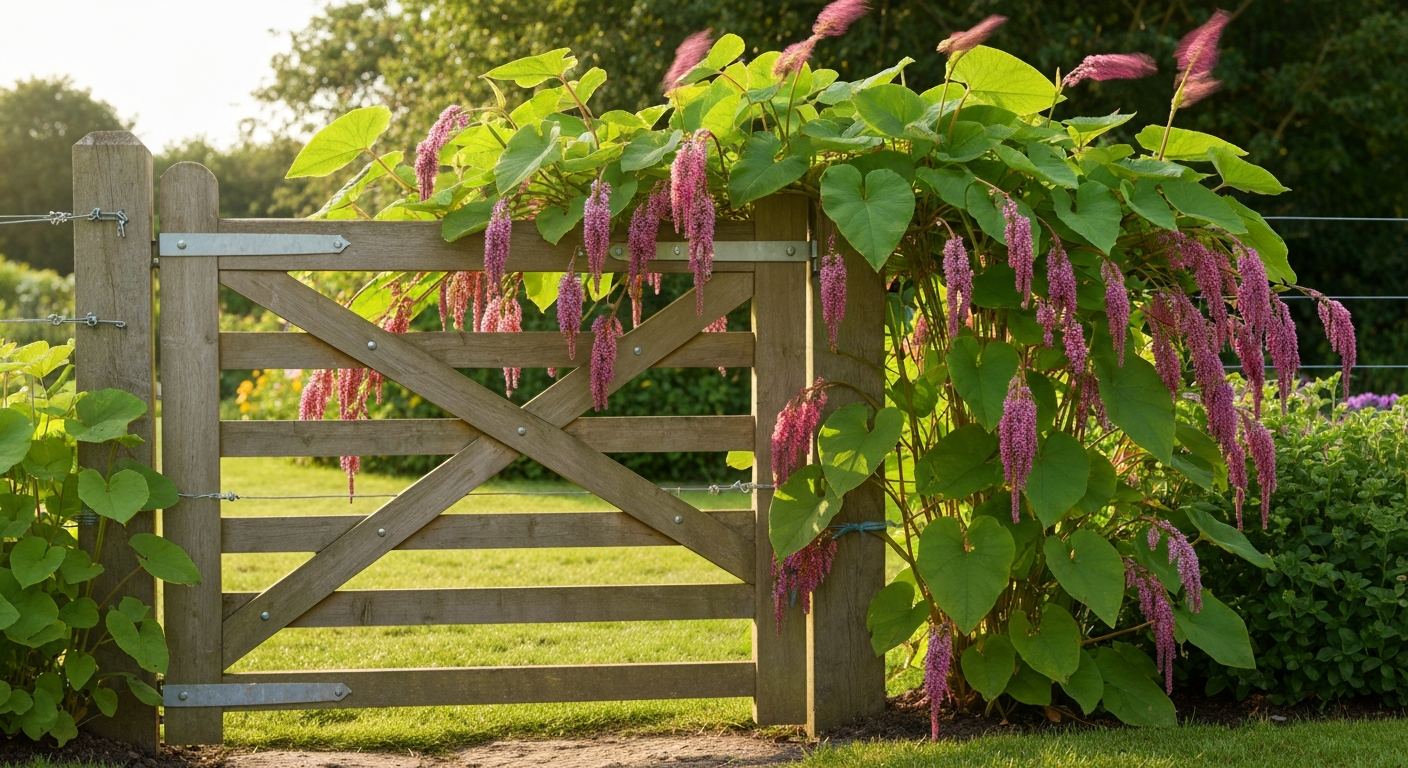
Quick ID: what does kiss-me-over-the-garden-gate actually look like?
Persicaria orientalis (basionym Polygonum orientale) goes by two main common names in gardens: kiss-me-over-the-garden-gate and prince's feather (or princess feather). Both names fit the plant perfectly once you see it in bloom. Here is what to look for.
| Characteristic | Detail |
|---|---|
| Scientific name | Persicaria orientalis (L.) Spach |
| Common names | Kiss-me-over-the-garden-gate, prince's feather, princess feather |
| Mature height | 1–1.5 m (3–5 ft) typically; up to ~2 m in very favorable conditions |
| Spread | 0.5–1 m (20–40 in) |
| Flower form | Long pendulous/drooping racemes (tassels) of small deep-pink to rose flowers |
| Bloom time | Midsummer through autumn, until hard frosts cut it down |
| Seed/fruit | Shiny dark-brown to black lenticular achenes, ~2.8–3.5 mm |
| Life cycle | Annual in most temperate climates; may self-seed and persist in warm frost-free zones |
| Hardiness | Grown as an annual across most of the U.S.; dies with hard winter frosts in cooler climates |
The stems are thick and upright with large, heart-shaped to oval leaves that give the plant a lush, almost tropical look for an annual. The flower tassels droop elegantly downward, which is exactly what makes them so effective cascading over the top of a gate or fence. It is not a true climber with tendrils or twining stems, so it needs your help to stay on a structure, but it responds well to light tying and is forgiving of beginners who are learning as they go.
Why grow it over a gate at all?
The gate is actually where this plant shines most. The drooping flower tassels look awkward when the plant is just staked upright in a border, but the moment those long plumes can arch over the top of a structure and hang freely, the whole effect becomes dramatic. You get a natural floral curtain from midsummer through to the first frosts, which is a long season of interest for an annual. The plant grows quickly enough that even if you are starting from seed in spring, you will have something impressive by late July or August, and it will keep going strong while many summer annuals are already fading.
It is also honest about what it is: a big, bold, temporary display. It will not damage masonry the way a woody climber might over many years, and if you decide you want something different next season, you simply do not sow it again. That impermanence is actually a design advantage for gardeners who like to change things up. If you enjoy the look of other large-flowering shrubs trained against structures, the genus Magnolia offers similar architectural drama in a more permanent way, and there are guides to growing magnolia Little Gem and magnolia stellata that are worth reading alongside this one. For detailed care and growing tips, see how to grow magnolia little gem (resource id 3c6b00d3-ca03-4c1a-ac0f-8d013a5af12b). For more on cultivating showy flowering shrubs, see how to grow pink perfection camellias. For gardeners in warm climates, see our guide on how to grow camellias in Florida for tips on choosing heat-tolerant varieties and care.
When and where to plant
Timing your sow or transplant
The single most common reason kiss-me-over-the-garden-gate germinates poorly is skipping cold stratification. The seed needs a cold, moist period before it will sprout reliably, and without it germination can stretch to 60 days or more with many seeds simply not sprouting at all. You have two practical options: fall-sow directly into the ground and let winter provide the stratification naturally, or refrigerate the seed in a damp paper towel inside a plastic bag for about three weeks before sowing in spring. Seed suppliers commonly advise chilling (cold-stratifying) seeds, sowing them indoors a few weeks before the last frost, and transplanting seedlings out after the danger of frost has passed How to Grow Kiss-Me-Over-the-Garden-Gate (Prince’s Feather) | Gardeners' Path. I have tried both and the fall-sow method gives me stronger, more vigorous seedlings almost every time, so if your garden gate is in a spot where you can mark where the seeds are, fall sowing is worth doing.
| Method | When to act | Notes |
|---|---|---|
| Fall direct-sow (preferred) | After first hard frost, before ground freezes | Winter provides cold stratification naturally; strong seedlings in spring |
| Spring direct-sow after stratification | After last frost date; stratify seeds 3 weeks prior in fridge | Reliable if you remember to stratify; ideal germination temp 65–75°F (18–24°C) |
| Indoor start after stratification | 4–6 weeks before last frost date after 3-week fridge stratification | Seedlings can be leggy indoors; transplant carefully after hardening off |
| Transplant outdoors | After danger of frost has passed | Plant out into prepared, moist soil; water in well |
Choosing the right spot
Plant in full sun to part shade. Full sun gives you the most prolific flowering, but the plant handles a few hours of afternoon shade without complaint, which is useful if your gate is partly shaded by a building or tree. What it does not tolerate is a waterlogged position: the crown will rot if water sits around it. Beyond that it is remarkably unfussy about aspect, which is one of the reasons it has been a cottage-garden staple for so long. Pick the spot where you want the display, make sure water drains away, and you are most of the way there.
Soil requirements and watering needs
Persicaria orientalis is tolerant of a wide range of soil types including chalk, clay, loam, and sand, and it is not picky about pH. The RHS lists it as tolerant across all common garden soil pH ranges. That said, it performs noticeably better when the soil holds moisture without staying soggy, so the classic "moist but well-drained" description is genuinely accurate here rather than just a filler phrase. If your soil is heavy clay that puddles after rain, work in some grit or compost to improve drainage. If it is sandy and drains very quickly, dig in organic matter to improve water retention.
For watering, the key phase is establishment. While seeds are germinating and seedlings are getting established, keep the soil evenly moist. Letting it dry out at this stage will stall germination and set back young plants. Once the plant is actively growing and reaching knee height, it handles brief dry spells better, but you will still see the best bloom performance with regular watering during dry weather. A 5–8 cm (2–3 in) layer of mulch around the base does two useful things at once: it slows moisture loss and keeps weed competition down while the plant is getting established.
Feeding schedule and fertilizer recommendations
This is a fast-growing annual, so it benefits from steady nutrition across the growing season, but you do not need an aggressive feeding program. Overfeeding with high-nitrogen fertilizer (the kind that promises huge lush growth fast) will push the plant to produce a lot of leafy stems at the expense of flowers. I have made that mistake and ended up with a very impressive amount of greenery and disappointingly sparse blooms. The better approach is to amend the planting soil with well-rotted compost or a balanced slow-release granular fertilizer at planting time, then follow up with a liquid balanced or slightly phosphorus-forward feed every two to three weeks once flowering begins.
- At planting: work in well-rotted compost or a balanced slow-release granular fertilizer (e.g., 10-10-10) into the top 15–20 cm (6–8 in) of soil
- Early growth phase (first 4–6 weeks): no additional feeding needed if soil was amended at planting
- Once buds appear: switch to a balanced or slightly bloom-boosting liquid fertilizer (e.g., 5-10-5 ratio) every 2–3 weeks
- Mid to late summer: continue liquid feeding every 2–3 weeks to maintain bloom through to frost
- Avoid high-nitrogen feeds in mid-season: these push leafy growth over flowers
A word of honesty about Miracle-Gro and similar all-purpose feeds: they work fine as a baseline, but the standard formula is fairly high in nitrogen. Used occasionally they will not ruin your plant, but if you rely on them exclusively through the flowering season you may notice the blooms are sparser than they should be. A tomato fertilizer or dedicated flowering plant feed is a better choice from bud set onward because the NPK ratio is more appropriate for flower production.
Step-by-step planting guide
- Prepare the site 1–2 weeks before planting: dig the soil to a spade's depth (about 25–30 cm/10–12 in), remove any perennial weeds, and work in a generous layer of well-rotted compost or aged manure.
- Check drainage: fill the planting area with water and watch how quickly it drains. If it sits for more than 30 minutes, improve drainage with grit or raised planting before proceeding.
- Erect your support structure (gate, trellis, or horizontal wires) before planting so you do not disturb roots later. See the gate and support section below for specifics.
- Cold-stratify your seed if spring sowing: place seeds in a damp paper towel, seal in a plastic bag, and refrigerate for 21 days. Fall-sowers can skip this step.
- Sow seeds at the surface or press them just barely below the soil surface (2–3 mm maximum). They need light or near-light to germinate well. Firm gently.
- Space seeds or thin seedlings to 30–45 cm (12–18 in) apart. For a gate display, a single row of plants 30 cm (12 in) from the base of the structure works well. Closer spacing (25–30 cm) gives a denser, quicker cover; wider spacing (40–50 cm) suits plants that will spread significantly.
- Water in gently after sowing or transplanting. For transplants, use a diluted liquid seaweed or balanced fertilizer in the first watering to reduce transplant stress.
- Once seedlings reach about 15 cm (6 in) tall, apply a mulch layer of 5–8 cm (2–3 in) around (not touching) the stems to retain moisture and suppress weeds.
- Begin tying stems loosely to your support structure as soon as they are long enough, using soft garden ties in a figure-of-eight knot. This protects the stem from wire abrasion while anchoring it effectively.
Supporting and training over a garden gate
Because Persicaria orientalis is not a true climber, it will not self-attach to a gate or fence the way a climbing rose or clematis might. What it does do is grow tall and fast with flexible stems that respond well to gentle guidance. The goal is to lead the stems upward and encourage them to arch over the top of the gate so the flower tassels can droop freely on the other side. Here is a method that works reliably even for beginners.
- Before the plants go in the ground, fit your support: attach horizontal wires to the gate posts or fence at intervals of 30–45 cm (12–18 in), with the lowest wire at least 50 cm (20 in) above soil level to allow air circulation. Galvanised wire (gauge 12–14) held by vine eyes screwed into wooden posts works well and stays taut.
- Alternatively, push a fan of bamboo canes (at least 1.5 m/5 ft tall) into the soil behind the planting at an angle pointing toward the gate top. This gives stems an immediate guide to follow upward.
- As soon as stems reach the first wire or cane intersection (usually when the plant is 30–40 cm/12–15 in tall), loop a soft tie in a figure-of-eight around the stem and wire. Never tie tightly: the stem needs room to expand.
- Guide each main stem to a different point on the gate to spread coverage. Weave some stems horizontally along the wires and direct others straight upward — the mix of horizontal and vertical training encourages more lateral shoots and denser coverage.
- Once stems reach the top of the gate, encourage them to arch over by gently bending the tip and securing it loosely on the opposite side, or simply let them flop naturally over the top rail. The weight of the flower tassels will help pull them into the characteristic arching habit.
- Check and adjust ties every 2–3 weeks as the plant grows quickly in midsummer. Remove any ties that are starting to cut into stems.
- If a stem breaks (they are somewhat brittle in strong wind), tie off the remaining portion to the nearest wire and the plant will typically push a new shoot from below the break.
Gate and support selection
Not every garden gate is equally suited to supporting this plant, and choosing the right structure from the start saves frustration later. The main considerations are material, height, and whether you can attach wires or a trellis without damaging the structure.
| Support type | Best for | Attachment method | Watch out for |
|---|---|---|---|
| Wooden gate with posts | Most versatile; easy to screw vine eyes or staple wire | Galvanised wire through vine eyes; bamboo canes in soil beside post | Paint or stain posts before fitting hardware; check for rot at base |
| Metal/iron gate | Decorative look; inherently strong | Cable ties or plastic-coated wire clips around the frame bars | Metal heats up in full sun and can scorch tender stems touching it directly; use padding or space plants slightly away |
| Wooden trellis panel (freestanding or fixed) | Ideal for beginners; ready-made grid for tying | Screw panel to posts; plant 15–20 cm in front of panel | Ensure panel is anchored deeply enough to hold the weight of a mature plant in wind |
| Horizontal wire system on fence posts | Professional look; very flexible for training | Vine eyes and tensioned galvanised wire at 30–45 cm intervals | Install before planting; lowest wire should be ~50 cm above soil |
| Bamboo cane fan | Temporary or budget option; good for first-year growers | Push canes 30–40 cm deep in a fan; tie together at top | Not as stable in heavy wind; use with at least 3–4 canes per plant |
Whatever structure you choose, aim for a gate or support that is at least 1.2–1.5 m (4–5 ft) tall. The plant tops out at around that height in most gardens and you want the stems reaching and arching over the top, not piling up awkwardly against a short fence. A 1.5 m gate gives the flowering tassels room to drape elegantly over and down the other side, which is the signature look that makes this plant worth growing at a gate at all.
Pruning, deadheading, and seasonal care
As an annual, Persicaria orientalis does not require the kind of structured pruning you would do on a shrub or woody climber. What you do need to manage is deadheading and, critically, seed-head removal if you want to limit self-seeding. The flower tassels are long-lasting, but once they start to fade and the small dark achene seeds develop, you have a narrow window before those seeds disperse and come up everywhere the following year.
Deadhead spent tassels throughout the season to encourage the plant to keep producing new flower stems rather than putting energy into seed production. You will notice that where you remove an old flower stem, two or three new shoots often emerge from the leaf axils below the cut, which actually increases your flower count over the season. Toward the end of the season in late summer or early autumn, if you want to save seed for next year (more on that below), stop deadheading those stems and let a selection of tassels develop fully ripe seed heads. Mark them with a tie so you know which ones you are saving.
After the first hard frost kills the plant, remove the entire structure and compost it if it is clean and disease-free. Do not leave dead plant material piled at the base of the gate over winter as it can harbour fungal diseases and slugs.
Propagation from seed and seed-saving
Saving seed from kiss-me-over-the-garden-gate is straightforward and very satisfying, partly because the seeds are good-sized and easy to collect, and partly because a single plant produces an enormous quantity of them. Wait until the tassels you have set aside for seed-saving have developed plump, dark, shiny achenes. They should be dark brown to black and feel firm when pressed between your fingers. Cut the entire stem and hang it upside down inside a paper bag in a dry, warm spot for a week or two. The seeds will fall into the bag as they dry.
Store saved seeds in a paper envelope (not a sealed plastic bag, which traps moisture) in a cool, dry, dark location. Seeds stored this way remain viable for two to three seasons. Label them with the harvest date so you know what you are working with. When you sow them next season, remember that even fresh, well-stored seeds need that cold stratification period for reliable germination.
Managing self-seeding and invasiveness
This is the most important cautionary note in any honest guide to this plant. In the mid-Atlantic, southeastern, and Gulf Coast states of the U.S., Persicaria orientalis can self-seed very prolifically and has been flagged by extension sources as potentially weedy. North Carolina Extension notes it can self-seed prolifically and, in warm frost‑free or mild‑winter regions, may persist or naturalize and behave like a short‑lived perennial, raising concerns about weediness Kiss-me Over-the Garden Gate - Persicaria orientalis | North Carolina Extension Gardener Plant Toolbox. In those regions, a single plant left to set seed freely can produce hundreds of seedlings the following spring across a wide area. In cooler climates the plant dies cleanly with frost and self-seeding is much easier to manage, but even in colder zones a productive plant can leave behind more seedlings than you bargained for.
- Deadhead spent flowers consistently throughout the season before seed heads form fully
- In warm regions (particularly southeastern U.S.), be especially vigilant: remove flower heads before seeds mature and darken
- After the plant dies in autumn, clear all fallen seed heads from around the gate and bin them (do not compost unless you have a hot compost system)
- In spring, hoe or hand-pull any unwanted seedlings promptly when they are small — they transplant easily to new spots if you want more plants
- If you are in a warm frost-free region, consider growing it in a container to limit seed dispersal into garden beds and surrounding areas
Growing kiss-me-over-the-garden-gate in containers
Container growing is a genuinely practical option for this plant, especially if you want to control where seeds land or if you want to move the display around. Use a large pot of at least 30–40 cm (12–15 in) in diameter and depth, since the root system needs room to support a plant that can reach 1.5 m tall. Fill with a good-quality potting mix amended with compost, and place the pot right at the base of your gate or trellis so the stems can be tied onto the structure as they grow.
Container-grown plants dry out faster than those in the ground, so you may need to water daily in hot weather. Check the soil by pushing a finger an inch into the mix: if it feels dry at that depth, water thoroughly until it drains from the bottom. Feed container plants every 10–14 days with a balanced liquid fertilizer through the flowering season, since nutrients leach out of containers with frequent watering. The upside is that you can position the container for maximum display effect and move it if the show is not going where you want it.
Troubleshooting: pests, diseases, and common problems
Persicaria orientalis is generally a tough and unfussy plant, but it is not problem-free. Here is what actually goes wrong and what to do about it.
| Problem | Likely cause | What to do |
|---|---|---|
| Poor or no germination | Skipped cold stratification; seed sown too deep; soil too dry or too cold | Stratify seed 3 weeks in fridge; sow at surface or max 2–3 mm deep; keep soil at 65–75°F (18–24°C) and evenly moist |
| Leggy, pale seedlings indoors | Insufficient light; started too early before transplant conditions are ready | Move under grow lights or to a bright south-facing window; delay indoor start until 4–6 weeks before last frost |
| Wilting despite watering | Waterlogged roots, especially in heavy clay soil; root rot beginning | Check drainage; reduce watering; improve soil structure; do not let pot-grown plants sit in standing water |
| Sparse flowering despite good growth | Too much nitrogen fertilizer; too much shade | Switch to a bloom-boosting or balanced feed; move to a sunnier position if possible |
| Aphids on stems and buds | Common in warm, dry periods | Knock off with a strong jet of water; spray with insecticidal soap if infestation is heavy; beneficial insects usually control mild cases |
| Slugs and snails eating seedlings | Particularly a problem in cool, wet springs | Use slug traps or pellets around emerging seedlings; clear leaf litter from around the gate base; copper tape around containers |
| Powdery mildew on leaves | Poor air circulation; dry soil followed by humid nights | Improve spacing; avoid overhead watering in evenings; remove affected leaves; treat with a baking-soda solution or sulfur-based fungicide if severe |
| Stems collapsing or breaking at gate | Insufficient tying; too few anchor points; strong wind | Add more tie points every 30–40 cm up the stem; ensure wires are taut; use bamboo canes to reduce lateral movement |
| Excessive self-seeding | Seeds allowed to ripen and fall before removal | Deadhead consistently; clear all seed material in autumn before dispersal |
Seasonal care checklist at a glance
| Season | Key tasks |
|---|---|
| Autumn (current season) | Fall-sow seeds in prepared bed; mark sowing area; install or check gate/trellis structure; clear last season's plant debris |
| Late winter/early spring | If spring sowing: begin cold stratification 3 weeks before planned sowing date; prepare soil and amend with compost |
| Spring (after last frost) | Direct-sow or transplant seedlings; water in well; apply mulch once seedlings reach 15 cm; begin tying stems to support |
| Early summer | Continue tying and training stems upward and across gate; begin liquid feeding as buds form; check for aphids and slugs |
| Midsummer to early autumn | Deadhead spent flowers regularly; continue feeding every 2–3 weeks; water during dry spells; mark any seed-saving stems |
| Autumn (end of season) | Collect and dry saved seeds; remove all dead plant material; clear fallen seed heads; store seeds in cool dry place for next year |
Design and spacing tips for the full gate effect
For a gate display that looks intentional rather than accidental, plant a row of three to five plants spaced 30 cm (12 in) apart along the base of the gate. This spacing gives enough density for full coverage by midsummer without plants competing so heavily that airflow is compromised. If you want a really dense curtain effect quickly, you can reduce spacing to 25 cm, but keep an eye on mildew as air circulation tightens.
Consider combining it with something lower-growing in front of the gate base, since Persicaria orientalis has fairly open lower stems once it gets tall. Compact annuals or low perennial groundcover in a complementary color can fill that gap and make the whole design look more complete. The deep-pink to rose flower color pairs beautifully with white, cream, or pale-purple companions. If you enjoy the idea of pairing dramatic flowering shrubs with structural training, guides to growing Miss Kim lilac and michelia champaca offer useful inspiration for the broader garden design around a gated entry. For ideas on pairing large-flowering trees with gate plantings, see our guide on how to grow michelia champaca. For related guidance on small fragrant michelias, see how to grow michelia alba (reference: ab0fc06b-ae19-4ae8-83c9-53a3c0dd63c7). For tips on sourcing and establishing specific cultivars, see how to get 744t honeysuckle in grow a garden.
One last thing worth saying: this plant rewards confidence. It is vigorous, it grows fast, and once you get the stratification step right, it is genuinely hard to fail with. If your first season does not produce the display you hoped for, the most likely culprit is either unstratified seed or not enough tying-in at the gate. Fix those two things and your next season will be very different. For another relevant comparison, see how to grow miss kim lilac. For another relevant comparison, see how to grow magnolia stellata.
FAQ
What is Persicaria orientalis (kiss-me-over-the-garden-gate) — quick ID and key facts?
Persicaria orientalis (syn. Polygonum orientale) is a fast‑growing, warm‑season herbaceous plant commonly called kiss‑me‑over‑the‑garden‑gate or prince’s feather. Typical height 1–1.5 m (3–5 ft), occasionally to ~2 m in rich sites. Leaves are triangular/ovate; flowers form long drooping pink/rose tassels (racemes) from mid‑summer into autumn. Treated as an annual in most temperate areas (sets seed and dies with hard frost); in very mild/warm climates it can self‑seed heavily or behave like a short‑lived perennial. Seeds are small achenes (dark, shiny) and readily produced.
Which USDA hardiness zones and light conditions suit it best?
Treat as an annual in most zones; it performs reliably in USDA zones ~2–9 as an annual (survival over winter is unlikely except in frost‑free areas). Best in full sun to light shade — full sun gives the most blooms; tolerates part‑shade but may become leggy. Prefers warm growing season temperatures.
When should I plant seeds or transplants?
Direct‑sow outdoors after the last hard frost when soil is warming (late spring). Alternatively, fall sow outdoors in regions with freezing winters for natural stratification. If starting indoors, cold‑stratify seeds ~2–3 weeks, then sow and transplant outdoors after danger of frost. Note: many growers prefer direct sowing or fall sowing because indoor starts can be slow and leggy.
How do I prepare the site and soil?
Choose a sunny spot beside the gate/support with well‑drained soil. Work in 2–4 inches (5–10 cm) of organic matter (compost) to improve moisture retention and fertility, especially in sandy or very poor soils. pH is not critical; avoid waterlogged planting sites. Mulch 2–3 inches to conserve moisture and suppress weeds once plants are established.
What are step‑by‑step planting instructions for growing it over a garden gate?
1) Install the gate trellis/support (wires, mesh or horizontal rails) before planting. 2) Prepare planting holes and add compost. 3) Sow seeds on surface or very shallowly (press into soil) or set out transplants spaced ~30–45 cm (12–18 in). 4) Plant each seedling at the base of the support so stems can be led onto it. 5) Immediately place bamboo canes or a small fan‑shaped stake behind each plant to encourage upward growth. 6) As stems grow, loosely tie to the lowest wire or rail; progressively train to higher wires until the gate is covered. 7) Keep evenly moist while establishing and feed lightly (see feeding schedule).
What support and training methods work best to scramble it over a gate?
Use a simple trellis, horizontal wires (spaced 30–45 cm/12–18 in), a light mesh (5–10 cm/2–4 in openings), or a fan of bamboo canes attached to the gate. Plant at the base and guide emerging stems onto the lowest support, using soft ties in figure‑of‑eight knots to avoid crushing stems. Allow stems to weave through mesh or be wrapped loosely over horizontal rails. Check ties every few weeks and retie as needed. Remove older dead stems to make room for new growth.