
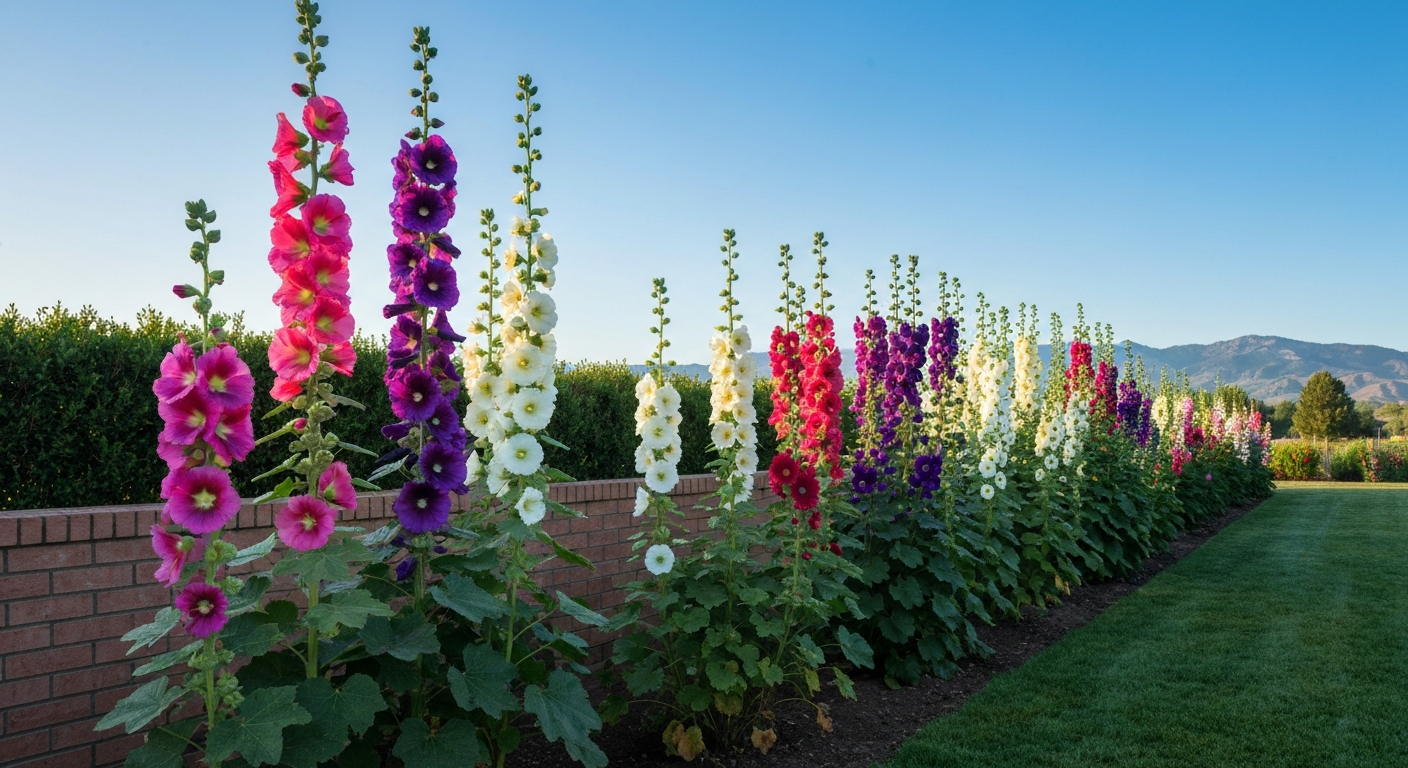
Hollyhocks grow beautifully in Colorado, tall, dramatic spires in hot pinks, reds, creamy whites and deep purples, but you have to work with the state's alkaline soils, short mountain seasons, drying winds and almost inevitable rust pressure rather than pretend those challenges don't exist. The good news is that hollyhocks are genuinely tough plants. Plant them in full sun, give them decent drainage, space them generously so air moves between the stems, water deeply at the root zone rather than overhead, and sow seed at the right time for your elevation. Do those things, and Colorado hollyhocks can put on a show that stops people on the sidewalk.
How to Grow Hollyhocks in Colorado: Complete Guide for Gardeners
Marcus Holloway
17 Jul 2026
Quick seasonal calendar for Colorado
Colorado is not one climate. A gardener in Denver deals with a very different season than someone in Salida or Durango, and the mountains are a world apart from the Eastern Plains. The table below gives approximate sowing, transplanting and key care windows for four broad regions. Always cross-check your specific last and first frost dates using NOAA/NCEI climate normals or the USDA 2023 Plant Hardiness Zone Map for your exact address, these are the authoritative sources and local variation within each region can be significant.
| Region | Approx. Frost-Free Window | Direct Sow Outdoors | Start Indoors | Transplant Out | Fall Cleanup |
|---|---|---|---|---|---|
| Front Range (Denver metro, Fort Collins, Pueblo) — USDA zones 5b–6b | Early May to late Sep/early Oct (~130–150 days) | Mid-May to late June; or late Aug–Sep for biennial overwintering | Late Feb to mid-March (8–10 weeks before last frost) | After last frost: early to mid-May | After first hard frost; remove all rust-infected debris |
| High Plains (Eastern Colorado, La Junta, Lamar) — zones 5b–6a | Late April to mid-October (~150+ days) | May to late June; or August for fall sow | Late Feb to early March | Early to mid-May | October; destroy infected leaf litter |
| Foothills (1,500–2,400 m / ~5,000–8,000 ft) — zones 4b–5b | Mid-May to mid-September (~90–120 days) | Late May to mid-June only; fall sow risky | Early to mid-March | Late May after last frost | September; mulch crown lightly before hard freeze |
| Mountains (above 2,400 m / ~8,000 ft) — zones 3b–4b | Late June to early September (~60–80 days) | Not reliable; indoor start strongly preferred | Late February (10–12 weeks before last frost) | After last frost: mid to late June | August–September; heavy mulch, choose annual types |
Mountain gardeners should strongly consider treating hollyhocks as annuals by starting seeds indoors early and selecting fast-blooming annual cultivars (some can flower the first year from a February indoor start). At high elevations the biennial growth habit, first-year rosette, second-year bloom, can mean you never see a flower before frost kills the plant.
Choosing the right hollyhock for Colorado gardens
The species most widely grown is Alcea rosea, but the hollyhock group includes Alcea rugosa (the roughleaf or Antwerp hollyhock) and various modern hybrids. The choice matters in Colorado because rust, Puccinia malvacearum, is nearly universal here, and cultivar selection is your first and most cost-effective line of defense.
Types and habits
- Alcea rosea: The classic cottage garden hollyhock, typically biennial (rosette first year, blooms second year, self-seeds freely). Highly susceptible to rust.
- Alcea rugosa (roughleaf hollyhock): Single yellow flowers, notably more rust-resistant than A. rosea due to thicker, rougher leaf texture that makes spore adhesion harder. A strong choice for Colorado gardens where rust is a recurring problem.
- Annual/first-year-flowering hybrids (e.g., 'Majorette' series, 'Queeny Purple', 'Summer Carnival'): Bred to flower in the first season from seed. Invaluable for short-season mountain gardens. Flowers are often double, slightly shorter stems.
- Double-flowered varieties (e.g., 'Chater's Double' series): Spectacular but often more rust-prone and need staking. Best for Front Range and Plains sites with longer seasons.
- Halo series hybrids: Known for good vigor and moderate rust tolerance compared with older Chater types.
My honest recommendation for most Colorado gardeners: start with Alcea rugosa or a rugosa-type hybrid for your main planting, and use a first-year annual type (like 'Majorette') as a fast-payoff companion. You get rust resistance plus the instant gratification of seeing blooms the same season you plant. Once you have a healthy stand established and you've dialed in your rust management routine, branch out into the more dramatic double-flowered varieties.
Site selection: light, wind and Colorado microclimates
Hollyhocks need at least 6 hours of direct sun daily, and in Colorado that's rarely a limiting factor, we have around 300 sunny days a year in most of the state. What does limit them is wind. Colorado's Front Range chinook winds, afternoon plains gusts and mountain downslope breezes can snap 6-foot hollyhock stems at the base or shred flowers before they fully open. Choose a site that gets full morning sun but has some shelter from the prevailing west or southwest wind: a south- or east-facing fence line, the leeward side of a garage or outbuilding, or a position backed by a hedge or dense shrub border.
CSU Extension notes that hollyhocks are best adapted to lower elevations and protected sites in Colorado, that advice is worth taking seriously. Even at Front Range elevations, a sheltered south-facing microclimate against a brick wall can push your effective hardiness zone up half a zone and extend the bloom period by two or three weeks. Avoid frost pockets (low spots where cold air pools on still nights) and be cautious about planting in dense shade, which worsens air circulation and dramatically accelerates rust.
- Full sun minimum: 6 hours direct sun, 8+ preferred for best flowering and rust suppression.
- Wind shelter: leeward side of fence, wall, building or dense shrub row — critical above 6,000 ft.
- South or east aspect: maximizes early-season warmth and extends the frost-free window.
- Avoid frost pockets and low-lying areas that hold moisture — these encourage rust and crown rot.
- Good air circulation around plants: don't crowd hollyhocks against walls so tightly that air can't move freely around stems and leaves.
Soil basics for Colorado: alkalinity, drainage and amendments
Here's where a lot of Colorado gardeners run into trouble. Most native soils across the Front Range, Plains and lower foothills are alkaline, with pH values commonly ranging from about 7.0 up to 8.3. At the higher end of that range, micronutrient availability, particularly iron and manganese, drops sharply, and you'll start seeing chlorotic (yellowing) foliage even on plants that are otherwise healthy. Hollyhocks tolerate slightly alkaline soil fairly well, but struggling in pH 8.0+ clay with poor drainage is a different matter.
CSU Extension is admirably honest about the limits of soil acidification in Colorado: calcareous (high-calcium carbonate) soils are extremely resistant to pH change, and while elemental sulfur is the standard acidifying amendment, you'd need impractically large quantities applied over months or even a full year to move the needle meaningfully. I'd steer you away from chasing a pH number and toward a more pragmatic approach: test your soil first (CSU operates a Soil, Water and Plant Testing Laboratory that provides actionable results), then amend with organic matter and address micronutrient deficiencies directly.
Practical amendment steps
- Get a soil test before you do anything else. A CSU Extension soil test tells you your actual pH, organic matter percentage, and nutrient levels. Don't guess.
- Work in 2 to 4 inches of well-rotted compost across the entire planting area and incorporate it 10 to 12 inches deep. This improves water-holding capacity, drainage on heavy clay, and adds slow-release nutrients without dramatically shifting pH.
- If your pH is above 7.8 and you're seeing chlorosis, treat with chelated iron (not iron sulfate, which is quickly neutralized in calcareous soil) applied as a soil drench or foliar spray per label rates. Chelated manganese works the same way for manganese deficiency.
- Don't use large doses of synthetic high-phosphorus fertilizers in alkaline Colorado soil — phosphorus locks up quickly at high pH and ties up zinc as a secondary problem.
- If your drainage is genuinely poor (water sitting for more than 30 minutes after irrigation), raised beds or mounded planting rows are a better long-term fix than amendments alone.
Raised beds, containers and soil mixes for poor native soils
Raised beds are one of the best investments a Colorado hollyhock grower can make, especially on the urban Front Range where compacted clay subsoil and high pH are the default. A 12-inch-deep raised bed filled with a quality blended soil mix gives you immediate control over pH, drainage and organic matter content that would take years to achieve by amending native soil in place. Because hollyhocks have deep taproots, go 12 to 18 inches deep if you can, they'll reward the extra depth with better drought tolerance and stronger stems.
Containers work well for hollyhocks at higher elevations or on patios, with one important caveat: these are big plants, and a single hollyhock in bloom can reach 6 to 8 feet tall. You need a large, heavy container, at least 15 to 20 gallons, to provide root volume, stability against wind, and enough soil mass to buffer moisture and temperature swings. Use a quality potting mix rather than bagged garden soil (which compacts in containers), and add 20 to 25 percent perlite by volume for drainage. Containers dry out faster in Colorado's low humidity and wind, so plan on more frequent watering than in-ground plants.
Recommended soil mix for raised beds and containers
- 40–50% quality compost (well-rotted, not fresh green compost)
- 30–40% topsoil or loam (for raised beds; omit for containers)
- 20–25% coarse perlite or horticultural grit for drainage
- Optional: a handful of granular, slow-release balanced fertilizer (5-5-5 or similar) worked in at planting
- Target pH: 6.5–7.0. Test the mix before planting; most commercial composts are near neutral and will naturally moderate high native soil pH in a raised bed context.
When to sow hollyhock seeds in Colorado
Timing is where Colorado's varied elevations really matter, and getting this right is the single most impactful decision you'll make. Hollyhocks are typically biennial, sown in one season, they build a rosette of foliage and overwinter as a crown, then flower the following summer. In Colorado's short-season mountains, that two-year timeline can be cut short by an early fall freeze before the rosette is established enough to survive. Here's how to think about sowing timing by approach and region. For detailed regional guidance on when to grow hollyhock seeds, see when to grow hollyhock seeds.
Direct sowing outdoors
On the Front Range and High Plains, you have two windows for direct sowing. The first is a spring sow in mid-May through late June, after your last frost. Seeds sown in May will germinate quickly in warm soil, build a good rosette through summer and fall, and flower the following year. The second option, and one I genuinely like for biennial types, is a late-summer fall sow in late August to early September. Sow seeds directly in the ground, let them germinate and establish a small rosette before frost, and they'll overwinter in place and flower the following season with a head start over spring-sown plants. In the foothills and mountains, fall sowing becomes riskier: frosts can come as early as September, and a small seedling caught by an early freeze before it hardens off may not survive. Stick with spring or indoor sowing above about 7,000 feet.
Fall sow vs. spring sow: a practical comparison
| Approach | Best For | Timing (Front Range/Plains) | Timing (Foothills/Mountains) | Bloom Year | Risk |
|---|---|---|---|---|---|
| Fall direct sow | Biennial types, low-elevation sites with predictable fall | Late Aug to early Sep | Not recommended above ~7,000 ft | Following summer | Early frost kills young seedlings before hardening off |
| Spring direct sow | All elevations, beginner-friendly | Mid-May to late June after last frost | Late May to mid-June after last frost | Second summer (biennial) or same year (annual types) | Slow establishment in hot, dry summers without consistent moisture |
| Indoor start (transplant out) | Mountain gardens, first-year bloom, controlled conditions | Start late Feb to mid-March; transplant May | Start late Feb; transplant mid to late June | Same season (with annual/hybrid types) or following year | Transplant shock if hardening off is rushed |
Starting seeds indoors: schedule, setup and hardening off
Starting hollyhocks indoors gives Colorado gardeners a meaningful head start, especially at elevation. For step-by-step instructions on how to grow hollyhock plants, see our detailed guide. The process is straightforward, but a few details separate a strong batch of transplants from a leggy, root-bound mess.
Sowing schedule and setup
- Calculate 8 to 10 weeks before your last expected frost date. For most Front Range gardens that means starting in late February to mid-March. Mountain gardeners at 8,000+ feet can start as early as late February since their transplant date is mid to late June.
- Use individual cells or small pots (3 to 4 inches) rather than flat trays — hollyhocks develop a taproot early and hate having it disturbed. Biodegradable peat or coir pots that go into the ground intact are ideal.
- Fill with a fine-textured seed-starting medium, not garden soil or heavy compost. Moisten the medium before sowing.
- Sow seeds about 6 mm (1/4 inch) deep, one or two seeds per cell. Hollyhock seeds are flat and disc-shaped; press them lightly into the surface and cover.
- Germination temperature: 16 to 21°C (61 to 70°F). A heat mat set to the lower end of this range works well. Seeds typically germinate in 10 to 14 days under these conditions.
- Once seedlings emerge, move them to your brightest window or under grow lights (14–16 hours of light per day). Leggy, pale seedlings are almost always a light problem, not a watering problem.
- Thin to one seedling per cell once the first true leaves appear. Water consistently but let the surface dry slightly between waterings to prevent damping-off fungal issues.
Hardening off: don't skip this step
Hardening off is where I see beginners lose otherwise healthy transplants. Colorado's spring air is dry, windy and intense in UV exposure, dramatically different from a warm indoor growing environment. Start hardening off about 10 to 14 days before your planned transplant date. Set seedlings outside in a sheltered, partly shaded spot for 1 to 2 hours on the first day, then progressively extend exposure over the following days, gradually introducing more direct sun and wind. By day 10, they should be able to handle a full day outdoors. Never put indoor-grown seedlings directly into full afternoon sun and wind on day one, the leaves will desiccate and scorch even when the plant looks structurally fine.
Transplanting out
Transplant after your last frost date, ideally into soil that has warmed to at least 10°C (50°F). Space plants 60 cm (24 inches) apart, this spacing is not just about room to grow, it's critical for air circulation and rust prevention. Water transplants deeply immediately after planting. For the first month, the City of Longmont's ColoradoScaping guidance recommends watering new plantings 2 to 3 times per week deeply, then tapering frequency as roots establish. After the first season, you can shift to deep, infrequent soaks, typically once or twice a week in summer depending on your soil and exposure.
Propagation from root crowns and divisions
Hollyhocks don't divide as neatly as many perennials, they grow from a central taproot and crown rather than spreading rhizomes or clumping fibrous roots. That said, established plants can be propagated from offsets or crown sections, and this is a useful technique when you have a particularly healthy, rust-resistant plant you want to multiply.
When to divide in Colorado
The best window for dividing or transplanting established hollyhock crowns in Colorado is early spring, just as new growth begins to emerge from the crown, typically late April on the Front Range, mid to late May in the foothills. At this point the plant's energy is directed toward new root growth, soil temperatures are rising, and you have a full growing season ahead for the division to reestablish before winter. Fall division is possible in early September on the Front Range but riskier: the plant has less time to regenerate roots before the first hard freeze, and going into winter with a recently disturbed crown increases the chance of winter loss.
How to divide a hollyhock crown
- Water the plant deeply 24 hours before dividing to reduce transplant stress.
- Dig around the crown with a sharp spade, working at least 8 to 10 inches out from the base to minimize taproot damage. Hollyhock taproots go deep — expect to lose some length.
- Lift the crown carefully. Look for natural offset crowns or basal rosettes growing at the edges of the main crown. These are your divisions.
- Use a clean, sharp knife to separate offset crowns from the main plant. Each division needs a piece of crown tissue and at least a few healthy roots attached.
- Dust cut surfaces lightly with powdered sulfur or a diluted copper-based fungicide to reduce infection risk — especially important if rust or crown rot has been present in the garden.
- Replant divisions immediately at the same depth as the original plant, in prepared soil, and water in well. Don't let roots dry out between digging and replanting.
- Shade the newly planted division for 5 to 7 days if transplanting in warm, sunny weather. A floating row cover or a temporary shade screen works well.
Growing hollyhocks from root crowns and divisions is a great way to preserve a specific plant, but for sheer volume and disease control, seed propagation is usually more practical. For step-by-step instructions, see our guide on how to grow hollyhocks from roots. Starting fresh from clean, tested seed each generation also breaks the rust cycle more effectively than dividing from plants that have had rust pressure, and seed from reputable houses is typically cleaned to remove surface spore contamination, since Puccinia malvacearum spores ride on seed debris rather than inside the seed itself. RHS guidance on Hollyhock rust notes that Puccinia malvacearum has not been found inside hollyhock seed embryos but spores can be carried on seed debris, and recommends buying clean, tested seed or seed cleaned/treated by professional seed houses to reduce the chance of introducing rust blank" rel="noopener noreferrer">Hollyhock rust — RHS Advice (notes on seed and spore carriage).
Year-by-year care: watering, feeding, staking and mulching
Watering
Colorado's semi-arid climate means consistent moisture management is critical, especially in the first year. A general guideline of about 1 inch of water per week (rain plus irrigation combined) works well for most established ornamental beds, but the method matters as much as the amount. Always water at the base of plants, not overhead. Overhead irrigation is the single fastest way to accelerate hollyhock rust because it creates the warm, wet leaf surface conditions the fungus loves. Use a soaker hose, drip line or gentle hand watering at ground level. Water deeply enough to wet the root zone 6 to 12 inches down, then let the surface dry before watering again. In Colorado's hot, dry summers this typically means deep watering every 3 to 5 days for established plants, more frequently in sandy Plains soils or during heat waves.
Feeding
Hollyhocks are not heavy feeders and in amended soil with good compost they often don't need much supplemental fertilizer. A single top-dressing of balanced slow-release granular fertilizer in early spring as growth begins is usually enough for the season. Avoid high-nitrogen quick-release fertilizers (yes, this includes Miracle-Gro applied more than once or twice a season): excess nitrogen produces lush, soft foliage that is more susceptible to rust and less able to hold up tall stems in wind. In alkaline Colorado soils where micronutrients are limiting, chelated iron applied in late spring addresses chlorosis more effectively than any general fertilizer.
Staking
Stake hollyhocks early, when plants are about 18 to 24 inches tall, before they need it. A bamboo cane or metal stake driven 12 to 15 inches into the ground beside each stem, with soft ties loosely looped around the stem every 12 to 18 inches as it grows, is the standard approach. In very windy Colorado sites, a triangle of three stakes with soft twine looped around all three works better than a single stake, which can act as a lever and actually damage the stem in a strong gust.
Mulching
A 2 to 3-inch layer of organic mulch around (not directly against) hollyhock crowns conserves soil moisture, moderates soil temperature and suppresses weeds. In Colorado this is especially valuable during the late-spring dry period before summer monsoons arrive. Use wood chip mulch, shredded bark or straw. Pull the mulch back a few inches from the base of each stem to keep the crown dry and reduce crown rot risk.
Overwintering
Established hollyhock crowns are reasonably cold-hardy. Most named varieties handle USDA zones 3 to 9, so Front Range and Plains gardens are well within their cold tolerance. The bigger risk in Colorado winters is not extreme cold but freeze-thaw cycles and desiccation: dry, warm chinook winds in January and February can pull moisture from crown tissue that's sitting in frozen soil. After the first hard frost, cut stems down to within a few inches of the ground, remove and destroy all infected leaf debris (do not compost it, more on that below), and apply a 3 to 4-inch layer of dry mulch over the crown. In mountain gardens above 8,000 feet, add an extra layer of protection with pine boughs or a frost cloth over the mulched crown. Remove mulch gradually in spring as temperatures stabilize.
Managing hollyhock rust and other pests
Hollyhock rust (Puccinia malvacearum) is, bluntly, a near-certainty in most Colorado gardens over time. The pathogen shows up as yellow spots on the upper surface of leaves and orange-brown powdery pustules on the undersides. It overwinters in infected basal leaves and garden debris, and it spreads rapidly when conditions are warm and moist with poor air circulation. CSU Extension's PlantTalk program is specific about this: rust is hollyhocks' most common disease problem, and once established in your soil and debris it keeps coming back year after year.
The key insight from the science is that rust survives in debris, not in the seed embryo itself, which means clean cultural practices genuinely work. This is one of those situations where doing the unglamorous maintenance jobs (picking infected leaves, cleaning up in fall) makes a bigger difference than any spray program. Here's an integrated approach that reflects what CSU Extension and the Pacific Northwest Plant Disease Management Handbook both recommend.
Integrated rust management
- Start with rust-resistant varieties: Alcea rugosa and rugosa-type hybrids are your best first defense. Their rougher, thicker leaves resist spore adhesion.
- Space plants 60 cm (24 in) apart and avoid crowding near walls or other plants that restrict airflow.
- Water only at the base — never overhead. Wet foliage is the primary driver of rust infection.
- Remove infected leaves as soon as you see them throughout the season. Put them in the trash or burn them; do not compost infected material.
- In fall after the first frost, cut all stems to the ground and remove every scrap of leaf debris from the bed. This removes the overwintering inoculum and is the single most effective management step you can take.
- Rotate planting location every 2 to 3 years if possible to break the soil-borne debris cycle.
- If you want to use fungicides, apply preventively when warm, moist conditions are forecast — not reactively after rust is widespread. CSU Extension and PNW handbooks list sulfur, chlorothalonil and myclobutanil as options registered for hollyhock rust in home garden settings. Follow label directions and reapply every 7 to 14 days as directed. Sulfur is the most accessible option for home gardeners and works well as a preventive when applied before infection establishes.
- Buy clean, professionally packaged seed from reputable seed houses. Surface spores on homesaved seed debris are a common way rust re-enters a garden.
Other pests
Beyond rust, hollyhocks in Colorado occasionally deal with spider mites in hot dry summers (knock back with a strong water spray at the base early in the morning, or use insecticidal soap), Japanese beetle damage in urban Front Range gardens (handpick adults early morning when they're sluggish), and occasional aphid colonies on new growth (usually resolved by beneficial insects or a targeted spray of neem oil). Slugs are rarely a problem in Colorado's dry climate but can appear in consistently moist, heavily mulched beds.
Saving seed and encouraging self-seeding
One of the joys of growing hollyhocks is that they self-seed reliably once established, filling gaps in a border and gradually naturalizing to your specific garden conditions. Allow seed heads to fully ripen and brown on the stalk before collecting, the flat, disc-shaped seeds are easy to gather and dry in a paper bag for a week before storing in a cool, dry place. For self-seeding in place, simply leave a few seed heads on the plant and let them drop naturally in late summer. You'll have volunteers the following spring. Just be aware that seeds from hybrid and double-flowered varieties may not breed true, if color and form consistency matter, buy fresh seed each season or select carefully from open-pollinated varieties.
How Colorado compares to other climates
It helps to understand what makes Colorado specifically challenging compared to other regions where hollyhocks thrive. Gardeners growing hollyhocks in Phoenix face the opposite problem: intense heat and aridity mean hollyhocks need afternoon shade and very frequent deep irrigation, and they often behave as winter annuals rather than summer bloomers. At the other extreme, growing hollyhocks in Australia's temperate zones involves higher humidity, which makes rust pressure more intense and requires even more vigilant air circulation management. For region-specific advice, see how to grow hollyhocks in Australia. Colorado's challenge is a combination of alkaline soils (largely absent in both Phoenix's sandy desert soils and Australia's more variable types), dramatic elevation-driven season length variation, and drying winds that stress plants but, interestingly, also tend to keep leaf surfaces drier than humid climates, which can moderate rust somewhat when combined with good cultural practice.
Troubleshooting common Colorado hollyhock problems
| Symptom | Likely Cause | Fix |
|---|---|---|
| Yellow leaves with orange pustules on undersides | Hollyhock rust (Puccinia malvacearum) | Remove infected leaves, improve air circulation, apply sulfur or myclobutanil preventively, destroy all fall debris |
| Pale/yellow leaves between green veins (interveinal chlorosis) | Iron or manganese deficiency from alkaline soil | Apply chelated iron or chelated manganese as soil drench; test soil pH |
| Stunted, very slow growth | Compacted clay soil, waterlogged roots, or pH above 8.0 | Improve drainage, add compost, test soil, consider raised bed |
| Stems flopping or snapping | Wind damage, insufficient staking, or excess nitrogen causing soft growth | Stake early, reduce nitrogen fertilizer, choose a more sheltered site |
| No bloom in year two (biennial types) | Crown killed by hard freeze or freeze-thaw cycle without mulch | Mulch crowns before first hard freeze; ensure crown is not buried too deep |
| Seedlings dying shortly after germination (damping off) | Overwatering indoors + poor air circulation | Allow surface to dry between waterings, improve air circulation, use clean sterile seed-starting mix |
| Plants bloom in first year but die after (expected biennial behavior) | Normal biennial life cycle; not a problem | Allow self-seeding, or replant annually from seed for continuous display |
FAQ
When is the best time to sow hollyhock seed and transplant in Colorado's different elevations?
Lower‑elevation Front Range/Plains: sow seed outdoors in late April–June (after last frost) or sow indoors mid–late spring for transplanting after danger of frost; you can also autumn‑sow for earlier flowering next year. Shorter season/high elevation: start seeds indoors 6–8 weeks before the last frost and transplant only after frost risk has passed, or treat hollyhocks as biennials and autumn‑sow in a protected spot so plants overwinter and bloom year two. Always check your local last‑frost/first‑frost normals (NOAA/CSU) and add a 1–2 week buffer for microclimates.
How should I prepare heavy, alkaline Colorado soils for hollyhocks?
Test your soil first. Instead of trying to markedly lower calcareous pH (slow and often impractical), improve structure and nutrient availability by working in 2–4 inches of well‑rotted compost, loosening compacted clay, and planting on mounded or raised beds for better drainage. Use localized fixes for micronutrient issues (chelated iron or foliar feeds) or grow hollyhocks in containers with an acidic potting mix if iron chlorosis is severe.
Which propagation methods work best for hollyhocks in Colorado?
Seeds: easiest and most common—direct‑sow in spring/early summer or autumn‑sow for overwintering. Indoor sowing mid–late spring for transplanting is fine for short seasons. Transplants: buy healthy plug plants and space ~24 in (60 cm) apart. Division: Alcea species are generally biennial/short‑lived perennials—divide crowns or transplant rooted suckers in early spring if present. Seed is preferred for variety selection and rust‑free sourcing.
How often and how deeply should I water hollyhocks in Colorado?
Establishment: water deeply 2–3 times/week for the first month in low‑elevation Front Range conditions (adapt per soil texture). After established, switch to deep, infrequent watering that wets the root zone (6–12 in), using roughly 1 inch/week (rain + irrigation) as a starting guideline and adjusting for elevation, heat, and soil drainage. Avoid frequent shallow watering and overhead watering during warm humid periods to reduce disease risk.
What fertilizing and mulching practices help hollyhocks thrive in semi‑arid Colorado gardens?
Soil test first to guide fertilizer rates. Work compost into the bed annually and apply a balanced slow‑release fertilizer in spring if growth is weak. Mulch 2–3 in around plants to conserve moisture and moderate soil temperature—keep mulch away from crowns to prevent rotting. For alkaline soils, organic matter improves micronutrient availability more practically than bulk pH change.
How should I stake and prune tall hollyhock stems in windy Colorado sites?
Space plants well for airflow. Stake tall stems early with bamboo canes or use vertical supports/netting, tying stems loosely to avoid trunk damage. Remove faded flower spikes to encourage further bloom and cut back spent material in autumn to reduce overwintering disease. For biennial habit, cut down in late fall after seed set or leave a few seedheads for self‑sowing if rust pressure is low.