
Azaleas grow well in the UK when you get three things right: acid soil (pH 5.0–6.0), a sheltered spot with dappled or morning light, and enough moisture through dry spells. Miss any one of those and you'll get poor flowering, yellowing leaves, or a plant that just sits there looking miserable. Get all three right and you'll have one of the most spectacular flowering shrubs a British garden can offer, with blooms from April through June depending on the variety.
How to Grow Azaleas UK: Complete Care Guide for Gardeners
Marcus Holloway
12 Aug 2026
What this guide covers and who it's for
Whether you've just bought your first azalea from a garden centre or you're planning a full woodland-edge border, this guide walks you through everything from choosing the right variety to diagnosing why your plant won't flower. I've tried to make it genuinely useful for beginners who want a clear starting point, while going into enough detail that experienced growers can troubleshoot confidently. The focus is the UK climate, but where UK advice differs meaningfully from warmer conditions (such as in Australia or the southern United States), I'll flag that too. For gardeners in the southern United States, see our guide on how to grow azaleas in Florida for region-specific advice on heat, humidity and suitable cultivars. You'll also find a monthly care calendar at the end so you always know what to do next.
Azaleas vs rhododendrons: what's actually different
This is one of those things that confuses almost everyone, including people who've been gardening for years. Botanically, every azalea is a rhododendron. They're all members of the genus Rhododendron within the family Ericaceae. The name 'azalea' is a horticultural label, not a scientific one, used to refer to two subgroups: the evergreen azaleas (mainly from the Tsutsusi subgenus, including Kurume and Indica types) and the deciduous azaleas (mainly Pentanthera, including Mollis and Ghent hybrids). So when you see a guide on how to grow rhododendrons and azaleas together, it's not redundant, the two labels just highlight different groups within the same genus.
Horticulturally, you can usually tell an azalea apart from a typical rhododendron by its smaller, thinner leaves and its flower structure. Azalea flowers typically carry 5 to 7 stamens, while most rhododendrons carry 10 or more. In the garden, this distinction matters because the two groups can behave slightly differently in terms of hardiness, pruning response, and how aggressively they grow. Azaleas are generally more compact, which makes them easier to fit into smaller gardens and containers. For detailed care of the broader rhododendron genus, the principles in this guide apply closely, but it's worth consulting a dedicated rhododendron guide for the larger-leaved species.
Choosing the right azalea variety for the UK
Variety selection is where a lot of gardeners go wrong. There are hundreds of azalea cultivars and not all of them are suited to the UK's climate, particularly in colder parts of Scotland, the north of England, or exposed coastal gardens. The RHS hardiness rating system runs from H1a (tropical) to H7 (very hardy), and for most of mainland UK you want varieties rated H4 (tolerating down to around -10°C) or H5 (down to around -15°C). See RHS – RHS hardiness rating (definitions H1a–H7) for the full definitions and temperature ranges used to match cultivars to your microclimate. Always check the hardiness rating on the plant label or RHS plant finder entry before buying.
The RHS Award of Garden Merit (AGM) is a reliable shortcut here. AGM varieties have been trialled under UK conditions and proven reliable. Some consistently recommended AGM cultivars include 'Dreamland', 'Fantastica', 'Bashful', 'Caroline Allbrook', 'Crete', and 'Hydon Dawn', all of which perform well in typical UK garden conditions. For deciduous azaleas with brilliant autumn colour as well as spring flowers, look at Mollis hybrids or Ghent azaleas. For evergreen varieties that hold their foliage year-round and give a tidier winter presence, Kurume and Japanese azalea types are excellent choices.
If you're gardening in a warmer climate such as Australia, the calculus changes somewhat. For growers in warmer parts of the United States (for example, Oklahoma) see how to grow azaleas in Oklahoma for region-specific advice on heat tolerance, drought management and suitable cultivars. Indica azaleas (tender evergreen types that struggle in cold UK winters) thrive in subtropical and warm-temperate Australian conditions, and you'll have far more variety choice. In those warmer environments, the bigger challenge tends to be heat and drought tolerance rather than frost hardiness, so focus on indica hybrids bred for warmth and choose sheltered spots with afternoon shade to prevent leaf scorch and bud drop.
| Group | Deciduous or Evergreen | Typical Hardiness (RHS) | Best for UK Use | Key Traits |
|---|---|---|---|---|
| Kurume hybrids | Evergreen | H4–H5 | Yes, across most of UK | Small flowers, compact habit, good for containers |
| Japanese azaleas (e.g., 'Hino Crimson') | Evergreen | H4–H5 | Yes | Low spreading, good ground cover, reliable bloomer |
| Mollis hybrids | Deciduous | H5–H6 | Yes, especially north UK | Large flowers, strong autumn colour, very hardy |
| Ghent hybrids | Deciduous | H5–H6 | Yes | Fragrant, tall, good woodland planting |
| Indica hybrids | Evergreen | H2–H3 | Mild UK areas only / containers | Large showy flowers, poor cold tolerance |
| Knap Hill / Exbury hybrids | Deciduous | H5 | Yes, excellent UK choice | Very large flowers, wide colour range, robust |
When to plant and how UK climate affects timing
The RHS recommends planting azaleas in October or in March and April. Those two windows exist for good reason. October planting lets roots establish before the ground freezes, taking advantage of still-warm soil. March and April planting catches the soil as it warms up but before the heat and drought of summer put newly planted shrubs under stress. I'd generally favour autumn planting for container-grown plants if your soil drains well, because you'll have much less watering work to do over winter. If you're in a colder region or planting something of borderline hardiness, spring planting is safer as it avoids the risk of a newly planted azalea getting hammered by a harsh first winter.
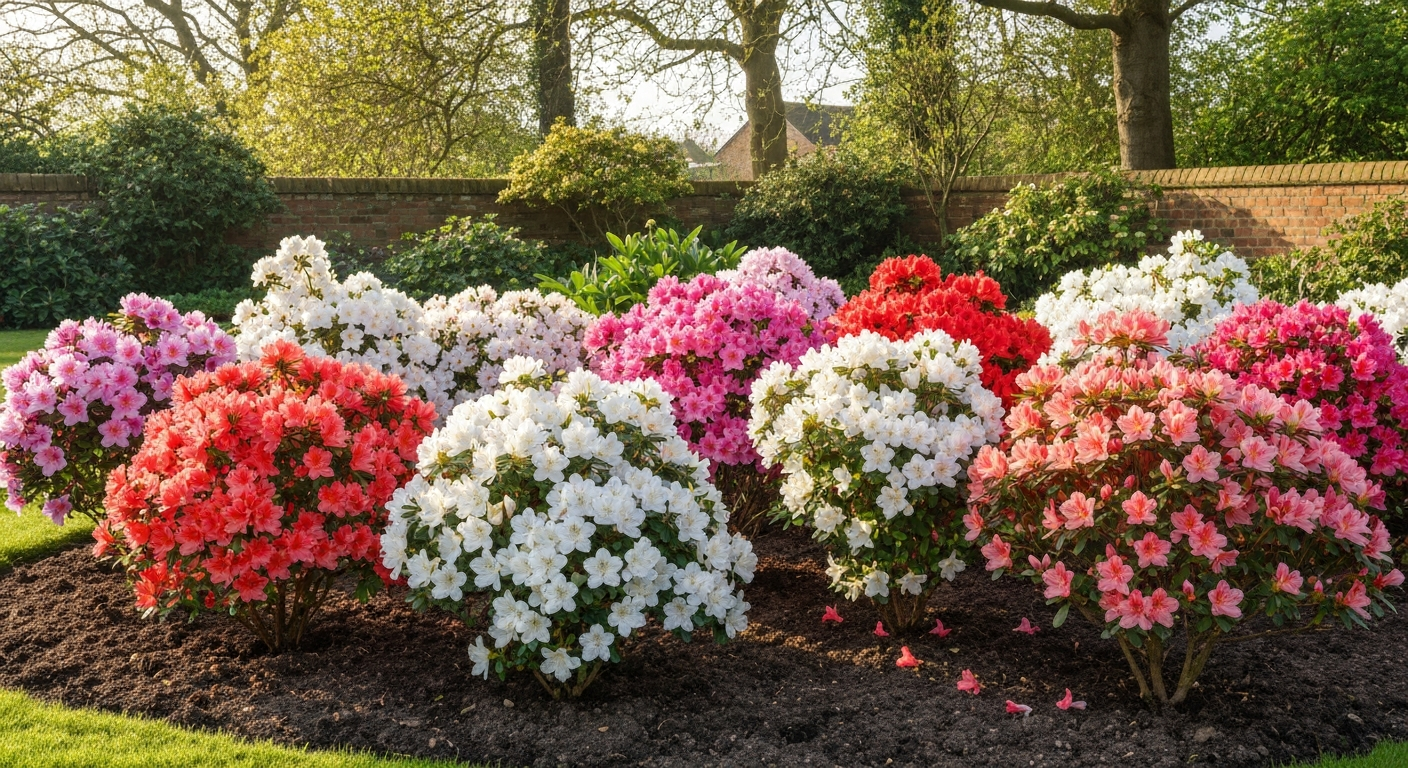
Bloom timing in the UK varies by type. Early-flowering azaleas (such as some Kurume types and the Wilson azalea) open from late March into April. Mid-season varieties bloom through May. Late-flowering deciduous types like some Exbury hybrids can carry on into June. If you plant a mix of early, mid, and late-season cultivars you can have azalea colour in the garden for two full months, which is genuinely worth doing if you have the space. Microclimates matter a lot here: a south-facing garden in Surrey will see blooms two or three weeks ahead of a north-facing slope in Yorkshire, even with the same variety.
Picking the right spot: light, shelter and drainage
Azaleas naturally grow at the edges of woodland, which tells you a lot about what they want. Dappled shade or partial shade is ideal. A spot that gets morning sun and afternoon shade is close to perfect in the UK, protecting flowers from the intensity of midday sun (which fades blooms faster) while giving enough light for good bud development. Full deep shade produces leggy, sparse plants that flower poorly. Full sun can work on a north-facing slope or in northern England and Scotland where summer sun is less intense, but in a south-facing English garden you risk scorching the foliage and shortening bloom life.
Shelter from cold easterly winds is important, particularly for early-flowering varieties whose buds open when late frosts are still a risk. A position near a wall, a fence, or the canopy of larger trees all help. Avoid frost pockets, which are low-lying areas where cold air collects on still nights. These can damage or destroy open flowers on an otherwise perfectly hardy plant. Also avoid planting directly under the drip line of trees such as beech, whose surface roots compete aggressively with azaleas and whose canopy often creates dry shade, exactly the wrong combination.
Drainage is non-negotiable. Azaleas are shallow-rooted and will rot in waterlogged soil. If you dig a test hole and it fills with water and stays filled for more than an hour, you need to either improve drainage before planting or grow your azaleas in raised beds or containers instead. Ideally, you want soil that holds moisture (so the plant doesn't dry out in summer) but drains freely after rain. This balance is easier to achieve in loamy or sandy-loam soils than in heavy clay, though clay can be improved.
Getting the soil right: pH, structure and the ericaceous question
Azaleas need acid soil and this isn't negotiable either. The target pH is 5.0 to 6.0. Below pH 5.0 the soil becomes too acidic and some nutrients become unavailable. Above pH 6.5 you'll see yellowing leaves (chlorosis) caused by iron and manganese deficiency, poor flowering, and a plant that declines year by year no matter how much you water and feed it. Test your soil pH before you plant. Basic pH test kits from any garden centre are accurate enough for this purpose, or you can send a sample to a soil analysis lab for a more detailed report.
If your soil is alkaline, be honest with yourself about what's achievable. The RHS is quite direct on this: reducing soil pH significantly is not simple and is rarely a long-term solution in a garden with naturally chalky or limestone-based soil. You can lower pH incrementally by incorporating acidic materials like sulphur chips, composted pine bark, or ericaceous compost, but in a garden with a naturally high pH the soil will gradually revert. For alkaline gardens, the realistic answer is to grow azaleas in containers filled with ericaceous compost, or in raised beds isolated from the surrounding soil with a membrane and filled with an acid growing medium.
For gardens with naturally acid or neutral soil (pH 6.0–6.5), you have more options. Incorporating acidic organic matter like leaf mould (especially pine or oak leaf mould), composted bark, or proprietary ericaceous compost into the planting area will usually bring pH into range and improve structure at the same time. Avoid adding lime, chalk, or alkaline manures such as mushroom compost, which will push pH in the wrong direction.
Preparing the planting area
For heavy clay soil, dig the planting area to two spade depths and work in coarse organic material such as composted bark or coarse grit. This improves both drainage and aeration, both of which azalea roots need. Don't create a beautifully dug, perfectly enriched planting hole surrounded by hard clay, because this creates a sump where water collects around the roots. Improve a wider area than just the planting hole, or raise the planting level slightly so water drains away from the rootball rather than pooling beneath it.
For free-draining sandy soil, one spade depth is usually enough. The priority here is adding organic matter to improve moisture retention, composted bark and leaf mould both work well. Sandy soils dry out quickly and azaleas are drought-sensitive, particularly in their first two seasons, so building in water-holding capacity before planting pays dividends later. In both soil types, remove perennial weeds thoroughly before planting, particularly couch grass and bindweed, as they're very hard to remove once an azalea is established.
Planting step by step
Container-grown plants (most common)
- Water the plant thoroughly in its pot at least an hour before planting so the rootball is fully moist.
- Dig a planting hole roughly twice the width of the rootball and no deeper than its height.
- Loosen the sides and base of the hole with a fork so roots can penetrate outwards.
- Remove the plant from its pot and gently tease out any circling roots from the outer surface of the rootball.
- Place the rootball in the hole so the top of the rootball sits just at or very slightly (1–2 cm) above the surrounding soil level. Azaleas are shallow-rooted and planting too deep is a very common cause of failure.
- Backfill with a mix of the original soil and ericaceous compost or composted bark, firming gently as you go to remove air pockets.
- Water in thoroughly, then apply a 7.5 cm (about 3 inches) layer of mulch around the plant, keeping it a few centimetres clear of the stem.
- Water again two to three times per week for the first four to six weeks if rainfall is insufficient, then transition to the regular watering regime below.
Bare-root plants
Bare-root azaleas are available mainly through specialist nurseries and are best planted during dormancy, typically November through to early March. Soak the roots in a bucket of water for one to two hours before planting. Follow the same depth guidance as for container plants: the point where the roots meet the main stem should sit just at soil level, not buried. Firm soil in carefully around the roots and water in well. Bare-root plants often look alarming in their first spring, but be patient, they usually establish well once soil warms up.
Balled plants (root-balled)
Balled plants come with their rootball wrapped in hessian or netting. Plant them without removing the hessian, which will rot away naturally. Remove any plastic ties or non-biodegradable netting before backfilling. The same depth rules apply: don't bury the plant deeper than it was growing before. These plants are typically larger specimens and benefit from staking if they're in an exposed position, using a short stake angled at 45 degrees to avoid damaging the rootball.
Watering: getting through establishment and beyond
Azaleas are not drought-tolerant plants, especially in their first two years while their root systems are still developing. They need consistently moist (not waterlogged) soil. In the UK, you'll rarely need to water between October and April, but from May onward, and particularly from July through September, check the soil regularly and water during dry spells. The RHS specifically recommends starting regular watering from July onwards during dry conditions. Don't wait for the plant to wilt, by the time you see wilting stress the plant has already been under pressure for days.
One detail that makes a real difference, particularly in areas with hard tap water: use rainwater where possible. Tap water in many parts of England is alkaline and contains dissolved calcium and magnesium, which gradually raises the pH of the rootzone and can cause the chlorosis you were trying to avoid. A water butt is a worthwhile investment if you're growing azaleas in pots or in a borderline-pH garden. For established plants in good acid soil, tap water is generally fine in moderation, but consistent use of very hard tap water over years can nudge soil pH upward.
When you do water, water deeply and thoroughly rather than giving little and often. A shallow daily splash encourages shallow rooting. Instead, soak the root zone properly every few days during dry weather, allowing the top couple of centimetres to dry slightly between waterings. For container plants, water until it drains freely from the base, then wait until the top of the compost feels just dry before watering again.
Feeding and mulching
If your azalea is growing in genuinely good acid garden soil, it probably doesn't need much feeding at all. The RHS makes this point clearly: in decent acid soil, rhododendrons and azaleas are unlikely to need additional fertiliser. The risk of over-feeding is at least as real as the risk of under-feeding. Too much nitrogen produces lush soft growth at the expense of flowers, and feeding in late summer encourages tender new growth that gets damaged by early frosts.
Where feeding does help is for container plants and for plants in poorer soils showing signs of nutrient deficiency (pale or yellowing leaves in the growing season). For these, apply a slow-release granular ericaceous fertiliser in spring, following the manufacturer's rate (and I'd err toward the lower end rather than piling it on). A formulated liquid ericaceous feed applied fortnightly from May to the end of July can supplement this for containers. Stop all feeding by the end of July to avoid encouraging late soft growth.
Mulch is arguably more important than fertiliser for azaleas. Apply a 5 to 7.5 cm layer of organic mulch, such as composted bark, chipped bark, leaf mould, or well-rotted garden compost, in late autumn through to late winter. Renew and replenish it each spring. Mulch does three jobs at once: it insulates the shallow roots from temperature extremes, conserves soil moisture, and as it breaks down gradually improves soil structure and (with acidic materials like bark or leaf mould) helps maintain a lower pH. Keep mulch a few centimetres away from the main stem to prevent rot.
Light requirements: more nuance than 'partial shade'
The advice to plant azaleas in partial shade is correct but incomplete. What azaleas really want is bright, indirect light for most of the day, with shelter from harsh midday sun. Morning sun is excellent: it warms the plant and dries off overnight dew, reducing fungal problems. Afternoon shade protects flowers from fading and prevents the soil surface from drying out rapidly. In northern UK gardens with less intense summer sun, azaleas can often handle more direct sun than the same variety could manage in Surrey or Kent.
Deep shade (such as the north side of a tall fence or the interior of a dense canopy) produces plants that are healthy enough but flower poorly, because azaleas need sufficient light to set flower buds for the following season. If your azalea is in deep shade and producing plenty of foliage but very few flowers, light is almost certainly a contributing factor. Thinning out overhanging branches to let in more dappled light often triggers a noticeable improvement in flowering within one to two seasons.
Pruning: timing is everything
The single most important thing to understand about pruning azaleas is that they flower on wood produced in the previous year. Prune at the wrong time, specifically in late summer or autumn, and you cut off the buds for next year's flowers before they've even had a chance to open. The rule is simple: prune immediately after flowering. That means May or June for most UK azaleas, depending on when they bloom.
Deadheading
Snap off spent flower trusses by hand immediately after they fade. This is worth doing because it redirects the plant's energy from seed production into building stronger growth and better buds for next year. For azaleas this is a light task, the trusses snap off cleanly at the base. Be careful not to damage the small leaf buds that form just below each truss.
Light shaping
If your azalea is getting leggy or lopsided, do any shaping immediately after flowering using sharp, clean secateurs or loppers. Remove crossing branches, cut back any particularly long growth to a healthy outward-facing bud, and aim to maintain an open, natural shape rather than clipping it into a formal ball (which looks unnatural and reduces airflow). For most established azaleas, this kind of light tidy-up every two to three years is all that's needed.
Renewal pruning
For deciduous azaleas that have become overgrown or are flowering poorly due to old dense wood, harder pruning is an option and they respond to it better than most evergreen types. Cut back old, woody stems to within 30–45 cm of the ground immediately after flowering. The plant will look alarming for the rest of the season but should push strong new growth through summer. Don't do this to evergreen azaleas unless you have no choice, they can take several years to recover from hard pruning. Always use clean, sharp tools and wipe blades with a disinfectant solution between cuts to reduce the risk of spreading disease.
Seasonal care through the year
Spring (March–May)
Spring is the most exciting and most demanding season for azalea care. Check for frost damage on early-opening buds and protect with horticultural fleece on forecast frost nights. Replenish mulch if it has broken down over winter. Begin watering if spring is dry. Apply granular ericaceous fertiliser to container plants at the start of the season. Plant new azaleas in March or April. Deadhead and do any light pruning immediately as flowers fade.
Summer (June–August)
Summer is largely about keeping moisture consistent. Water regularly from July if rainfall is below average, using rainwater where you can. Stop feeding by the end of July. Watch for pests, particularly vine weevil in containers and lacebug on foliage (look for pale stippling on the upper leaf surface and dark spotting underneath). This is also the window for taking semi-ripe cuttings for propagation.
Autumn (September–November)
Autumn is planting season for new azaleas and a good time to plant container-grown specimens. Apply a fresh layer of mulch from October to insulate roots before winter. Check drainage: if water is sitting around plants after rain, address this now rather than leaving plants to sit in waterlogged soil all winter. Move container plants to a sheltered position if they're of borderline hardiness.
Winter (December–February)
In a normal UK winter, hardy azaleas need minimal intervention. The main risks are waterlogging (which mulch and good drainage manage) and severe frost on evergreen foliage. For marginally hardy varieties or container plants, wrap the pot in bubble wrap or hessian to insulate the rootball, and move containers to a frost-free shed or greenhouse during prolonged very cold spells. Don't prune during winter. Don't feed. Dormancy is important for bud development.
Growing azaleas in containers
Container growing is the best solution for anyone with alkaline soil, and it genuinely works well. Azaleas are well-suited to pots because they have compact root systems and don't need enormous containers to thrive. Choose a pot that is proportionally sized to the plant, one that leaves roughly 5–7 cm of growing room around the rootball. Terracotta pots look wonderful but dry out quickly; plastic or glazed pots retain moisture better, which suits azaleas.
Fill with a peat-free ericaceous compost. The RHS recommends a loam-based ericaceous mix (a combination of John Innes with ericaceous compost), which holds structure better than pure ericaceous compost over time. Pure peat-free ericaceous compost can break down and compact over two to three seasons, reducing aeration and drainage, so check the compost condition annually and repot or refresh as needed. Repot every other year into a slightly larger container, or in intervening years remove the top 5 cm of old compost and replace it with fresh ericaceous mix.
Drainage holes are essential. Stand the pot on feet or pot feet to keep drainage holes clear. Water container azaleas regularly, they dry out far faster than in-ground plants and are very sensitive to drought stress in pots. Feed with a liquid ericaceous fertiliser fortnightly from May to the end of July. In winter, insulate the pot to protect roots from hard freezes, which damage pot-grown roots much more quickly than the same temperatures affect in-ground plants.
Propagation: cuttings and layering
Semi-ripe cuttings (evergreen azaleas)
This is the most reliable propagation method for named evergreen cultivars, which won't come true from seed. Take cuttings from mid to late summer (July to August in the UK), when the current season's growth has firmed up slightly but is not yet fully woody. Choose healthy shoot tips 7–10 cm long, cutting just below a leaf node with a clean, sharp blade. Remove the lower leaves and any flower buds. Wound the lower 1–2 cm of the cutting by scraping the bark lightly on one side with a knife to expose the green tissue beneath. Dip in hormone rooting powder or gel, then insert into a mix of equal parts perlite and peat-free ericaceous compost. Cover with a propagator lid or clear polythene bag to maintain humidity, and place in a warm spot out of direct sun. Rooting typically takes 8–12 weeks. Pot on individually once rooted and overwinter in a frost-free place.
Simple layering
Layering is lower-effort and has a very high success rate, making it my preferred method for home gardeners. In spring or early summer, select a young, flexible low-growing stem. Make a shallow upward-angled cut partway through the stem about 30–40 cm from the tip, dust the cut with rooting hormone, and wedge the cut open with a small stone or matchstick. Pin the stem into a shallow depression in the soil (or into a pot of ericaceous compost placed next to the plant), using a piece of bent wire to hold it in place. Cover with a thin layer of soil and keep moist. Roots typically form within 6–12 months. Once rooted, sever the connection to the parent plant and leave the new plant in place for a few more weeks before carefully lifting and potting or transplanting it.
A note on seed
Seed propagation is only reliable for species (not hybrids or named cultivars), which won't come true from seed. If you want to reproduce a specific named cultivar, always use cuttings or layering. The RHS is clear on this point: named cultivars must be propagated vegetatively to maintain their characteristics.
Moving established plants: how to transplant azaleas
Azaleas transplant better than many shrubs because their roots are compact and fibrous rather than deep and anchoring. The best time to move them is in autumn (October) or early spring (March), when the plant is not in active growth or in flower. Prepare the new planting hole before you lift the plant. Water the plant well 24 hours before lifting. Dig around the plant at least 30–40 cm out from the main stems to preserve as much of the root system as possible. Lift the whole rootball intact and move it directly to the new hole. Replant at the same depth as it was growing before, water in thoroughly, mulch, and water regularly for the rest of the growing season. Azaleas moved with care in the right season establish surprisingly quickly.
Why your azalea isn't flowering (and how to fix it)
Poor or no flowering is the most common complaint from azalea growers, and the causes are almost always one of four things. First, pruning at the wrong time: if you pruned in late summer or autumn you've cut off next year's buds. There's no fix for this season, but stop pruning at the wrong time and flowering will resume. Second, too much shade: plants in deep shade simply don't develop enough buds. Improving light levels by opening up the canopy above will usually pay off within a season or two. Third, bud blast: this is a fungal disease spread by the rhododendron leafhopper, which lays eggs into buds in late summer. The buds turn brown and fail to open. The fix involves controlling leafhoppers with netting or insecticide and removing and destroying affected buds. Fourth, drought-induced bud drop in late summer: lack of moisture from July to September when buds are forming causes them to drop. Consistent watering during that period prevents this.
Common pests and diseases
| Problem | What to look for | Main cause / conditions | Practical treatment |
|---|---|---|---|
| Vine weevil | Notched leaf edges; plant wilts and collapses (grubs eat roots) | Mainly containers; adults active April–October | Use nematodes (Steinernema kraussei) in August–September; use vine weevil barrier glue on pot feet for adults |
| Rhododendron leafhopper | Wedge-shaped pale green insects on leaf undersides from summer | Warm dry summers; transmits bud blast fungus | Netting to exclude; contact insecticide if severe; remove affected buds |
| Lacebug | Pale stippled upper leaves; dark tar-like spotting on undersides | Dry, hot summers; south-facing sunny positions | Improve humidity; neem oil or insecticidal soap sprays on undersides |
| Powdery mildew | White powdery coating on upper leaf surface | Poor air circulation, dry roots | Improve drainage and airflow; remove affected leaves; fungicide if persistent |
| Root rot / Phytophthora | Sudden wilting, dark stem at base, soggy roots | Waterlogged soil | Improve drainage immediately; no chemical cure for established infection; remove and destroy severely affected plants |
| Azalea gall | Pale green or red fleshy galls on leaves or shoots | Fungal infection (Exobasidium), worse in wet conditions | Remove and destroy galls before they turn white; improve air circulation |
| Scale insects | Brown waxy bumps on stems; sticky honeydew | Any time, often unnoticed until severe | Rub off manually; use a plant oil wash in spring when crawlers are active |
| Aphids | Clustered soft-bodied insects on new growth | Spring flush of new growth | Blast off with water; predatory insects usually handle light infestations; insecticidal soap for heavier outbreaks |
Monthly care calendar for UK gardeners
| Month | Key tasks |
|---|---|
| January–February | Check mulch, top up if thin. Protect container plants from hard freezes. No pruning, no feeding. |
| March | Plant new azaleas. Replenish mulch. Apply slow-release ericaceous fertiliser to containers. Begin checking soil moisture. |
| April | Continue planting. Protect early open flowers from frost with fleece on cold nights. Deadhead as flowers fade. |
| May | Deadhead and carry out light shaping immediately after flowering. Begin regular watering if dry. Apply liquid feed to containers. |
| June | Complete pruning. Continue watering. Take softwood cuttings from deciduous azaleas if desired. Start layering. |
| July | Water regularly; switch to rainwater where possible. Begin semi-ripe cuttings of evergreen azaleas. Last liquid feed of season. |
| August | Continue watering during dry spells. Stop feeding by end of month. Apply vine weevil nematodes to containers. Check for lacebug. |
| September | Continue watering. Begin planting new azaleas from mid-month. Check drainage ahead of autumn rain. |
| October | Prime planting month. Apply mulch layer 5–7.5 cm deep. Move tender container plants to shelter. |
| November | Finish planting bare-root azaleas. Insulate containers. No pruning or feeding. |
| December | Dormancy. Protect from waterlogging. No feeding, no pruning. Check pot insulation during cold spells. |
Companion plants and garden design with azaleas
Azaleas are at their best in woodland-style planting schemes alongside other acid-loving shrubs. Rhododendrons make natural companions (and for planting a mixed rhododendron and azalea border the principles in this guide apply equally to both). Camellias, pieris, and kalmia all share the same soil requirements and create a layered planting with different flowering seasons. Pieris in particular is excellent because its brilliant red new growth in spring echoes the colour of azalea flowers while giving the border something interesting before and after the main bloom. For a guide to the closely related rhododendron species, the care principles overlap substantially with what's covered here. For advice on planting and caring for common lilac, see our short guide on how to grow Syringa vulgaris (common lilac). For a full guide on how to grow rhododendrons and azaleas, see the dedicated how to grow rhododendrons and azaleas resource for detailed species-specific care and troubleshooting. For a detailed, dedicated walkthrough of rhododendron care and species selection, see our guide on how to grow rhododendron plant.
Under and around azaleas, low-growing acid-tolerant ground covers work beautifully. Creeping phlox, heathers (Calluna and Erica varieties in well-drained acid soil), and foxgloves (Digitalis purpurea, which self-seeds freely in acid woodland conditions) all complement the scale and flowering period of most azaleas. Ferns, particularly Dryopteris species, fill the space around deciduous azaleas elegantly and cover the bare winter stems without competing aggressively for resources.
For small gardens or courtyard spaces, a single well-chosen azalea in a handsome glazed container planted with trailing ivy or small-leaved heuchera around the base creates a complete, low-maintenance acid-loving display. The container approach also lets you bring the colour wherever you most want it, a doorstep in full bloom in May is genuinely one of the highlights of the British gardening calendar, and azaleas deliver it reliably when their basic needs are met.
FAQ
What spot in my UK garden is best for azaleas?
Choose a sheltered, partially shaded site (dappled light or light shade) away from cold prevailing winds and frost‑pockets. Avoid heavy root competition (e.g., under large trees) and locations that waterlog; azaleas are shallow‑rooting so need free‑draining but moisture‑retentive soil. If your garden is alkaline or very exposed, use containers or raised beds with ericaceous compost.
What soil do azaleas need and what pH should I target?
Azaleas prefer acidic, humus‑rich soil with good structure. Aim for pH c.5.0–6.0. Improve heavy clay by digging two spade depths and adding coarse organic material (composted bark, leaf mould) and grit for drainage; in sandy soil add composted bark or loam to retain moisture. In alkaline gardens use ericaceous compost or containers—don’t attempt large rapid pH changes in heavy soil.
When and how deep should I plant azaleas in the UK?
Best planting times are autumn (October) or spring (March–April). Plant so the top of the rootball is level with or just below soil level—azaleas are surface‑rooting and must not be planted too deep. Backfill with improved, acid soil (or ericaceous mix), firm lightly, water thoroughly and apply a 5–7.5 cm mulch of bark/leaf mould. Protect newly planted roots from drying.
Which azalea varieties suit the UK climate?
Look for RHS‑rated cultivars with suitable hardiness (H4–H5 for most of the UK). AGM winners and trial favourites include Kurume/Indica types, yakushimanum hybrids and select named cultivars (e.g., 'Dreamland', 'Fantastica', 'Caroline Allbrook'). Choose evergreen or deciduous types to suit site and desired seasonality; check the plant’s hardiness rating for your microclimate.
How often and how much should I water azaleas?
Keep the rootzone consistently moist but not waterlogged. Water thoroughly at planting and during dry spells—especially from July onward. In summer, aim for deep, infrequent watering rather than frequent light wettings so water penetrates the root zone. In hard‑water areas use rainwater where possible to preserve soil acidity. Mulch conserves moisture and protects shallow roots.
Do azaleas need feeding? If so, when and what should I use?
In good acidic garden soil extra feeding is often unnecessary. For containers or poor soils apply a slow‑release ericaceous fertiliser in spring or use a balanced acidic liquid feed during the growing season. Avoid late‑summer/early‑autumn feeds that spur soft growth before winter. Do not over‑fertilise—follow product rates.