
You can grow beautiful hydrangeas all across Michigan, but the species you choose matters enormously. Hydrangea paniculata and H. arborescens (smooth hydrangea) are the workhorses here: both are rated to USDA zone 3 and will survive an Upper Peninsula winter without fuss. Bigleaf hydrangeas (H. macrophylla), the showiest mopheads and lacecaps, are far less reliable north of roughly Lansing unless you give them a sheltered spot and winter protection. Get the species right for your zone first, and almost everything else falls into place.
How to Grow Hydrangeas in Michigan: Zones, Planting & Care
Marcus Holloway
13 Jul 2026
Quick-Start Checklist for Michigan Hydrangea Growers
Before diving into the details, here is the practical fast-track. These are the decisions and tasks that matter most for getting Michigan hydrangeas off to a strong start.
- Identify your USDA zone (3b–6b depending on your county) before buying any plant.
- Choose H. paniculata or H. arborescens for zones 3b–5a (Upper Peninsula, northern Lower Peninsula); add H. macrophylla or H. quercifolia only in zones 5b–6b (southern Lower Peninsula) or sheltered microclimates.
- Plant in spring after your last frost date, or in early fall at least 6–8 weeks before your average first hard freeze.
- Dig your hole 1.5–2x the width of the root ball but no deeper; set the crown at or just slightly above grade.
- Water deeply at planting and maintain roughly 1 inch of water per week through the first growing season.
- Mulch 2–3 inches of shredded bark or wood chips around the base, keeping it away from the crown.
- Test soil pH before planting; target pH 5.5–6.5 for most species (lower, around 4.5–5.5, if you want blue mopheads).
- Skip fall fertilizing entirely; feed in spring only, following a soil test.
- For Upper Peninsula and northern Lower Peninsula plants, wrap stems loosely with burlap or pile on 6–8 inches of shredded leaves in late October before hard frost.
- Prune paniculata and arborescens in late winter/early spring; prune macrophylla and quercifolia right after they finish blooming in summer.
Michigan's USDA Zones and Why Microclimates Change Everything
The 2023 USDA Plant Hardiness Zone Map places Michigan across a surprisingly wide range: the coldest corners of the Upper Peninsula sit in zones 3b–4a, the northern Lower Peninsula runs through zones 4b–5a, and southeastern and southwestern Lower Michigan reaches zones 5b–6b. That is a difference of roughly 20 degrees Fahrenheit in average annual minimum temperatures from one end of the state to the other, which is the difference between a panicle hydrangea sailing through winter unprotected and a bigleaf hydrangea dying to the ground every January.
What the zone map cannot show you is the microclimate on your specific property. Lake Michigan's eastern shoreline (the so-called 'Fruit Belt' from Benton Harbor to Traverse City) stays warmer later into fall and cools more slowly in winter because of the lake's thermal mass. Gardeners in Saugatuck or South Haven can often push a zone warmer than the map suggests, meaning a bigleaf hydrangea that struggles in Kalamazoo inland might thrive just 20 miles west near the lakeshore. Conversely, low-lying inland spots collect cold air on still nights and can be half a zone colder than nearby hillsides. Before you buy, look up your county or ZIP code using the 2023 USDA interactive map or MSU Enviroweather, which tracks actual soil temperatures and growing degree days at weather stations across the state. That extra 10 minutes will save you years of disappointment.
Which Hydrangea Species Belong in Michigan
Four species do the real work in Michigan gardens. Each has a distinct cold-hardiness profile, bloom time, and pruning need. Here is an honest summary.
Hydrangea paniculata (Panicle Hydrangea)
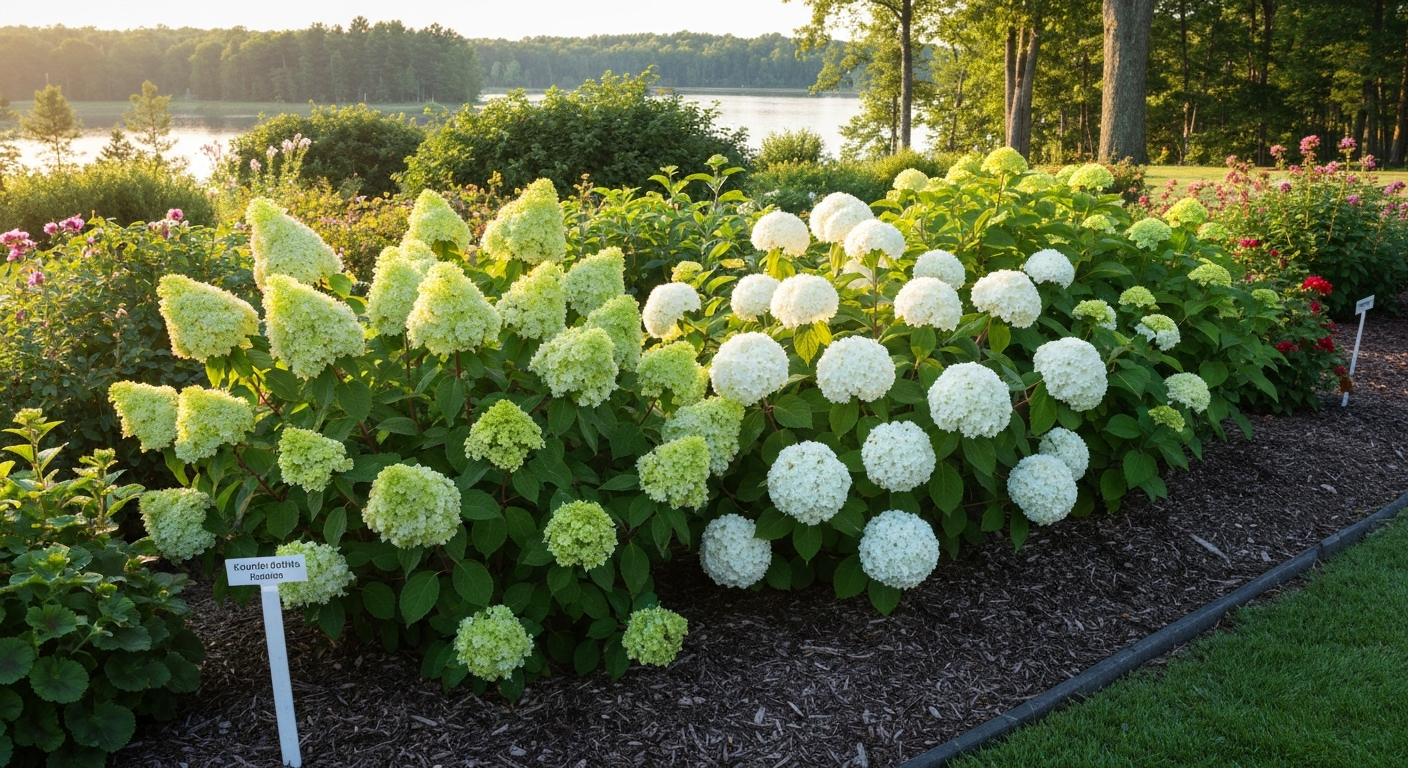
This is Michigan's most reliable hydrangea, full stop. Panicle hydrangeas are hardy to USDA zone 3, which means even Marquette and Iron Mountain winters do not faze them. They bloom on new wood every year, so even if a brutal cold snap kills stems back to the ground, they rebound and bloom the same season. Flowers emerge creamy white in midsummer and transition to pink, then antique rose as fall approaches. They tolerate full sun better than any other hydrangea and can handle clay-heavy soils common in much of southern Michigan. Varieties range from compact 3-foot shrubs to 15-foot tree forms.
Hydrangea arborescens (Smooth Hydrangea)
Smooth hydrangeas are native to eastern North America and arguably the most cold-tolerant species available, surviving to zone 3 without protection. 'Annabelle' is the classic: enormous pure-white globes up to 12 inches across on a 4–5 foot shrub. Newer introductions like 'Incrediball' have stronger stems that hold those big heads upright in rain. Like paniculata, smooth hydrangeas bloom on new wood, so they are forgiving of hard pruning and cold winters. They prefer afternoon shade in Michigan's southern counties but tolerate more sun in the cooler north.
Hydrangea macrophylla (Bigleaf, Mophead, Lacecap)
These are the blue and pink showstoppers you see on every garden magazine cover, and they are also the species that frustrates the most Michigan gardeners. H. macrophylla blooms on old wood: buds set in late summer on the previous year's stems, and those buds are damaged or killed when temperatures drop below roughly -5 to -10°F. That puts them at real risk anywhere in Michigan's zone 5 or colder, which is most of the state. See our guide on how to grow hydrangeas in zone 5 for planting, winter protection, and cultivar recommendations tailored to that climate. In zone 5b–6b (southern Lower Peninsula, lake-influenced shoreline communities), they can thrive with thoughtful site selection. North of that, use reblooming cultivars like 'Endless Summer' or 'Twist-n-Shout' that also push new-wood buds, giving you a second chance at flowers even if old-wood buds freeze.
Hydrangea quercifolia (Oakleaf Hydrangea)
Oakleaf hydrangea is a four-season plant: white cone-shaped flowers in early summer, handsome burgundy fall foliage, exfoliating cinnamon bark in winter, and bold oak-shaped leaves all season. It is rated to zone 5, which makes it a strong choice for the southern two-thirds of the Lower Peninsula but marginal in the UP or northern Michigan without protection. Like bigleaf, it blooms on old wood, so protect stems in winter if you want flowers. It handles dry shade better than any other hydrangea species, which makes it useful under mature trees.
Species Hardiness and Best Uses at a Glance
| Species | USDA Zone Rating | Blooms On | Color Change With pH? | Best Use in Michigan |
|---|---|---|---|---|
| H. paniculata (Panicle) | 3–8 | New wood | No | Statewide, full sun, all soils |
| H. arborescens (Smooth) | 3–9 | New wood | No | Statewide, shade-tolerant, native |
| H. macrophylla (Bigleaf) | 5b–9 (reliably) | Old wood (some reblooming) | Yes | Southern LP, lake shores, sheltered spots |
| H. quercifolia (Oakleaf) | 5–9 | Old wood | No | Southern/central LP, dry shade |
Cultivar Recommendations by Michigan Region
Zone maps tell you what survives; cultivar selection tells you what thrives. Here are specific picks that have proven themselves in Michigan's three main gardening regions, along with the reason each one works.
Upper Peninsula (Zones 3b–4b)
Stick to paniculata and arborescens here. 'Limelight' (H. paniculata) is probably the most popular UP choice: lime-green flowers that age to pink, extreme cold hardiness, and adaptability to the clay-loam soils common around Marquette. 'Little Lime' is the compact version for smaller yards. 'Incrediball' (H. arborescens) delivers enormous white blooms on stronger stems than 'Annabelle,' which matters when summer thunderstorms roll through. For something a little different, 'Pinky Winky' (H. paniculata) has bicolored white-to-deep-pink panicles and outstanding cold hardiness. All of these bloom reliably every year regardless of what winter did to them.
Northern Lower Peninsula (Zones 4b–5a)
The same paniculata and arborescens picks work here, but you gain a few more options. 'Quick Fire' (H. paniculata) is one of the earliest-blooming panicle hydrangeas, starting in late June, which matters in a shorter growing season. 'Vanilla Strawberry' (H. paniculata) puts on a long show, with large panicles turning rich strawberry-pink by August. If you have a protected south- or west-facing wall in Traverse City or Petoskey with good snow cover, a reblooming macrophylla like 'Endless Summer' or 'BloomStruck' may survive and flower, but treat it as an experiment rather than a guarantee.
Southern Lower Peninsula (Zones 5b–6b)
This is where Michigan gardeners get to play with the full palette. Bigleaf cultivars including 'Nikko Blue,' 'Endless Summer,' 'Incrediball Blush,' and the lacecap 'Twist-n-Shout' all perform here, especially near the Lake Michigan shoreline. Oakleaf varieties like 'Snowflake' and 'Alice' thrive in the shade of mature suburban trees around Ann Arbor, Kalamazoo, and Grand Rapids. Panicle standouts 'Phantom' (very large flower heads) and 'Bobo' (ultra-compact, 2–3 feet) round out the palette. For gardeners in zone 6a–6b around Detroit, Monroe, or Coldwater, the species options approach what gardeners in Ohio or Indiana enjoy, though a zone 5 winter event every few years keeps the selection honest. For gardeners in warmer climates who want tailored advice, see a practical guide on how to grow hydrangeas in zone 9.
Choosing the Right Spot: Sun, Wind, Drainage, and Spacing
Most hydrangeas want morning sun and afternoon shade in Michigan's southern counties, where summer afternoon heat is real. In the UP and northern Lower Peninsula, a full-sun location is usually fine and often preferable for panicle and smooth hydrangeas, which flower more prolifically in sun. The worst spots for any hydrangea are low-lying frost pockets with poor drainage, or exposed windy ridges where desiccating winter winds can kill stems and buds even when temperatures alone would not.
Wind is an underappreciated problem in Michigan. Winter winds from the west and northwest can strip moisture from stems and kill flower buds on bigleaf hydrangeas even in a zone 6 garden. A fence, a north-facing foundation wall, or a planting on the leeward east side of a structure gives bigleaf hydrangeas meaningful protection. Panicle and smooth hydrangeas are far less sensitive to this, but they still appreciate some wind buffering if you want taller specimens to stand upright in storms.
For spacing, most mature panicle and smooth hydrangeas need 4–8 feet of clearance depending on cultivar; compact types like 'Bobo' can go as close as 3 feet. Bigleaf types typically spread 3–5 feet. Plant far enough apart that air circulates between shrubs: crowded plantings invite fungal issues. Good companion plants include shade-tolerant perennials like hostas and astilbes under oakleaf hydrangeas, or full-sun perennials like coneflowers and Russian sage alongside panicle types. Avoid planting hydrangeas directly under shallow-rooted trees like Norway maples that compete aggressively for moisture.
Soil, Drainage, and pH: Testing, Adjusting, and Color Control
Michigan soils vary wildly. Sandy soils dominate the western Lower Peninsula and much of the UP; heavy clay shows up around the Great Lakes shorelines and in much of southeastern Michigan; and loam soils are scattered in between. Hydrangeas prefer well-drained, moderately fertile soil with consistent moisture. Sandy soils drain too fast and need organic matter worked in before planting. Clay soils hold moisture but can become waterlogged, which rots roots. Raised beds are a practical fix for either extreme.
Testing Your Soil
MSU Extension offers soil testing through their diagnostic lab, and it is worth the modest fee before you start amending anything. You can also use the USDA NRCS Web Soil Survey to get baseline pH, drainage class, and texture data for your parcel, though a lab test on your actual soil is more reliable for garden-scale decisions. At minimum, use an inexpensive home pH meter or test kit to establish whether you are starting acidic, neutral, or alkaline.
Adjusting pH Safely
For most hydrangeas (panicle, smooth, oakleaf), target a pH of 5.5–6.5. For blue bigleaf cultivars, you want to push lower, ideally 4.5–5.5, because it is actually aluminum availability that determines blue color, and aluminum becomes available to plants only when soil pH drops below roughly 5.5. To lower pH, use elemental sulfur for slow, sustained shifts or aluminum sulfate for faster results. Aluminum sulfate works in weeks rather than months, but it can damage or kill plants if you over-apply, so always follow the label rate. Elemental sulfur is safer for larger adjustments: for sandy Michigan soils, roughly 1–1.5 lb of elemental sulfur per 100 square feet will drop pH approximately one unit; loam soils need closer to 2–3 lb; heavy clay soils may need 3–4 lb. Incorporate sulfur into the top 6 inches of soil well before planting and retest after 60–90 days, since the microbial conversion process takes time. If your Michigan soil tests alkaline (pH above 7.0, which can happen in areas with high-calcium glacial deposits), large pH drops take sustained effort and repeated applications over multiple seasons.
How pH Controls Mophead and Lacecap Color
Here is the chemistry without the jargon: blue color in H. macrophylla requires aluminum ions to bind with the anthocyanin pigment in the sepals. Peer-reviewed work shows the blue/pink shift in H. macrophylla is driven by aluminum (Al3+) complexation with delphinidin-derived anthocyanins and that soil pH controls aluminum availability, with sepal color depending on Al3+ uptake and vacuolar pH rather than pH alone Comparative Transcriptome Analysis Unveils the Molecular Mechanism Underlying Sepal Colour Changes under Acidic pH Substratum in Hydrangea macrophylla (PMC). Aluminum is naturally present in most Michigan soils, but at pH above 6.0, it forms insoluble compounds that roots cannot absorb. Drop pH below 5.5 and aluminum becomes soluble and available, the pigment binds with it, and flowers turn blue. Keep pH above 6.5 and you get pink. The zone in between (roughly 5.5–6.5) often produces muddy purple or mauve tones. Crucially, only H. macrophylla and its close relative H. serrata respond this way. Panicle, smooth, and oakleaf hydrangeas do not change color with pH regardless of what you do to the soil. Also important: cultivar genetics impose limits. White-flowering cultivars will not turn blue no matter how acidic you make the soil, and some pink cultivars are genetically resistant to the blue shift. Expect the color change process to take a full growing season or more, and do not expect perfect results every time.
Exact Planting Timing for Michigan
Timing planting around frost dates is not optional in Michigan. A late spring frost in the UP can arrive into late May; in southeastern Lower Michigan the last frost typically falls in late April to early May. Always confirm your specific area using MSU Enviroweather or the NOAA climate normals for your county.
| Region | Typical Last Spring Frost | Safe Spring Planting Window | Fall Planting Cutoff (6–8 wks before hard freeze) |
|---|---|---|---|
| Upper Peninsula (zones 3b–4b) | Late May to early June | Early to mid-June | Late August to early September |
| Northern Lower Peninsula (zones 4b–5a) | Mid- to late May | Late May to mid-June | Early to mid-September |
| Southern Lower Peninsula (zones 5b–6b) | Late April to early May | Early to mid-May | Late September to mid-October |
Spring planting is the safer choice for Michigan, especially for bigleaf hydrangeas and any new cultivar you have not grown before. The long warm season gives roots time to establish before the first hard freeze. Fall planting works well for the cold-hardy panicle and smooth hydrangeas in southern and central Michigan: plant them at least 6–8 weeks before your expected first hard frost so roots anchor before the ground freezes. In the Upper Peninsula, fall planting for hydrangeas is risky unless you are working with container-grown panicle or smooth types in early to mid-August, which is a very narrow window. When in doubt, pot the plant up and overwinter it in an unheated garage, then plant in spring.
Step-by-Step Planting and Staking Guide
The single most common mistake I see is planting too deep. Hydrangea crowns planted 2–3 inches below grade suffocate slowly, show poor growth for a season or two, and then die with no obvious cause. The fix is simple: plant at or just slightly above grade and let the crown breathe.
- Water the container thoroughly 1–2 hours before planting so the root ball is moist and holds together.
- Dig a hole 1.5–2 times as wide as the root ball, but only as deep as the root ball itself. If anything, err shallower rather than deeper.
- Mix the excavated soil with 2–3 inches of finished compost, but do not over-amend. A heavily amended pocket soil in otherwise poor native soil can act like a drain and concentrate water, or roots may refuse to spread beyond the amended zone.
- Remove the plant from its container and gently loosen any circling roots with your fingers or a hand claw. Circling roots left untouched will girdle the shrub years later.
- Set the plant in the hole so the top of the root ball sits at or just above the surrounding soil level. The crown (the point where stems emerge from roots) must not be buried.
- Backfill with the amended native soil, firming gently in layers to eliminate large air pockets. Do not stomp; just firm with your hands.
- Water deeply and slowly until the planting area is thoroughly saturated. This settles the soil and makes first contact with roots.
- Apply 2–3 inches of shredded bark mulch over the root zone, keeping mulch 3–4 inches away from the crown and main stems to prevent rot.
- For staking: most hydrangeas do not need staking at planting. If you are planting a tall paniculata in an exposed spot, drive a single stake into the soil outside the root ball and tie loosely with flexible garden tape, leaving slack for the stem to move in wind. Remove the stake after one full growing season.
- Label the plant with species and cultivar name. This sounds obvious, but you will absolutely need this information when it comes time to prune.
First 6 Weeks After Planting: The Establishment Checklist
- Weeks 1–2: Water deeply every 2–3 days if no rain; the root ball must not dry out while roots are not yet in native soil.
- Week 3: Begin transitioning to once-weekly deep watering (1 inch equivalent) unless temperatures are above 85°F or soil feels dry an inch below the surface.
- Week 4: Check that mulch has not shifted or mounded against the crown; adjust if needed.
- Week 5: Look for new leaf emergence or stem elongation, a sign roots are anchoring. Do not fertilize yet.
- Week 6: If planted in spring, a light balanced slow-release fertilizer can be applied now only if soil test indicates a need. If planted in fall, skip all fertilizer until the following spring.
- All 6 weeks: Watch for wilting in afternoon heat. Newly planted hydrangeas will wilt on hot days even in moist soil; this is normal. Wilt that does not recover by morning indicates drought stress and requires immediate deep watering.
Watering, Mulching, and Fertilizing Through the Season
Established hydrangeas need roughly 1 inch of water per week during the growing season, delivered in one or two deep sessions rather than daily sprinkles. Deep watering encourages roots to grow downward; shallow daily watering keeps roots near the surface where they are vulnerable to drought and temperature swings. In Michigan's warm July and August, 1 inch per week is a minimum; during heat waves or on sandy soils, increase to 1.5–2 inches. A simple rain gauge in the garden tells you exactly what nature is providing. Drip irrigation or soaker hoses are far more efficient than overhead sprinklers and keep foliage dry, which reduces fungal disease.
Mulch is not optional in Michigan winters. A 2–3 inch layer of shredded bark or wood chips over the root zone moderates soil temperature, conserves moisture through summer, and in winter acts as insulation for roots. Replenish mulch each spring as it decomposes; decomposing organic mulch also slowly improves soil structure over years. Just keep it away from the crown.
For fertilizing, less is more here. A soil test is the best guide, but in the absence of one, a single spring application of a balanced slow-release granular fertilizer (something like 10-10-10 or a comparable formula) at label rates is adequate for most established hydrangeas. If you are growing blue-flowering bigleaf cultivars, switch to a low-phosphorus, acid-plant fertilizer (a formula around 12-4-8 is what UMass Extension recommends) because high phosphorus interferes with aluminum uptake and works against blue color. Apply fertilizer in spring as growth emerges and skip fall feeding entirely. Fall fertilizing stimulates soft new growth that gets killed by frost and weakens the plant. I will be direct: Miracle-Gro can feed your hydrangeas, but the high-phosphorus soluble formulas can push pink color in your bigleaf types, so if blue is your goal, choose a product specifically formulated for acid-loving plants.
Pruning Rules by Species: Get This Wrong and You Lose Blooms
Pruning is where most failed-bloom stories begin. The single most important thing to know is whether your hydrangea blooms on old wood (last year's stems) or new wood (growth produced this season). The University of New Hampshire extension Pruning Hydrangeas, UNH Extension fact sheet summarizes species-specific pruning: bigleaf and oakleaf hydrangeas bloom on old wood and should be pruned right after flowering, while smooth (H. arborescens) and panicle (H. paniculata) bloom on new wood and are pruned in late winter/early spring Pruning Hydrangeas — UNH Extension fact sheet. Prune an old-wood bloomer in spring and you remove every flower bud.
| Species | Blooms On | When to Prune | How to Prune |
|---|---|---|---|
| H. paniculata (Panicle) | New wood | Late winter / early spring (March–April in Michigan) | Cut stems back by 1/3 to 1/2; remove crossing or dead stems entirely |
| H. arborescens (Smooth) | New wood | Late winter / early spring (March–April) | Cut to 12–18 inches above ground or to ground level for maximum size; remove old stems |
| H. macrophylla (Bigleaf) | Old wood (mostly) | Immediately after flowering (July–August) | Remove spent flower heads and oldest stems at the base; never cut to ground unless all stems are dead |
| H. quercifolia (Oakleaf) | Old wood | Immediately after flowering (August–September) | Light shaping only; remove dead wood in early spring; avoid heavy pruning |
A useful rule of thumb for bigleaf and oakleaf types: if in doubt, do not prune. A season with no pruning might mean a slightly less tidy shrub, but it will not cost you flowers. An aggressive spring haircut on an old-wood bloomer will cost you every bloom for that entire season. For reblooming bigleaf cultivars like 'Endless Summer,' you can do light deadheading after each flush of flowers to encourage rebloom, but still avoid cutting back into the main framework stems until right after the main flowering period.
Winter Protection in Michigan: What to Do and When
Panicle and smooth hydrangeas in Michigan essentially need no winter protection. Their buds form in spring on new wood, so there is nothing to protect from frost. If stems die back to the ground in an extreme UP winter, new shoots will come up in spring and flower that same summer.
Bigleaf and oakleaf hydrangeas are a different story. Their flower buds sit on last year's stems through the winter, and those buds are damaged or killed below roughly -5 to -10°F. In zone 5b–6b, a moderate winter means full flowering; a cold snap in March after warm February weather (the classic Michigan scenario) can trigger bud break and then kill the emerging buds with a late frost. Here is what actually helps:
- After the first hard frost (late October in most of the Lower Peninsula), loosely tie bigleaf stems together with soft twine to prevent breakage from snow load.
- Pile 6–8 inches of dry shredded leaves around the base and lower stems to insulate the crown and the lower bud zones.
- For added protection, build a wire cage around the plant (chicken wire works) and fill it loosely with dry leaves or straw, covering the stems to a height of 18–24 inches where possible.
- Do not use plastic bags or tarps directly against stems: they trap moisture and promote rot and mold.
- Remove protection gradually in spring: wait until nighttime temperatures reliably stay above 28°F, then remove the cage fill but leave the mulch base.
- In late March or April, gently scratch a small section of bark on the lower stems: if green tissue is underneath, the buds below that point survived. If it is brown all the way to the ground, cut dead stems to the base and accept that this year's flowers will come from any new wood the reblooming cultivar pushes.
Pests and Diseases: What to Watch For in Michigan
Michigan hydrangeas are relatively pest-resistant, but a handful of problems come up consistently in the state's humid summers.
Powdery Mildew
The most common disease on bigleaf hydrangeas in Michigan, especially during the humid August weeks. White powdery coating on leaves, worse on plants in low-air-circulation spots or shaded sites. Organic options: neem oil spray or a dilute potassium bicarbonate solution, applied at the first sign of infection. Chemical options: myclobutanil or propiconazole fungicides are effective but rarely necessary unless infection is severe. Prevention is more effective than treatment: improve spacing and airflow, avoid overhead watering, and choose mildew-resistant cultivars when possible.
Leaf Spot (Cercospora and Botrytis)
Circular brown or purple-bordered spots on leaves, often starting on lower leaves. Remove affected leaves promptly. Drip irrigation instead of overhead watering prevents most cases. Copper-based fungicide sprays work as an organic option; chlorothalonil is a conventional chemical choice for persistent cases.
Japanese Beetles
These show up across southern Michigan from late June through July and will skeletonize hydrangea leaves quickly. Hand-picking in early morning (when beetles are sluggish) is effective for small plants. Neem oil has limited effectiveness once adults are present. Pyrethrin-based sprays work for immediate knockdown. Systemic neonicotinoids (imidacloprid) kill beetles but also harm pollinators and should not be used on flowering plants.
Root Rot (Phytophthora and Pythium)
Wilting that does not respond to watering, combined with dark or mushy stem bases at the soil line. Almost always caused by overwatering or poor drainage. There is no effective chemical cure once established; the fix is improving drainage, reducing irrigation frequency, and in bad cases replanting in a raised bed. This is why getting drainage right at planting matters so much.
Propagation Methods for Michigan Hydrangeas
Propagating hydrangeas is genuinely satisfying and not particularly difficult. The three main methods are softwood cuttings, division, and layering.
Softwood Cuttings
Take cuttings in late spring to early summer (May–June in southern Michigan, June in the north) when new stems are actively growing but not yet hardened. Cut a 4–6 inch stem just below a leaf node, remove the lower leaves, dip the cut end in rooting hormone powder, and stick into moist, well-draining propagation mix (50/50 perlite and peat or coir). Cover with a humidity dome or clear plastic bag and place in bright indirect light. Roots typically form in 4–6 weeks. Transplant to a pot and grow through summer; overwinter in an unheated garage in Michigan before planting out the following spring.
Division
Smooth hydrangeas (H. arborescens) and to some extent bigleaf types can be divided in early spring before growth begins. Dig the entire clump, separate sections with a sharp spade ensuring each division has roots and at least 2–3 stems, and replant immediately. Best done on a cool overcast day to reduce transplant stress.
Layering
Layering is the lowest-effort method and works well for bigleaf and oakleaf types. In late spring, bend a long flexible stem to the ground, wound the bark lightly at a node (scrape or make a shallow cut), pin the wounded section into moist soil with a wire staple, and cover with a few inches of soil while leaving the growing tip above ground. Keep moist through summer. By fall the buried node will have rooted; cut the stem from the parent plant in early spring the following year and transplant.
Troubleshooting: Poor Blooms, Yellowing Leaves, and Wilting
These are the three complaints I hear most often from Michigan hydrangea growers. Here is an honest assessment of the real causes.
| Problem | Most Likely Cause in Michigan | Fix |
|---|---|---|
| No blooms on bigleaf/oakleaf hydrangea | Winter-killed flower buds (old-wood buds frozen) | Switch to reblooming cultivar; add winter stem protection; try a sheltered south-facing site |
| No blooms on panicle or smooth hydrangea | Pruned at wrong time, or excessive shade | Prune only in late winter; move or thin overhead trees for more sun |
| Yellow leaves with green veins (interveinal chlorosis) | Iron or manganese deficiency from high pH soil | Test soil pH; lower pH with sulfur; apply chelated iron as foliar spray for quick fix |
| Pale overall yellowing | Nitrogen deficiency or waterlogged roots | Improve drainage first; then apply balanced fertilizer after drainage is corrected |
| Wilting despite moist soil | Root rot from overwatering or clay drainage problem | Reduce watering; check root ball for rot; improve drainage with raised planting |
| Blue flowers turning pink mid-season | Soil pH has drifted up, or phosphorus fertilizer reducing Al uptake | Retest pH; apply aluminum sulfate if needed; switch to low-phosphorus acid fertilizer |
| Brown leaf edges in summer | Drought stress or wind scorch | Deep watering; add windbreak or move to more sheltered site next season |
Month-by-Month Seasonal Calendar for Michigan
Michigan's gardening season runs shorter than most gardeners wish, so timing tasks well is important. The dates below reflect general southern Lower Peninsula timing; shift everything 2–4 weeks later for the Upper Peninsula.
| Month | Key Tasks |
|---|---|
| March | Apply soil amendments (sulfur, lime) based on fall soil test results; do not prune yet |
| April | Prune panicle and smooth hydrangeas as growth begins; check for winter damage on bigleaf/oakleaf types; scratch-test stems |
| May | Plant container-grown hydrangeas after last frost; begin watering schedule; apply spring fertilizer |
| June | Monitor for Japanese beetles and powdery mildew; take softwood cuttings for propagation; water 1 inch/week |
| July | Prune bigleaf hydrangeas immediately after first flush of bloom; deadhead panicle types to encourage rebloom; water 1–1.5 inches/week in heat |
| August | Apply aluminum sulfate to bigleaf beds if pH adjustment is needed before next season; watch for leaf spot in humid weather; UP gardeners: complete fall planting by mid-August |
| September | Southern LP: last window for fall planting (complete by mid-September); reduce fertilizing to zero |
| October | After first hard frost: tie bigleaf stems, add leaf mulch mound, build wire protection cages if desired; apply 2–3 inch mulch layer over all hydrangea root zones |
| November–February | No active tasks; check cages are intact after heavy snow or ice storms |
| March (repeat) | Remove winter protection gradually as nighttime temperatures stabilize above 28°F; submit soil test for spring results |
Michigan Compared to Other Challenging Climates
Michigan sits in an interesting middle ground for hydrangea growing. Gardeners in warmer states like Georgia or Louisiana can grow bigleaf hydrangeas with far less anxiety about winter bud kill, but they face challenges with summer heat stress that Michigan growers never encounter. For specific guidance on warmer climates, see a practical guide on how to grow hydrangeas in Georgia. For gardeners in warmer, humid climates, see how to grow hydrangeas in Louisiana for region-specific advice on heat-tolerant cultivars, planting sites, and care. Colorado gardeners deal with alkaline soils and low humidity that create entirely different problems. For specific advice on managing alkaline soils and low humidity in the Rockies, see how to grow hydrangeas in Colorado. Canada's coldest growing zones share Michigan's UP challenges and lean even more heavily on paniculata and arborescens as the only reliable choices. For step-by-step guidance tailored to even colder climates, see our how to grow hydrangea in Canada guide. Michigan's advantage is a genuinely favorable summer climate with moderate humidity and temperatures that keep hydrangeas hydrated and thriving once you get past the winter hardiness hurdle.
FAQ
Which hydrangea species are best for different parts of Michigan (Upper Peninsula through southern Lower Peninsula)?
Upper Peninsula & cold northern Lower Peninsula: Hydrangea paniculata (panicle) and H. arborescens (smooth) — most cold‑hard and reliable. Northern/mid Lower Peninsula: paniculata, arborescens, and oakleaf (H. quercifolia) in protected sites. Southern Lower Peninsula and sheltered microclimates: H. macrophylla (bigleaf mophead/lacecap) and H. serrata can perform well if winter‑protected or planted in mild, sheltered locations. Choose paniculata/arborescens for broad reliability across Michigan; reserve macrophylla for gardens in USDA zones ~5–6 or sheltered sites.
How should I time planting in Michigan for best establishment (spring vs fall)?
Spring: Plant after your local last‑frost date (use county/ZIP frost tools or MSU Enviroweather) once soil is workable. Fall: Plant about 6–8 weeks before your average first hard frost to allow root establishment — fall planting is excellent in most Lower Peninsula locations. Avoid fall planting in the coldest UP sites where winters arrive early or where soils remain saturated. If in doubt, plant in spring.
How do I pick the exact site (sun/shade) and soil conditions for hydrangeas?
Site: Paniculata and arborescens tolerate full sun to part shade (paniculata best with morning sun + afternoon shade in hot sites). Macrophylla/serrata prefer morning sun and afternoon shade or dappled shade. Oakleaf prefers part shade and drier, well‑drained sites. Soil: Hydrangeas want consistently moist, well‑drained soil with good organic matter. Use Web Soil Survey or a soil probe to confirm drainage and texture. Avoid heavy waterlogged hollows and hot, reflective locations.
How does soil pH affect hydrangea flower color, and how can I manage color safely?
Only some species (mainly H. macrophylla and H. serrata) show pH‑dependent color shifts. Acidic soils (roughly pH <5.5) increase aluminum availability and favor blue tones; neutral (≈5.5–6.5) gives mauve/purple mixes; alkaline (>6.5) favors pink. Management: test soil first. To encourage blue, lower pH with elemental sulfur (slow, safer) or aluminum sulfate (faster but risk of burn if overapplied) per label and soil test rates. To encourage pink, raise pH slowly with lime (follow soil test). Results depend on cultivar genetics and take months; only use amendments based on test recommendations.
Step‑by‑step planting protocol for container or bare‑root hydrangeas
1) Choose site with appropriate light and good drainage. 2) Dig a hole 1–2× the root‑ball diameter, no deeper than the root ball. 3) Mix native backfill with 2–3" compost if desired (do not over‑amend). 4) Place plant so crown is at or slightly above final soil grade. 5) Backfill, firm lightly to remove air pockets, and water deeply. 6) Apply 2–3" organic mulch, keeping mulch 1–2" away from the crown. 7) Stake only if necessary for large panicle heads. 8) Monitor moisture closely the first season.
What watering, mulching and fertilizing schedule should I follow in Michigan?
Watering: Keep soil consistently moist — deep watering (about 1"/week equivalent) and increase during hot/dry spells. Mulch: Apply 2–3" organic mulch (bark, shredded leaves, compost) to conserve moisture and insulate roots; keep mulch off the crown. Fertilizing: Spring application — for macrophylla blue types use a low‑phosphorus, acid fertilizer once in spring; for most hydrangeas use a balanced slow‑release fertilizer in early spring when growth resumes and a light mid‑season side‑dress if growth is weak. Always follow soil test results and label rates.