
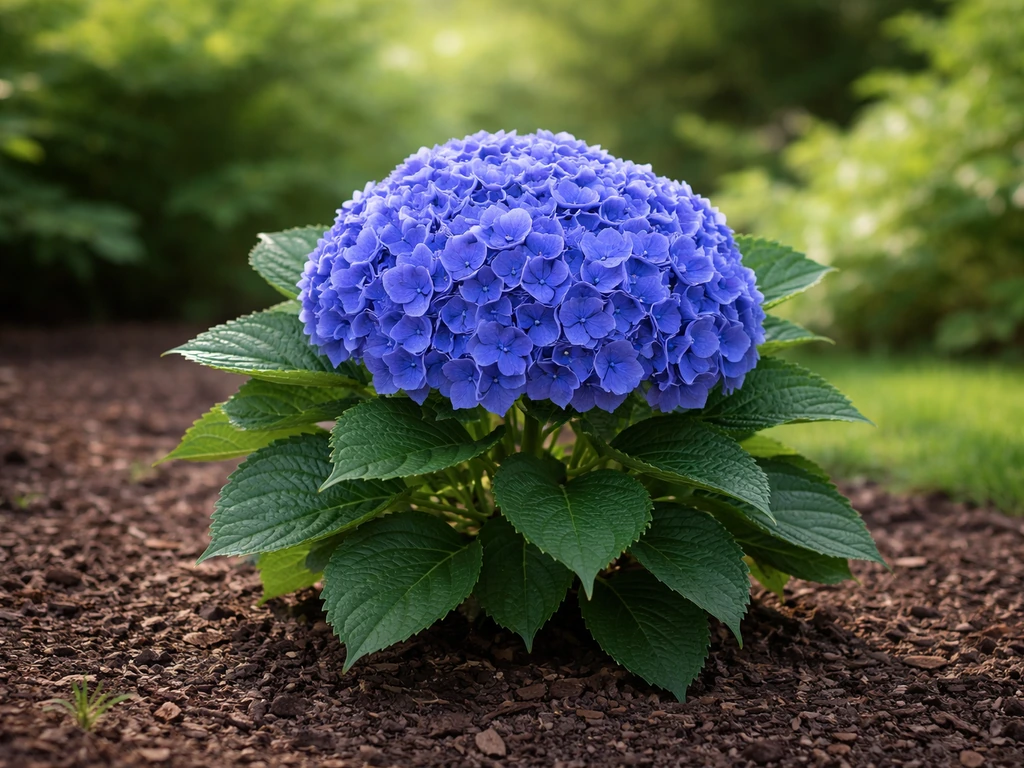
Nikko Blue hydrangea thrives in USDA zones 6 through 9, produces big mophead blooms in July and August, and will reliably flower blue as long as your soil pH stays below 6.0 and aluminum is available. Get those two things right, protect the old wood through winter, and prune only right after flowering, and you'll have a 3-to-6-foot shrub covered in true blue flowers every summer. Purple hydrangeas also need the same basics: acidic soil, consistent moisture, and the right pruning time so old wood can still bloom how to grow purple hydrangeas.
How to Grow Nikko Blue Hydrangea: Soil, Planting, Care

Marcus Holloway
6 Jul 2026
What Nikko Blue actually is (and why that matters for growing it)
Nikko Blue is a bigleaf hydrangea, specifically Hydrangea macrophylla, in the mophead (hortensia) group. That classification isn't just trivia, it tells you almost everything you need to know about how to care for it. Bigleaf hydrangeas bloom on old wood, meaning the flower buds form in late summer and fall on stems that grew during the current season, then those buds sit through winter and open the following July and August. That single fact explains most of the failures people run into: bad pruning timing wipes out next year's blooms, and a hard winter can kill the buds right on the stem before they ever open. If you've ever grown an Endless Summer hydrangea and found it more forgiving, that's because it was bred to also bloom on new wood, Nikko Blue doesn't have that safety net, so your site selection and winter protection decisions carry more weight.
Where Nikko Blue grows best
Nikko Blue is rated for USDA zones 6 through 9. In zone 6, you'll be managing winter bud protection every year. In zones 7 through 9, it's much more straightforward. Outside those zones, you're fighting the plant's nature rather than working with it, and you'll spend every spring disappointed by bloomless stems.
Within its range, this plant performs best in a spot with morning sun and afternoon shade. That's the sweet spot where it gets enough light to bloom well without the afternoon heat stress that scorches leaves and dries out the root zone. Full sun all day is workable in cooler climates, but in zones 8 and 9, afternoon shade isn't optional, it's the difference between a plant that thrives and one that wilts daily and produces pale, short-lived blooms. Avoid deeply shaded spots too. Too much shade reduces flowering and weakens stems.
Choosing the right site: sun, spacing, and microclimate
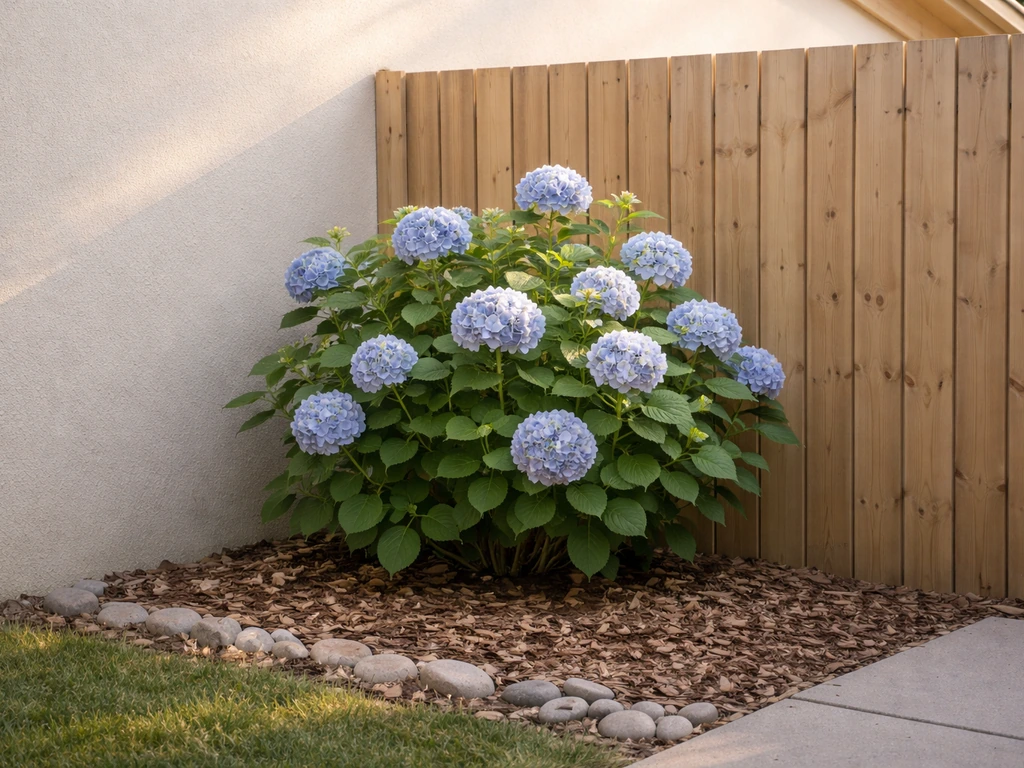
Before you dig a hole, think about microclimate as much as sun exposure. A spot on the north or east side of a building or fence gives you that morning sun and afternoon protection naturally. It also buffers the plant from harsh winter winds, which desiccate stems and damage flower buds. Exposed, windy sites are hard on Nikko Blue even when temperatures stay above freezing, the buds dry out and die just like they would in a cold snap.
For spacing, plan on the mature size: 3 to 6 feet tall and roughly as wide. Give each plant at least 4 to 5 feet from neighboring shrubs and 3 feet from structures to allow good air circulation, which helps prevent powdery mildew later. If you're planting a hedge or mass planting, 4-foot centers give you a full look without crowding.
One more site consideration: drainage. Nikko Blue wants consistently moist soil, but sitting in waterlogged ground will rot the roots fast. If your site stays soggy after rain, either amend it heavily or choose a different spot. Raised beds work well if drainage is a persistent problem in your yard.
Soil and amendments: how to get (and keep) blue flowers
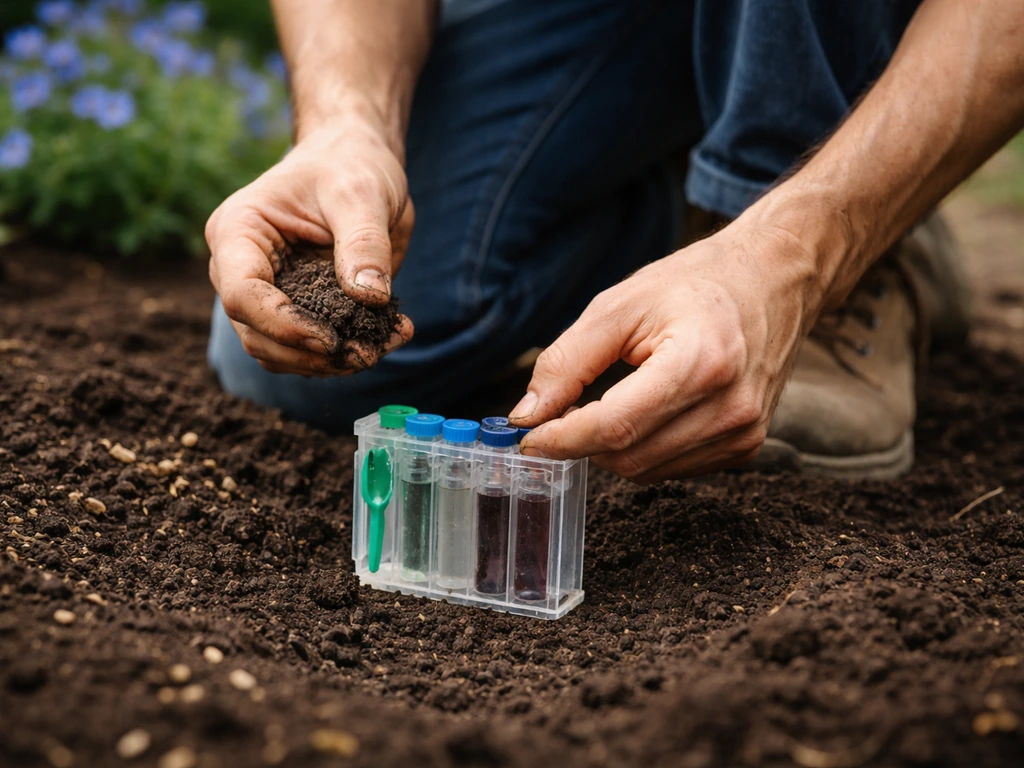
Here's the chemistry in plain terms: Nikko Blue flowers are blue when aluminum ions are available in the soil, and aluminum becomes available when soil pH is acidic, ideally below 6. To get red blooms, you’ll need to understand how soil chemistry affects hydrangea color and then adjust it accordingly blue when aluminum ions are available. 0. In alkaline soil (pH above 7.0), aluminum locks up and the flowers shift toward pink or muddy purple. This isn't a myth or a trick, it's just plant chemistry, and it's completely within your control if you're willing to test your soil and amend it.
Start with a soil test before you plant. Your local cooperative extension office can test for pH and nutrient levels for a few dollars, and it's worth every cent. If your pH is already between 5.5 and 6.0, you may just need to maintain it. If it's above 6.5, you have work to do.
To lower pH and support blue color, use wettable sulfur: broadcast about 1/2 cup per 10 square feet and work it into the soil before planting. For established plants, aluminum sulfate is the faster-acting option that also adds the aluminum ions directly. Organic matter also helps, mix in 2 to 3 inches of compost at planting to improve moisture retention and feed soil biology, which supports healthy nutrient uptake. Avoid adding lime or wood ash anywhere near Nikko Blue, because both raise pH and will push your flowers pink.
Ongoing pH maintenance is part of the job with this plant. Check your soil every year or two and reapply acidifying amendments as needed. If you're in an area with naturally alkaline water, your irrigation itself can slowly push pH up over time, something to watch for if your flowers start shifting color unexpectedly.
Planting Nikko Blue: timing, depth, and getting it established
The best time to plant Nikko Blue is spring after the last frost, or early fall at least 6 weeks before your first expected freeze. Spring planting gives the root system a full growing season to establish before facing its first winter. Fall planting works well in zones 7 to 9 where winters are mild; in zone 6, I'd stick with spring to give the roots every advantage.
- Dig your hole twice as wide as the root ball and the same depth — not deeper.
- Set the plant so the top of the root ball sits level with the surrounding soil surface. Planting too deep is one of the most common mistakes and leads to crown rot and poor establishment.
- Backfill with your amended soil (compost mixed in), gently firming it around the roots to eliminate air pockets.
- Water thoroughly immediately after planting — soak the entire root zone until water pools briefly on the surface.
- Apply 3 to 5 inches of organic mulch (pine bark, pine straw, or shredded leaves) around the plant, keeping it a few inches away from the main stems.
During the first growing season, your only job is keeping the roots consistently moist. Aim for about 1 inch of water per week, and increase that to 2 inches per week during hot, dry stretches. Don't rely on rainfall alone, check the soil every few days by sticking your finger 2 inches into the ground near the root zone. If it feels dry, water deeply. A newly planted Nikko Blue has a small root system and can go from fine to severely wilted in 24 hours during a summer heat wave.
Ongoing care: watering, mulching, and feeding
Watering
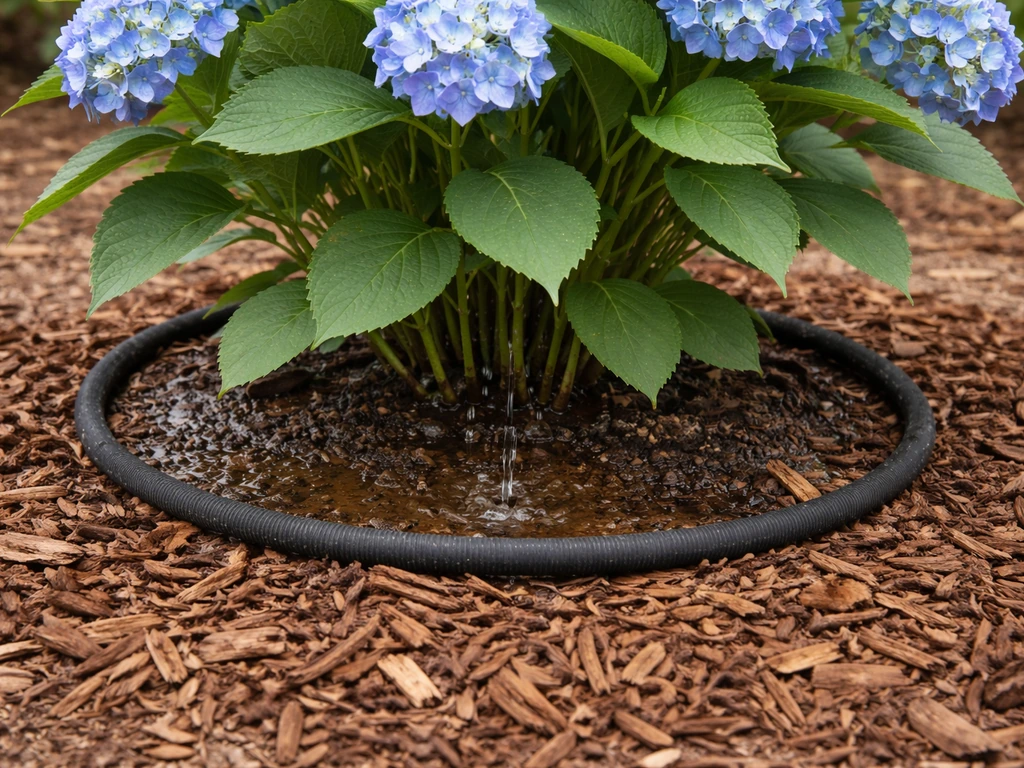
Once established, Nikko Blue needs about 1 inch of water per week through the growing season, and up to 2 inches per week in heat or drought. Deep, infrequent watering is better than daily shallow watering, you want moisture penetrating down to the root zone, not just wetting the surface. Morning watering is ideal so foliage dries before evening, reducing fungal disease risk. Drip irrigation or soaker hoses at the base of the plant are the most efficient setup.
Mulching
Keep 3 to 5 inches of organic mulch around the plant year-round. Pine bark, pine straw, and shredded fall leaves all work well and have the added benefit of slowly acidifying the soil as they decompose, which supports blue flower color. Refresh the mulch layer each spring. In fall in zone 6, build up the mulch layer a bit higher around the base to protect the crown and lower stems from freeze damage.
Fertilizing
A balanced fertilizer works well for Nikko Blue. Apply a general-purpose granular fertilizer like 8-8-8 or 10-10-10 at about 1 pound (roughly 2 cups) per 100 square feet three times per season: once in March, once in May, and once in July. Spread it evenly under the plant's canopy and water it in. Stop fertilizing after July, late-season nitrogen pushes tender new growth that won't harden off before winter, leaving stems and buds vulnerable to freeze damage. Avoid heavy doses of nitrogen fertilizer in general; too much nitrogen is one of the known reasons bigleaf hydrangeas produce lots of lush foliage but no flowers.
If you're chasing that deep blue color, you can use a fertilizer formulated for acid-loving plants (like those sold for azaleas and rhododendrons). Just make sure you're not overfeeding, more fertilizer doesn't mean more or bluer flowers.
Pruning Nikko Blue without losing your blooms
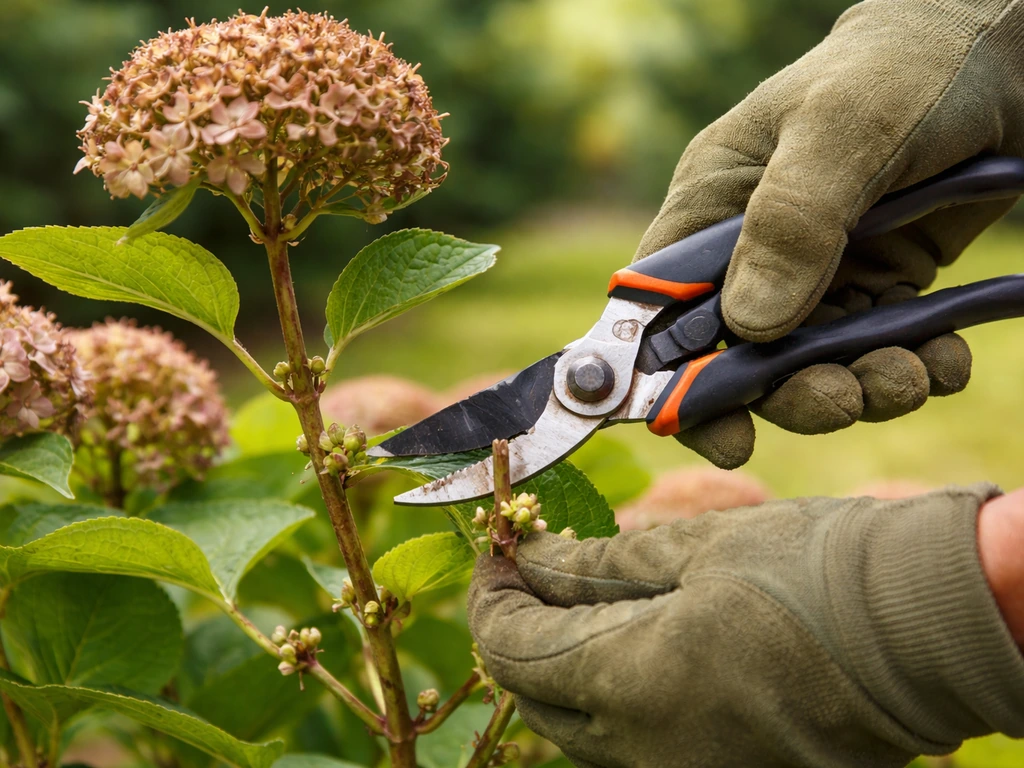
This is where most gardeners accidentally sabotage themselves. Nikko Blue blooms on old wood, the buds that will open next July are already forming on this year's stems by late summer. If you prune in fall, late winter, or early spring, you are cutting off next year's flowers. It's that direct.
The correct time to prune is immediately after flowering, which for Nikko Blue means late summer, roughly August through early September. At that point, you can remove spent flower heads and cut back any stems that bloomed. You can also remove dead or crossing stems at this time. What you should not do is give the plant a hard cutback in the fall or trim it up in spring "to tidy things up", either of those moves removes the buds you've been growing all season.
The one exception is spring cleanup after winter damage. Wait until you see new growth emerging from the stems, that tells you exactly which buds survived. Then cut back only the dead portions to just above living tissue. If you prune before you see that new growth, you risk cutting living stems that just look dead. I've made that mistake more than once, and it's a frustrating way to lose a full season of blooms.
If your plant has gotten overgrown or crowded, you can do light renewal pruning right after flowering by removing the oldest, thickest stems at the base, no more than one-third of the total stems in a single season.
Troubleshooting the most common problems
Chlorosis (yellow leaves with green veins)
If you're seeing leaves that look yellow but the veins stay dark green, that's interveinal chlorosis, and in Nikko Blue it almost always comes down to soil pH being too high. When pH climbs above 6.5 or 7.0, iron and manganese become chemically unavailable to the plant even if they're present in the soil. The plant starves for micronutrients it can't absorb.
The fix starts with a soil test to confirm pH. Then apply a soil acidifier (elemental sulfur or aluminum sulfate) to bring pH back into range. For a faster response on a plant that's already symptomatic, apply chelated iron as a foliar spray or soil drench. If your soil pH is above 7.2, standard iron chelates may not work, look for EDDHA chelated iron, which remains effective at higher pH levels. Drought stress can also make chlorosis worse by reducing nutrient uptake, so make sure the plant is getting enough water.
No blooms (or very few)
The four main reasons Nikko Blue fails to flower are: winter injury to the flower buds, pruning at the wrong time, too much shade, and excess nitrogen fertilizer. Work through that list honestly. If you're in zone 6 and had a harsh winter with no protection on the plant, the buds almost certainly died. If you trimmed the shrub back in fall or spring, the buds are gone. If the plant is under a dense tree canopy, it won't bloom well regardless of everything else.
Winter injury
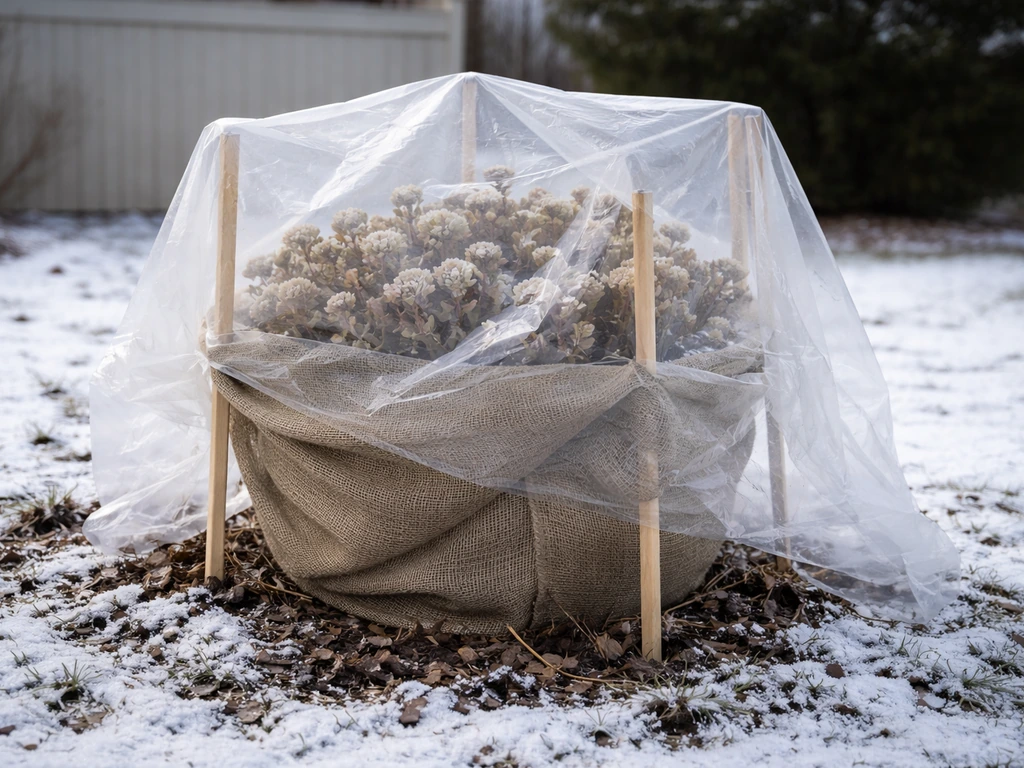
Winter damage is the defining challenge of growing Nikko Blue in zone 6, and it's not rare even in zone 7 during unusual cold snaps. Cape Cod’s Hydrangea Injury Fact Sheet documents winter injury patterns for bigleaf hydrangea, including stem and bud susceptibility. The buds that form in August and September sit on the stems all winter, fully exposed. A hard freeze, especially an early one before the plant has hardened off or a late one after growth starts in spring, can kill those buds without killing the stems. The plant looks alive but produces no flowers.
To protect the buds, cover the plant when temperatures drop below freezing, especially before the plant is fully dormant. An old bed sheet, burlap wrap, or a cardboard box placed over the shrub overnight provides enough insulation to protect the buds in most situations. For zone 6 gardeners, some people build a simple wire cage around the plant and fill it with dry leaves for the whole winter, that's the most reliable protection I've seen. Thick mulch at the base protects the crown and the lower stems, where some buds often survive even when upper stems freeze.
If your plant does suffer winter injury, wait until you see new growth in spring before pruning. Cut dead stems back to just above the first set of living buds. The plant will often push new growth from lower on the stem or even from the crown, and while you may lose that year's blooms, the plant itself is usually fine.
Powdery mildew and other pests
Powdery mildew shows up as a white, powdery coating on leaf surfaces and is most common in humid conditions with poor air circulation. It's rarely fatal but it's unsightly and stresses the plant. The best prevention is good site selection (avoid crowded spots), morning watering so leaves dry quickly, and spacing plants to allow airflow. If you catch it early, a neem oil spray or a fungicide labeled for powdery mildew on ornamentals will knock it back. Remove heavily infected leaves to reduce spore spread.
Aphids occasionally cluster on new growth, and spider mites can be a problem in hot, dry summers. Both respond well to a strong spray of water or insecticidal soap. Leaf spot diseases show up in wet seasons but are generally minor. The healthier your plant's overall growing conditions, right pH, consistent moisture, good drainage, appropriate sun, the more resistant it will be to most pest and disease pressure.
Quick-reference care calendar
| Season / Month | Task |
|---|---|
| Early spring (March) | Apply first round of balanced fertilizer (8-8-8 or 10-10-10); check soil pH; apply acidifier if needed |
| Spring (after new growth visible) | Prune winter-damaged stems back to living tissue only; remove mulch piled against stems |
| Late spring (May) | Apply second round of fertilizer; top up mulch to 3–5 inches; begin regular watering schedule (1 inch/week) |
| Summer (July) | Apply third and final fertilizer round; increase watering to 2 inches/week during heat waves; enjoy blooms July–August |
| Late summer (Aug–early Sep) | Prune spent blooms and any bloomed stems immediately after flowering — this is the only correct pruning window |
| Fall | Stop fertilizing; build up mulch at base; prepare winter protection for zone 6 plants; cover when freeze is forecast |
| Winter (zone 6) | Keep wire cage with leaf fill or covering in place during freeze events; check for desiccation on mild days |
Where Nikko Blue fits in your hydrangea garden
Nikko Blue is a classic for a reason, that big, true-blue mophead bloom is hard to match for sheer impact in a summer border. It's worth knowing where it sits relative to other hydrangeas you might be growing. It's more demanding than panicle types like Vanilla Strawberry, which bloom on new wood and don't care much about soil pH. Vanilla Strawberry hydrangeas are usually easier to grow because they bloom on new wood and are less sensitive to soil pH. It's also less forgiving than reblooming cultivars when winter takes out the buds. If you're in zone 6 and want something with a similar look but more winter resilience, other bigleaf varieties bred for cold tolerance may be worth exploring. But if you want that specific deep blue and you're willing to manage the soil pH and protect the buds, Nikko Blue delivers something genuinely beautiful that few other shrubs can match.
FAQ
How can I tell if my Nikko Blue is going to be blue or pink before it blooms?
Look at your soil pH from a test, not guesswork. If pH is consistently below about 6.0 and you have decent soil aluminum availability, flower color is usually more reliably blue. If it is above 6.5, expect pink or muddy purple even if the plant looks healthy.
My hydrangea has lots of leaves but no flowers, what should I check first?
Check pruning timing first, then winter bud survival, then shade level. Since buds form on old stems, trimming in fall or spring often removes next year’s blooms. After that, too much nitrogen (especially late in the season) can push leafy growth at the expense of flowers.
Should I prune off dead stems in early spring even if I have not seen new growth yet?
Wait until you see new shoots from the buds. Pruning too early risks cutting stems that are still alive but just not visibly sprouting yet, and that can cost you that season’s flowers.
Can I grow Nikko Blue in a container, and if so how do I manage pH?
Yes, but you must be more consistent with watering and pH because container soil changes faster. Use an acidic potting mix, keep the roots evenly moist (not soggy), and recheck pH periodically. Also avoid overfertilizing, since excess nitrogen in pots commonly leads to big foliage and few blooms.
What water quality issue could gradually change my hydrangea flower color?
Alkaline irrigation water can slowly raise soil pH over time, shifting blooms toward pink. If your neighborhood uses hard water, consider collecting rainwater or using filtration, and re-test soil every year or two to decide whether acidifying amendments are needed.
How do I protect Nikko Blue buds in zone 6 without smothering the plant?
Use a simple overnight covering for freezing nights, then remove it once temperatures rise. For longer protection, a wire cage filled with dry leaves can insulate better than wrapping the plant in wet materials. Keep mulch around the crown, and avoid piling mulch up so high it stays wet and cold for weeks.
Is morning sun required, or will afternoon shade alone work?
Morning sun is ideal because it dries leaves and supports steady bloom development. Afternoon shade is still crucial in zones 8 and 9 to prevent heat stress and leaf scorch. In practice, a site with east or north exposure often gives the best balance of light and winter wind protection.
How much should I water during hot spells for a newly planted Nikko Blue?
New plants can wilt quickly, sometimes within a day during extreme heat. Check soil moisture near the root zone and water deeply when the top couple of inches start to dry. Aim roughly for about 1 inch per week overall early on, then increase toward 2 inches per week during hot, dry stretches.
What mulch should I use if I want to support blue flowers, and should I change it in winter?
Pine bark, pine straw, or shredded leaves tend to help because they break down gradually and support an acidic soil environment. Keep mulch at about 3 to 5 inches year-round, refresh in spring, and in zone 6 consider building it slightly higher around the base going into fall for crown protection.
My leaves look yellow with dark green veins, can that be something other than pH?
Interveinal chlorosis in Nikko Blue is most often due to pH being too high for micronutrient uptake. Still, drought stress can worsen symptoms by limiting nutrient transport, so verify pH with a soil test and make sure watering is consistent before assuming it is only an iron shortage.
Will chelated iron fix blue color directly?
Chelated iron can help reverse chlorosis caused by nutrient unavailability, but it does not replace the need for low pH and aluminum availability for blue blooms. Think of it as symptom support for yellowing, while flower color still depends on maintaining soil conditions that keep aluminum available.
Why does my hydrangea sometimes bloom poorly even when pruning and winter protection seem fine?
Common hidden causes are too much shade, crowded planting that reduces airflow, and excess nitrogen fed late in the season. Powdery mildew or repeated leaf stress can also reduce overall flowering quality, so watch for disease pressure and adjust site spacing and watering timing.