
Blue hyacinths are some of the most reliably rewarding spring bulbs you can grow, and with the right cultivar, timing, and a little prep work, you can have those dense, fragrant spikes blooming outdoors in April or forced indoors almost any month of the year. Plant your bulbs in fall (September through November depending on your zone), aim for a planting depth of 10 cm (4 inches), and if you want them indoors in winter, plan on 10 to 16 weeks of cold before you bring them into the warmth. That's the core of it. Everything else in this guide fills in the detail so you don't lose bulbs to rot, get floppy stems, or end up with a washed-out purple when you were promised a rich navy blue.
How to Grow Blue Hyacinth: Complete Guide for Gardeners
Marcus Holloway
5 Aug 2026
What this guide covers (and how fast you'll see results)
This guide walks you through the full cycle: picking genuinely blue cultivars and healthy bulbs, planting them outdoors in fall, forcing them inside using a hyacinth vase or a pot, caring for them through bloom, and keeping those bulbs alive for future seasons. If you're planting outdoors in October, expect blooms in March or April. If you're forcing indoors and you start chilling bulbs in October, you can time a February bloom for a windowsill display. I've grown all three of the main true-blue cultivars described below, and the details here come from both hands-on experience and solid horticultural guidance, not just catalog copy.
Choosing true-blue cultivars and picking healthy bulbs
The cultivars that are actually blue
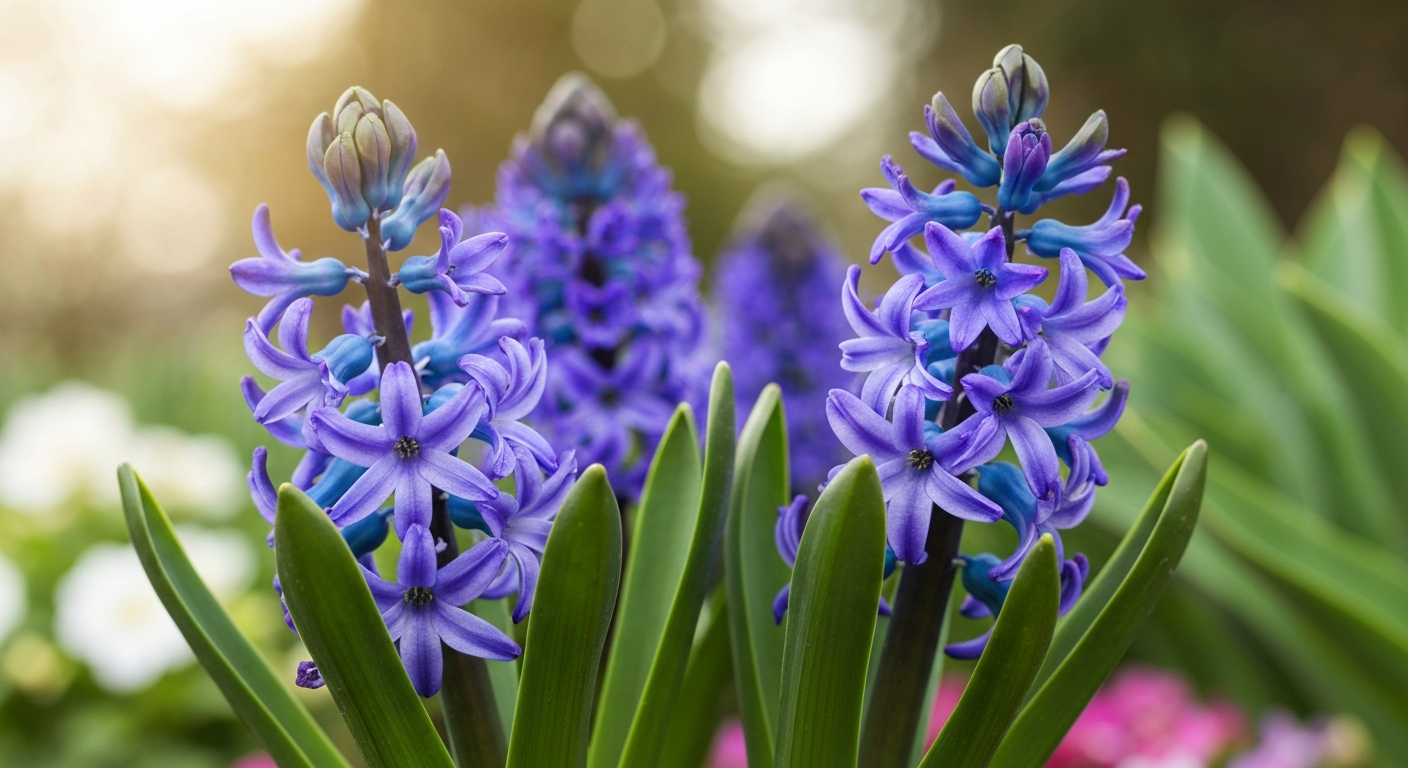
This matters more than most gardening decisions because hyacinth color labeling is notoriously loose. Plenty of bulbs sold as 'blue' bloom lavender or violet. There are three cultivars consistently verified by horticultural authorities as genuinely blue. 'Blue Jacket' delivers a deep, almost navy blue with a glossy sheen on the florets. 'Delft Blue' is softer, more of a medium periwinkle blue, and it's probably the most widely available. 'Blue Pearl' leans pearly lavender-blue rather than true blue, but it's cooler-toned than most purples and worth growing if you want something more delicate. If you want the deepest, most saturated blue, 'Blue Jacket' is your pick. For a classic cottage-garden look, 'Delft Blue' is hard to beat and performs well in most zones.
Verifying color and finding a trustworthy supplier
Buy from specialist bulb suppliers or reputable mail-order companies that source from Dutch growers and photograph their actual stock rather than using stock art. When you're shopping in-store, look for labeled species names (Hyacinthus orientalis) and the cultivar name printed clearly, not just a color like 'Blue Mix.' Check for bulbs graded 16/17 cm or larger in circumference (the measurement goes around the widest part of the bulb, not across it). Historical U.S. bulb trade tables classify hyacinth bulb sizes by circumference, listing garden sizes commonly 14–17 cm and top/forcible (exhibition/forcing) sizes often 17–19 cm. Larger circumference means more florets and a stronger spike. For garden planting, 14 to 17 cm bulbs work well. For forcing, push for 17 to 19 cm bulbs. That extra size genuinely makes a difference in floret count and stem strength.
What a healthy bulb looks like
Pick up the bulb and squeeze it gently. It should feel firm and heavy for its size, with tight, dry, papery outer tunics. Reject anything soft, spongy, or foul-smelling. Check the basal plate (the flat bottom from which roots grow) and make sure it's intact, hard, and dry. Blue-green powdery residue is Penicillium mold. Pink or reddish discoloration at the base is Fusarium. Either one means leave it on the shelf. I've lost entire forcing batches by buying discounted bulbs at the end of the season that looked fine on the outside but had compromised basal plates. It's not worth saving a few dollars.
Storing bulbs before planting
If you can't plant right away, store bulbs dry with good air circulation at room temperature, roughly 17 to 20°C (63 to 68°F). Don't refrigerate them yet (that's the deliberate chilling stage that comes later) and don't put them somewhere cool and damp like a garage floor. Cool, humid storage is exactly what encourages Penicillium. A mesh bag on a shelf at normal indoor temperatures is ideal for a few weeks.
At-a-glance planting depth and spacing table
| Method | Bulb Size (circumference) | Planting Depth (top of bulb to soil surface) | Spacing | Notes |
|---|---|---|---|---|
| Outdoor garden bed | 14–17 cm (bedding grade) | 10 cm / 4 in | 15–20 cm / 6–8 in apart | Plant pointed tip facing up; mulch 5–8 cm after planting |
| Pot forcing (indoor) | 17–19 cm (forcing grade) | Tip just at or slightly above rim | Bulbs can nearly touch in pot | Cover with 5 cm sand or foam to prevent bulbs lifting during rooting |
| Vase/water forcing | Largest available (17–19 cm) | Water just below basal plate, no contact | One bulb per vase | Use narrow-neck hyacinth glass; roots must not sit in water |
| Naturalized drift planting | 14–16 cm | 10 cm / 4 in | 10–15 cm / 4–6 in (closer for mass effect) | Works well in well-drained lawn edges or under deciduous trees |
When to plant outdoors: fall timing by zone
Hyacinth bulbs need a cold winter to bloom properly. That's not optional. Planting in fall gives bulbs time to establish roots before the ground freezes, and the cold period over winter provides the vernalization they need for spring flowering. The general rule from university extension guidance is to plant 6 to 8 weeks before your ground normally freezes, or when nighttime temperatures are consistently in the 4 to 10°C (40 to 50°F) range. That timing varies a lot by climate.
| Hardiness Zone | Typical Planting Window | Expected Bloom |
|---|---|---|
| Zones 3–4 (cold climates, e.g. Minnesota, Canada) | Late September to early October | Late March to early April |
| Zones 5–6 (e.g. Ohio, New England, Pacific Northwest) | Mid-October to early November | Mid-April |
| Zones 7–8 (e.g. Georgia, Virginia, Pacific Northwest coast) | November to early December | Late March to April |
| Zones 9–10 (mild winters, e.g. Southern California, coastal South) | Requires pre-chilling bulbs 10–12 weeks at 4–7°C before planting; plant December to January | February to March |
In warmer zones (9 and 10), your winters simply don't get cold enough naturally. You'll need to pre-chill bulbs in the refrigerator for 10 to 12 weeks before planting, which means treating them essentially like a forced pot bulb and then planting them out. Keep them away from ripening fruit in the fridge, because ethylene gas from apples and pears can damage the flower embryo inside the bulb.
Site selection and soil: what blue hyacinths actually need
Light requirements
Choose a spot with full sun to partial shade and a minimum of 4 to 6 hours of direct sun per day. Full sun produces the sturdiest stems and the most intense color. Partial shade is workable, especially under deciduous trees where the canopy is still bare when hyacinths bloom in early spring. Avoid deep or permanent shade. The plants will bloom but stems will be weak and lean badly toward any available light.
Drainage is everything
More blue hyacinth bulbs are killed by waterlogged soil than by any other single cause. Do a simple drainage test before you plant: dig a hole about 30 cm (12 inches) deep, fill it with water, and see how long it takes to drain. It should drain within 8 to 10 hours. If water is still sitting after that, the drainage is too poor for hyacinths and you'll lose bulbs to basal rot over winter. Raised beds, slopes, or amended beds are the fix, not a better cultivar.
Soil type, pH, and amendments
Hyacinths prefer a moderately fertile, loam or sandy loam soil with about 2 to 4% organic matter. The ideal pH sits between 6.0 and 6.8, slightly acidic to neutral. Before amending anything, do a soil test. UGA Extension recommends a slightly acidic to neutral soil pH of about 6.0–6.8 for flowering bulbs UGA Extension recommends a soil pH of about 6.0–6.8. You can get a reliable test through your local cooperative extension service for a few dollars, and it takes the guesswork out of what your soil actually needs. If your pH is too high, sulfur brings it down. If it's too low, ground limestone raises it. Add a general-purpose low-nitrogen bulb fertilizer or bone meal to the planting hole, not a high-nitrogen product. High nitrogen pushes leafy growth at the expense of the flower and makes stems weak. I've made the mistake of throwing granular all-purpose fertilizer into bulb beds as a shortcut, and the result was lush foliage and disappointing blooms.
Step-by-step outdoor planting instructions
- Prepare the bed by loosening soil to a depth of 30 cm (12 inches) and working in compost (about 5 cm / 2 inches) if your soil is compacted or low in organic matter. Rake level.
- Test drainage using the fill-and-drain method described above. If the site drains slowly, consider a raised bed or blend in coarse grit to improve structure.
- Dig individual holes or a wide trench to a depth that places the top of each bulb 10 cm (4 inches) below the soil surface. The pointed tip faces up.
- Space bulbs 15 to 20 cm (6 to 8 inches) apart for standard bed planting. For a massed display, tighter spacing of 10 to 15 cm (4 to 6 inches) creates a denser effect but may reduce airflow.
- Set each bulb on a small bed of coarse sand at the base of the hole. This improves drainage directly under the basal plate, which is the most rot-prone part.
- Backfill with the removed soil (improved with compost if needed) and firm gently by hand. Do not compact heavily.
- Water thoroughly after planting to settle the soil and initiate root growth. You should not need to water again unless you're in a dry spell, since fall rain typically handles moisture needs.
- Apply a 5 to 8 cm (2 to 3 inch) layer of mulch (shredded bark, straw, or leaves) after the ground has had a few light frosts. This insulates the soil and moderates freeze-thaw cycles, not to warm the soil.
One thing worth noting: wear gloves when handling hyacinth bulbs. The outer tunic contains oxalic acid crystals that irritate skin, especially if you're handling a large batch. It's not serious, but you'll know about it the next day if you skip the gloves.
Forcing hyacinths indoors: choosing your method
Forcing means manipulating the bulb's environment to trigger bloom earlier than it would naturally, or at any time of year you choose. There are three methods worth knowing: chilling and potting in soil, chilling in a hyacinth vase over water, and pre-chilled pot forcing. Each one suits a different goal and skill level. Vase forcing is the most visually dramatic and satisfying for a windowsill display. Pot forcing gives you the most control and the best-looking blooms. Pre-chilling bulbs in warm climates is essentially a workaround for zones with insufficient winter cold.
| Method | Best For | Equipment Needed | Cold Period Required | Time to Bloom After Cold |
|---|---|---|---|---|
| Hyacinth vase (water) | Windowsill display, watching roots grow, gifts | Narrow-neck hyacinth glass | 10–14 weeks at 4–7°C (39–45°F) | 2–4 weeks in a bright, cool room |
| Pot forcing (soil) | Best bloom quality, multiple bulbs, gifting | Pot with drainage, forcing-grade potting mix | 10–16 weeks at 4–7°C (39–45°F) | 2–3 weeks once moved indoors to warmth |
| Pre-chilled bulbs (warm zones) | Zones 9–10 where winters are too mild | Refrigerator, paper bag | 10–12 weeks at 4–7°C (39–45°F) | Plant outdoors or pot up after chilling; blooms 3–5 weeks later |
For vase forcing, the setup is beautifully simple but the details matter. For pot forcing indoors, the process mirrors commercial Dutch forcing protocols scaled down for home gardeners. If you're interested in growing hyacinths in a vase specifically, that method gets its own dedicated treatment elsewhere on this site. For tips specific to purple-flowering varieties, see our guide on how to grow purple hyacinth. For step-by-step instructions specifically on forcing hyacinths, see our guide on how to grow forced hyacinths. If you're looking for a game-specific guide, see how to grow purple hyacinth acnh for step-by-step instructions. For step-by-step instructions on vase forcing, see our guide on how to grow hyacinth in a water vase. The instructions below focus on pot forcing and the chilling calendar that applies to both methods.
Vase forcing step-by-step
- Select the largest, firmest bulbs you have (17 to 19 cm circumference if possible). One bulb per hyacinth glass.
- Fill the narrow-neck vase with water to a level just below where the basal plate will sit. The bulb base must not touch the water. Even a small gap prevents rot while still encouraging root growth toward the moisture.
- Set the bulb in the neck of the vase with the flat basal plate facing down.
- Place the vase in a cool, dark location at 4 to 10°C (39 to 50°F). A refrigerator set to its warmest setting, an unheated basement, or a cold garage works well.
- Check weekly. Top up the water level so it stays just below the basal plate. Roots will grow down into the water over the coming weeks.
- When roots fill the vase and the shoot is 2 to 5 cm (1 to 2 inches) tall, typically after 10 to 14 weeks of cold, move the vase to a cool, bright room at around 15 to 18°C (60 to 65°F). Avoid hot, sunny windowsills initially.
- Expect bloom 2 to 4 weeks after moving to warmth, depending on your cultivar and room temperature.
Pot forcing step-by-step
- Use fresh, well-draining potting mix and a pot with drainage holes. A 15 to 20 cm (6 to 8 inch) pot holds three to five bulbs nicely.
- Fill the pot with potting mix, then set bulbs so their tips sit just at or slightly above the pot rim. Bulbs can nearly touch each other in the pot.
- Cover the bulbs with about 5 cm (2 inches) of coarse sand or horticultural foam. This weighs down the growing medium so bulbs don't push up out of the pot as roots develop, which is a common issue.
- Water thoroughly so the mix is evenly moist but not waterlogged.
- Move the pot to your cold location at 4 to 9°C (39 to 48°F) for the full chilling period. A refrigerator, cold frame, or unheated garage works. Darkness is ideal but not strictly required if temperatures stay consistently cold.
- After the required cold period (see the chilling schedule below), move the pot to a cool, bright room at about 15 to 18°C (60 to 65°F). Avoid heat vents and direct heat.
- Water as needed to keep the mix evenly moist. Blooms will develop within 2 to 3 weeks.
Chilling schedules: how long, how cold, and when to start
The chilling period, also called vernalization, is the make-or-break part of forcing. The bulb needs sustained cold to complete its internal development. The right temperature range is 2 to 7°C (35 to 45°F). Too warm and the cold period doesn't count. Too cold and you risk damaging the flower bud inside. Duration varies by cultivar and your target bloom date.
| Cultivar | Minimum Cold Period | Target Bloom Month | Start Chilling By | Temperature |
|---|---|---|---|---|
| Blue Jacket | 12–13 weeks | February | Mid-October | 2–7°C (35–45°F) |
| Blue Jacket | 12–13 weeks | March | Early November | 2–7°C (35–45°F) |
| Delft Blue | 9–11 weeks | January | Late October | 2–7°C (35–45°F) |
| Delft Blue | 9–11 weeks | February | Late November | 2–7°C (35–45°F) |
| Blue Pearl | 9–11 weeks | February | Late November | 2–7°C (35–45°F) |
| Blue Pearl | 9–11 weeks | March | Early January | 2–7°C (35–45°F) |
General guidance from university extension sources puts the safe range at 10 to 16 weeks for most Hyacinthus orientalis cultivars. 'Blue Jacket' sits at the longer end of that range (12 to 13 weeks minimum), while 'Delft Blue' and 'Blue Pearl' typically need 9 to 11 weeks. If you're unsure of your cultivar or working with an unlabeled bulb, default to 13 weeks. You won't hurt the bulb with a slightly longer cold period, but cutting it short almost always means a stunted or incomplete flower spike.
When chilling in a home refrigerator, use the crisper drawer set to its warmest point, around 4 to 5°C (39 to 41°F). Keep bulbs in paper bags (not plastic, which traps moisture) away from fruit. Check them every two weeks for any signs of mold or rot. A single rotting bulb can spread Penicillium to its neighbors quickly in the enclosed space of a refrigerator.
Daily and seasonal care: light, water, and feeding
Outdoors during the growing season
Once shoots emerge in late winter or early spring, hyacinths need consistent moisture but never waterlogged conditions. Rainfall typically handles watering needs in most climates during their spring growing window. If you're in a dry spring, water when the top 3 to 5 cm (1 to 2 inches) of soil feels dry. Stop watering after the foliage dies back naturally in late spring or early summer. The bulbs want to dry out during summer dormancy. A slow-release bulb fertilizer applied in early spring as shoots emerge gives the bulb what it needs to build energy for next year's bloom. Avoid high-nitrogen fertilizers. They push leaf growth and soften stems.
Preventing floppy stems and keeping blooms upright
Floppy stems are one of the most common complaints with forced hyacinths, and usually there are two culprits: moving bulbs from cold to a warm room too fast, or keeping them in a room that's too hot. When you bring pots or vases out of cold storage, give them a transitional stage in a cool (12 to 15°C / 54 to 59°F), bright room for a week before moving them into full warmth. This allows stems to develop gradually and stay compact. Also, correct planting depth outdoors (10 cm to the top of the bulb) naturally supports a sturdier stem than shallow planting. If a bloom head gets so heavy it leans despite your best efforts, a thin bamboo stake and a loose tie are unobtrusive and effective. For detailed tips on how to make hyacinth grow straight, including staking, proper planting depth, and gradual temperature transitions, see our guide on stem support and temperature transitions.
After bloom care outdoors
Once flowers fade, remove the spent flower spike by snapping or cutting it off, but leave all the foliage intact. The leaves are still photosynthesizing and feeding the bulb for next year's bloom. Cutting them early is one of the most common reasons gardeners get poor or no blooms in the second year. Let foliage yellow and die back on its own, which typically takes 6 to 8 weeks after bloom. You can tie the leaves into loose bundles if they bother you aesthetically, but don't braid or rubber-band them tightly, as that limits light capture.
Bulb lifting, overwintering, and propagation
In zones 4 through 8, hyacinth bulbs can stay in the ground year-round if your soil drains well. In wetter climates or heavy soils, lift bulbs after the foliage dies back in early summer. Let them dry in a shaded, airy spot for a week, brush off soil, and store in a mesh bag or paper bag at room temperature (17 to 20°C / 63 to 68°F) in a cool, ventilated location until fall planting. Check periodically for soft spots or mold.
Hyacinths propagate naturally by producing small offset bulblets around the mother bulb. These can be separated at lifting time and replanted. They typically take 2 to 3 years to reach flowering size. It's not fast, but it's a satisfying way to expand a collection without buying new bulbs every year. Forced bulbs (especially vase-forced ones) are exhausted after bloom and rarely perform as well the next season. Pot-forced bulbs have a better chance if you plant them out in the garden after forcing, let the foliage die down naturally, and give them a full outdoor growing season to recover.
Seasonal care calendar at a glance
| Month (Northern Hemisphere) | Task |
|---|---|
| September–October | Plant outdoor bulbs (Zones 5–8). Begin refrigerator chilling for forced bulbs targeting January–February bloom. |
| October–November | Plant outdoor bulbs (Zones 7–8). Continue chilling forced bulbs. Do not water outdoor beds unless extremely dry. |
| November–December | Apply mulch to outdoor beds after first frosts. Forced bulbs in cold storage: check water levels in vases, check pots for moisture. |
| January–February | Bring forced pots/vases out of cold when roots are established and shoots are 2–5 cm tall. Move to cool, bright room. |
| March–April | Outdoor hyacinths bloom. Water if dry. Enjoy forced indoor blooms. Remove spent flower heads, not foliage. |
| May–June | Allow foliage to die back naturally. Fertilize with low-nitrogen bulb feed as blooms fade. Lift bulbs in wet or clay soils. |
| July–August | Store lifted bulbs dry at 17–20°C. Bulbs in ground: no watering needed during dormancy. |
Troubleshooting common problems
No blooms or very short flower spikes
This is almost always a chilling issue with forced bulbs (cold period cut short) or a foliage issue with outdoor bulbs (leaves were cut before they died back naturally the previous season). For outdoor bulbs that bloomed well in year one but not year two, the cause is nearly always premature foliage removal or waterlogged summer dormancy. If your bulb is sitting in wet soil all summer, the basal plate slowly rots and the flower bud fails to develop.
Floppy or leggy stems
Indoors: the room was too warm, the transition from cold was too abrupt, or the light source was too directional (causing the stem to lean). Outdoors: shallow planting, high nitrogen, or late-season warmth during bloom. The fix outdoors is proper planting depth (10 cm to the top of the bulb) and avoiding high-nitrogen feeding. Indoors, slower temperature transitions and rotating the pot a quarter turn daily help. A thin stake is a perfectly legitimate tool.
Rot and fungal disease
Blue-green powdery mold on stored or planted bulbs is Penicillium. Pink or brown discoloration at the basal plate, sometimes with a foul smell, is Fusarium basal rot. Both are made worse by mechanical damage to the bulb, cool humid storage below 17°C with poor airflow, and waterlogged soil. The practical response: remove and destroy affected bulbs immediately, don't compost them, and treat the remaining bulbs in a batch with a fungicide dust before replanting. Prevention through good drainage, proper storage, and handling bulbs carefully is far more effective than any after-the-fact treatment.
Pests
Squirrels, voles, and mice dig up hyacinth bulbs, especially freshly planted ones. The smell of the bulb attracts them. Laying a piece of wire mesh (chicken wire or hardware cloth) over the planting area just below the mulch deters most digging. Remove it in early spring before shoots emerge, or cut holes where the shoots will break through. Aphids can cluster on hyacinth flower spikes in warm spring weather. A strong spray of water from the hose is usually enough, or a diluted neem oil spray if the infestation is heavier.
Safety: toxicity to pets and people
All parts of Hyacinthus orientalis are toxic to dogs, cats, and horses if ingested, with the bulb being the most concentrated source. Symptoms in pets include drooling, vomiting, diarrhea, and lethargy. If you suspect a pet has eaten part of a bulb, contact your veterinarian immediately. The plant is also an irritant to human skin due to oxalic acid crystals, particularly in the outer tunic. Always wear gloves when handling large quantities of bulbs, and wash hands before touching your face. It's not a reason to avoid growing them, just something to know.
Companion plants and garden uses
Blue hyacinths combine beautifully with yellow daffodils and cream or white tulips for a classic spring combination. The contrast between 'Blue Jacket' and a pale yellow narcissus is genuinely striking. Grape hyacinths (Muscari) planted nearby echo the blue tones and extend the season slightly since they often bloom a week or two after Hyacinthus. Pansies and violas planted around hyacinths fill in the gaps as the bulb foliage ages and collapses. For a more formal look, pair blue hyacinths with white 'White Pearl' hyacinths in alternating rows. The fragrance from a massed planting near a path or entry is one of spring's real rewards, so site them where you'll actually walk past them. For color-specific cultivation tips, see our guide on how to grow pink hyacinth.
FAQ
Which true-blue hyacinth cultivars should I choose for reliable blue color?
Select verified blue cultivars: Hyacinthus orientalis 'Blue Jacket' (deep/navy blue), 'Delft Blue' (soft/medium blue) and 'Blue Pearl' (pearly/lavender-blue). Buy from reputable suppliers and verify cultivar name on label.
How do I choose healthy hyacinth bulbs? What sizes are best for outdoor planting vs forcing?
Look for bulbs that are firm, heavy for their size, with tight dry tunics, intact basal plates and no soft spots, mold, or foul odor. Avoid bulbs with blue-green (Penicillium) or pink (Fusarium) growth. Bulb-size convention: circumference measured around the widest part (cm). For best forcing and large blooms use 17–19 cm circ. For garden bedding 14–17 cm is common and performs well outdoors.
When and where should I plant hyacinth bulbs outdoors?
Plant in autumn, about 6–8 weeks before expected ground freeze or when night temps fall to ~4–10°C (40–50°F). Choose a site with full sun to part shade (minimum 4–6 hours direct sun), well-drained soil (no standing water), loamy or sandy-loam texture, good organic matter (2–4%), and pH ~6.0–6.8.
What are the exact planting depth and spacing recommendations? Can you give a quick table?
Plant bulbs about 2–3× bulb height (rule of thumb) — generally ~10 cm (4 in) from top of bulb to soil surface. Space bulbs 15–20 cm (6–8 in) apart. At-a-glance table (top of bulb to soil surface / center-to-center spacing): - Small bulbs (14–15 cm circ): depth 8–10 cm (3–4 in) / spacing 12–15 cm (5–6 in) - Medium bulbs (16–17 cm circ): depth 10 cm (4 in) / spacing 15–18 cm (6–7 in) - Large bulbs (18–19+ cm circ): depth 10–12 cm (4–5 in) / spacing 18–20 cm (7–8 in) Measure depth from top of bulb to soil surface; firm soil over bulbs and water after planting.
How do I force hyacinths in a vase (glass bulb vase)? Step-by-step and timing.
Vase forcing steps: 1. Choose large, healthy bulbs (17–19 cm circumference preferred). 2. Use a hyacinth bulb vase with a narrow neck so the bulb sits on the rim. Fill water to just below the basal plate — water must NOT touch the bulb. 3. Place in a cool, dark location at ~2–7°C (35–45°F) for root development. Typical chilling: 10–16 weeks depending on cultivar and target bloom date (see forcing calendar). Check weekly and top up water so roots have moisture. 4. After root system is 2–3 cm or roots reach water, move vase to bright, cool room (15–18°C / 60–65°F). Keep out of direct hot sun; rotate vase for even growth. 5. Expect 2–4 weeks from removal of cold to flowering. Keep stems cool to avoid leggy growth; stake only if necessary.
How do I force hyacinths in pots (potted forcing)? Step-by-step and timing.
Potted forcing steps: 1. Use clean pots (10–15 cm or larger depending on bulb size) with good drainage and fresh, well-draining potting mix. 2. Plant bulbs with the top just at or slightly above the soil surface for exhibition finish; multi-bulb pots may be crowded — aim for snug spacing so bulbs touch. For tall shoots, leave room for 12–18 cm shoot growth. 3. Place pots in a cool rooting area at ~8–10°C (46–50°F) for initial root growth for 2–3 weeks (optional) then move to vernalization at 2–7°C (35–45°F) for 10–16 weeks depending on cultivar. 4. After chilling, bring pots into a bright cool room (15–18°C / 60–65°F). Flowers should appear in 2–4 weeks. Maintain even moisture; do not overwater during chilling (keep moist but not wet). Use supports if stems flop.