
Yes, Miracle-Gro is good for pansies, and it works well when you match the right product to the right situation. Pansies are heavy feeders that respond visibly to consistent nutrition, and Miracle-Gro's water-soluble and slow-release formulas both deliver what these plants need. The catch is using the correct rate and timing: too much, too often, and you'll burn roots or trigger salt buildup; too little, and you'll get pale leaves and stalled blooms. The Soils & Fertilizers chapter from UNH Cooperative Extension explains that many synthetic fertilizers behave as salts that can draw water away from roots (causing tip/margin necrosis and white salt crusts in containers) and recommends leaching excess salts with generous watering and reducing application rates to prevent or correct fertilizer burn Soils & Fertilizers (chapter) — UNH Cooperative Extension educational chapter (discussion of soluble salts / salt injury / fertilizer burn). Get the balance right and your pansies will reward you with dense, colorful flowers from fall all the way through spring.
Is Miracle-Gro Good for Pansies? Feeding Guide & Fixes

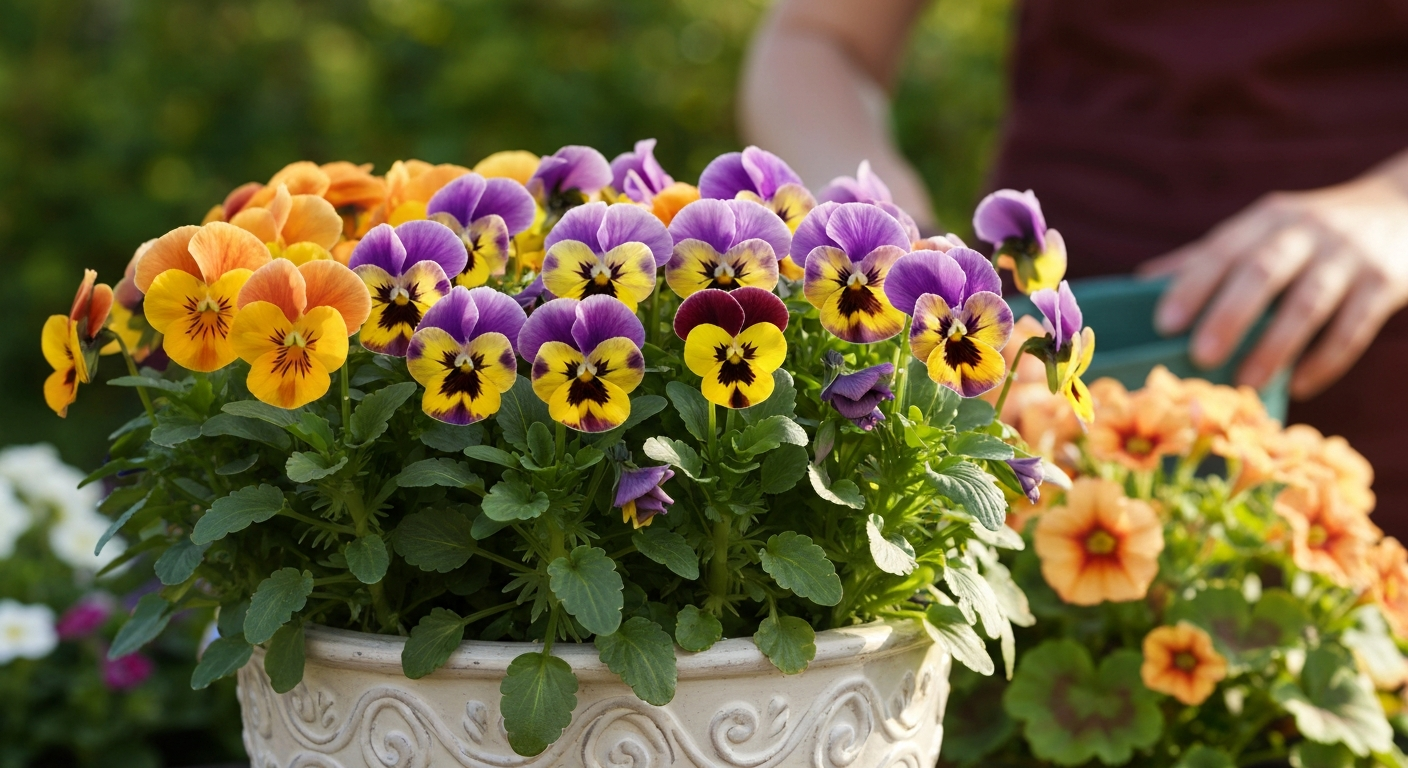
What pansies actually need from fertilizer
Pansies (Viola x wittrockiana) are cool-season annuals that push a surprising amount of growth and flower production into a relatively short window. University of Arkansas Cooperative Extension puts it plainly: pansies are heavy feeders and do respond well to fertilizer. That tracks with my own experience. A pansy that gets fed on schedule looks entirely different from one left to fend for itself in garden soil, the leaves are a deeper green, the stems are sturdier, and the flowers keep coming instead of petering out after the first flush.
In terms of nutrients, pansies want a reasonable nitrogen level to support leaf and stem growth, moderate phosphorus for root development and bloom initiation, and solid potassium for general plant health and cold hardiness. Commercial greenhouse growers often use a specialized 15-2-20 pansy formula, that high-potassium, lower-phosphorus ratio suits the plant's naturally compact growth habit. For home gardeners, an all-purpose balanced formula gets you most of the way there without needing specialty products. The soil pH matters just as much as the feed itself: UF/IFAS and Michigan State University Extension both note that pansies thrive in a slightly acidic substrate around pH 5.4 to 5.8. Outside that range, nutrients lock up in the soil and fertilizer stops working, regardless of what product you use.
The Miracle-Gro lineup: which products actually exist and what's in them
Miracle-Gro isn't just one product, it's a whole shelf of options, and they behave very differently. Knowing what you're buying saves you from applying the wrong thing at the wrong time.
Water-soluble all-purpose (24-8-16)
Miracle-Gro Water Soluble All Purpose Plant Food is the classic blue crystal formula with an N-P-K analysis of 24-8-16. You mix it with water and apply it directly to the soil. The label states it won't burn plants when used as directed, and that's mostly true in my experience, but 'as directed' is doing a lot of work in that sentence. The outdoor mixing rate is 1 tablespoon per gallon of water, applied every 7 to 14 days. For indoor or container plants, the gentler rate is 1/2 teaspoon per gallon every two weeks. This formula is fast-acting: you'll often see a response within a week.
Slow-release granular (Shake 'n Feed, 12-4-8)
Miracle-Gro Shake 'n Feed All Purpose Plant Food is a continuous-release granular fertilizer with a 12-4-8 analysis. The coating on each granule controls how quickly nutrients release, which means you apply it once and it feeds over several weeks. Scotts Miracle-Gro's own gardening content recommends Shake 'n Feed specifically for fall bedding plants like pansies, starting the feeding program about two weeks after planting. This is the formula Clemson Cooperative Extension's approach aligns with: mix a granular slow-release into the soil at planting and let it do the work, reducing your need to liquid-feed every week.
Potting mixes with built-in fertilizer
Miracle-Gro Potting Mix and Moisture Control Potting Mix both include a charge of slow-release fertilizer that's already mixed into the medium. If you're planting pansies into containers using fresh Miracle-Gro potting mix, you generally don't need to add any additional fertilizer for the first month or so. After that initial period the built-in nutrients are largely depleted and you'll need to start a separate feeding program.
Bloom-booster vs. all-purpose
Bloom-booster formulas (higher middle number, meaning more phosphorus) are sometimes marketed for flowering plants. For pansies, these aren't as necessary as they sound. Pansies actually want moderate phosphorus and higher potassium, so an all-purpose formula generally serves them better than a high-phosphorus bloom booster. Save the bloom-booster idea for plants with a different nutritional profile. For pansies, stick with all-purpose or the organic option described below.
Performance Organics (9-2-7)
Miracle-Gro Performance Organics All Purpose Plant Nutrition is a water-soluble organic granule with an analysis around 9-2-7. It's derived from feather meal, composted poultry manure, and other organic sources. The product directions call for feeding every 7 days. It works more gently than the synthetic formula, which is useful if you've had burn issues in the past or if you prefer a more organic approach. The lower nitrogen number means you're less likely to accidentally overfeed, but you do need to be consistent since the release is slower.
Which Miracle-Gro product to choose for pansies
| Situation | Best Choice | Why |
|---|---|---|
| Container pansies, active growing season | Water-soluble 24-8-16 | Fast-acting, containers exhaust nutrients quickly, easy to control dose |
| In-ground fall planting | Shake 'n Feed granular 12-4-8 | Mix in at planting, feeds steadily through cool-season establishment |
| Container pansies, low-maintenance approach | Shake 'n Feed granular | Apply once, lasts several weeks, fewer missed feedings |
| Sensitive plants or history of burn | Performance Organics 9-2-7 | Gentler nutrient delivery, lower burn risk |
| New containers with fresh Miracle-Gro potting mix | Nothing for first 4–6 weeks | Built-in fertilizer charge covers early growth |
My honest recommendation: for most home gardeners growing pansies in containers, the water-soluble 24-8-16 at the labeled rate every 7 to 14 days is the most flexible option because you can adjust it week to week. For in-ground beds, the Shake 'n Feed granular mixed in at planting is the lower-effort choice that still produces excellent results. If you're growing other flowering plants nearby, the same logic applies to related species like begonias and fuchsias, which also benefit from regular feeding with balanced formulas. For specific guidance, see Is Miracle Grow good for fuchsias for how feeding needs differ for that plant. If you want specifics on whether Miracle-Gro is good for begonias, see the related guide on 'is Miracle Grow good for begonias' for product and timing recommendations is Miracle-Gro good for begonias.
Getting the soil and container right before you fertilize
Fertilizer is only as effective as the growing medium it goes into. This is the part a lot of gardeners skip, and it's also the part that explains why feeding sometimes seems to do nothing.
For containers, use a quality potting mix with good drainage. Garden soil in a pot compacts quickly, reduces aeration, and can hold salts from fertilizer around the roots. A peat- or coir-based mix with perlite gives you the drainage and structure pansies need. Make sure every container has drainage holes, sitting in waterlogged media is one of the fastest ways to kill pansies and it makes fertilizer toxicity worse.
Soil pH is non-negotiable. Target 5.4 to 5.8 for pansies. If your soil or potting mix is outside that range, nutrients bind up and become unavailable even if you fertilize regularly. In-ground beds in your area may need a pH adjustment: sulfur brings pH down, lime brings it up. A basic soil test from your local extension office or garden center costs a few dollars and takes the guesswork out. Utah State University Extension advises watering the soil before applying fertilizer, which is practical advice for a good reason: fertilizer applied to dry roots is far more likely to cause burn, and moist soil helps distribute nutrients evenly.
Feeding pansies at transplant and planting time
The timing of the first feed matters. If you're starting with transplants from a nursery, the plants have been growing in a fertilized greenhouse mix and may have plenty of residual nutrients. Planting them into fresh Miracle-Gro potting mix or into garden soil that you've amended with compost means they don't need a heavy hit of fertilizer right away. Overfertilizing a newly transplanted pansy before it has time to establish roots is a common mistake I've seen backfire.
Clemson Cooperative Extension recommends incorporating a slow-release granular fertilizer into the soil at planting rather than waiting. That approach works well for in-ground beds: mix Shake 'n Feed into the top few inches of soil before you set your transplants, and the nutrients will be available as roots spread out over the following weeks. For containers, if you're not using a pre-fertilized potting mix, mixing a small amount of Shake 'n Feed into the potting medium before planting is a good foundation. Then begin liquid feeding two weeks after planting once the plant has settled in. University of Arkansas Extension recommends applying a mild fertilizer at fall planting and following up every 4 to 5 weeks in spring for continued performance.
How to apply water-soluble Miracle-Gro to pansies, step by step
This is for the classic blue 24-8-16 formula applied to either containers or garden beds. The mixing rates and frequency come directly from the product label.
- Water your pansies thoroughly the day before or the morning of fertilizing. Applying fertilizer to dry, stressed plants significantly increases the risk of root burn.
- Mix the solution: for outdoor beds and containers, use 1 tablespoon per gallon of water. For indoor or particularly sensitive container plants, use 1/2 teaspoon per gallon. Use a clean watering can or bucket — the blue crystals dissolve quickly.
- Apply to the base of the plants, watering the soil directly rather than soaking the foliage. Wet foliage from fertilizer solution can cause spotting, especially in direct sun.
- For containers, apply enough solution so it begins to drain from the bottom. This ensures the entire root zone receives nutrients and helps prevent salt accumulation at the surface.
- For in-ground beds, apply the mixed solution evenly across the root zone, roughly covering the soil out to the drip line of the plants.
- Repeat every 7 to 14 days during active growth. In cooler weather (below about 45°F/7°C) when pansy growth slows, extend that interval to every 14 days or pause feeding entirely.
- After applying, give the foliage a light rinse with plain water if any solution has splashed onto the leaves.
One thing I always watch: the color of the solution. If it looks very dark blue or concentrated, I dilute more. A pale, barely-tinted solution is closer to the right strength. It's far better to apply a slightly weaker solution consistently than to alternate between skipping and overdoing it.
How to apply slow-release or granular Miracle-Gro to pansies, step by step
Shake 'n Feed and similar slow-release granulars work differently from liquid feeds. You're relying on moisture and soil temperature to break down the coating and release nutrients gradually over weeks. Here's how to do it correctly for both containers and in-ground beds.
For containers
- At planting: mix the recommended rate of granules into your potting mix before filling the container. The product label gives specific rates per pot size — follow those exactly. Too many granules in a small pot is a common cause of salt injury.
- For established plants: scatter the recommended amount evenly across the soil surface, keeping granules away from direct contact with stems.
- Work the granules lightly into the top half-inch of potting mix with your finger or a small tool — this speeds up activation and prevents granules from washing off during watering.
- Water thoroughly after applying to start the release process.
- Reapply according to the label schedule, typically every 3 months. Do not apply more frequently than directed: slow-release fertilizers are designed to accumulate and adding extra loads up salt.
For in-ground beds
- At planting: broadcast granules at the label rate and work them into the top 3 inches of soil with a hand cultivator or garden fork before setting transplants.
- For established beds: broadcast granules around the plants, extending to just beyond the drip line. Avoid piling granules against stems.
- Rake lightly to incorporate granules into the top inch of soil.
- Water the bed thoroughly to activate the release process.
- Follow the Scotts Miracle-Gro guidance of beginning this program about two weeks after planting rather than on the day of transplanting, giving roots time to establish before the first supplemental feed.
- Reapply every 3 months or as directed on the label. In-ground beds hold moisture differently than containers, so the release may be slightly slower in dry conditions — water regularly to keep the feeding cycle consistent.
Seasonal timing: when to feed and when to back off
Pansies are cool-season plants, so their growing window is different from summer annuals like petunias or geraniums. Most gardeners in temperate zones plant pansies in fall (September to October) for a fall and winter display, or in early spring (February to March) as soon as the soil can be worked. Feed timing should follow the plant's active growth, not the calendar.
- Fall planting: incorporate slow-release granular at planting, then begin liquid feeding two weeks after transplanting. Feed every 7 to 14 days (liquid) or rely on the granular through winter. Back off feeding when temperatures consistently drop below 40°F (4°C) and plants go semi-dormant.
- Winter: in mild climates (zones 6 to 9) where pansies continue to grow slowly through winter, feed lightly once a month with a half-strength liquid solution. In colder zones where plants are dormant under frost, stop feeding entirely.
- Spring: resume regular feeding as temperatures climb back into the 45 to 65°F (7 to 18°C) range and new growth appears. This is when pansies put on their strongest bloom push, so consistent feeding every 7 to 14 days pays off visually.
- Late spring/early summer: as temperatures push above 70°F (21°C) regularly, pansy performance declines regardless of feeding. Reduce or stop feeding and plan to replace with warm-season annuals. Fertilizing stressed, heat-declining pansies doesn't revive them.
Spotting and fixing fertilizer problems
Overfertilizing pansies is more common than underfertilizing, especially in containers. Here's what to look for and what to do about it.
Signs of overfertilization
- Brown, scorched tips or margins on leaves — this is the classic salt burn pattern
- White crust on the surface of potting mix or on the outside of terracotta pots — that's salt deposits
- Wilting despite the soil being moist — salt is pulling water out of roots osmotically
- Stunted or distorted new growth
- Leaf yellowing combined with brown edges, which can indicate ammonium toxicity specifically (Michigan State University Extension documented this in greenhouse pansies)
How to fix it
- Stop fertilizing immediately.
- Flush containers with plain water: pour water through the container slowly until it runs freely from the drainage holes, then repeat. Extension guidance suggests flushing one to two full container volumes of water to remove the majority of soluble salts.
- Remove any visible white crust from the soil surface before flushing — that crust is concentrated salt.
- If the potting mix is heavily contaminated and the plant is still wilting after flushing, consider repotting into fresh medium.
- Resume feeding at half the standard rate once new healthy growth appears, then return to full rate after two to three weeks.
Signs of underfertilization
- Pale, yellowing leaves (especially older leaves turning uniformly yellow) — nitrogen deficiency
- Small, pale flowers or very few new buds forming
- Slow, weak growth with thin, limp stems
- Deep purple or reddish coloring on the undersides of leaves — can indicate phosphorus deficiency in cold soils
If you see these signs, start a regular liquid feeding program at the labeled rate. You'll usually see improvement within 10 to 14 days. Don't try to 'catch up' by applying a double dose, that's how overfertilization starts.
Organic alternatives to Miracle-Gro for pansies
Miracle-Gro Performance Organics is the easiest bridge if you want to stay within the brand but move toward organic inputs. Beyond that, there are several solid options for pansies specifically.
- Fish emulsion (typically 5-1-1): fast-acting organic liquid that pansies respond to well. It smells unpleasant for a day but breaks down quickly. Apply every 7 to 14 days.
- Compost: worked into soil at planting, compost improves structure, adds slow-release nutrition, and buffers pH. Not a complete fertilizer replacement on its own, but an excellent foundation.
- Worm castings: gentle, slow-release, and nearly impossible to overapply. Mix into potting medium at planting or top-dress around established plants.
- Balanced organic granular fertilizers (brands like Espoma Garden-Tone or Dr. Earth): apply at planting and monthly during the growing season. Similar approach to Shake 'n Feed but with organic inputs.
The tradeoff with organic options is consistency and speed. Synthetics like the 24-8-16 water-soluble formula act faster and give more predictable results, which is why many gardeners use organic amendments at planting and supplement with liquid synthetic feed during peak bloom periods. Both approaches work, it comes down to your priorities.
How this compares to feeding other flowering plants
Pansies sit at the heavier end of the feeding spectrum for cool-season annuals. If you're also growing begonias or fuchsias, those plants have their own fertilizer preferences and sensitivities that are worth understanding separately, particularly around nitrogen and potassium ratios. African violets are another interesting comparison because they're extremely sensitive to salt buildup from synthetic fertilizers, far more so than pansies. For guidance on whether Miracle-Gro is suitable for African violets, see our article Is Miracle-Gro good for African violets. Lilacs, being woody shrubs rather than annuals, operate on a completely different fertilizing schedule and respond poorly to the frequent liquid feeding that works well for pansies. For details on feeding woody shrubs like lilacs, see Is Miracle Grow good for lilacs. The logic of matching product type, rate, and timing to the specific plant's growth habit applies across all of these, even when the details differ.
The bottom line on Miracle-Gro and pansies
Miracle-Gro genuinely works for pansies when you use it correctly. The water-soluble 24-8-16 formula at 1 tablespoon per gallon every 7 to 14 days is your go-to for containers and active feeding during peak growth. The Shake 'n Feed granular mixed in at planting handles in-ground beds with less ongoing effort. Get your soil pH into the 5. The University of Florida/IFAS recommends a soil pH of about 5.4–5.8 for pansies and notes they benefit from periodic feeding (Pansies, UF/IFAS Gardening Solutions) Pansies — UF/IFAS Gardening Solutions. 4 to 5.8 range, water before you fertilize, and don't try to compensate for skipped feedings with double doses. Do those things consistently and pansies will perform well beyond what most people expect from them.
FAQ
Is Miracle‑Gro good for pansies?
Yes — used correctly Miracle‑Gro products can help pansies thrive. Pansies respond well to regular, balanced feeding because they are moderately to heavily feeding bedding plants. Choose the right product and follow label rates to avoid salt build‑up or overfertilization.
Which Miracle‑Gro products work best for pansies?
Good choices: - Slow‑release granular (Shake ’n Feed / general slow‑release formulas) for in‑ground beds and mixed containers — provides steady nutrition with less frequent applications. - Water‑soluble All Purpose Plant Food (e.g., 24‑8‑16) for quick feedings, bloom boost, or when plants need an immediate pick‑me‑up. - Performance Organics water‑soluble granules if you prefer an organic approach. Match product type to planting situation (see container vs. in‑ground advice).
How often should I feed pansies with Miracle‑Gro in containers?
Containers use up nutrients faster, so: - Slow‑release granular: apply at planting per label (usually every 2–3 months for feeding effect). - Water‑soluble: dilute per label and feed every 7–14 days during active growth (many Miracle‑Gro water‑soluble products direct weekly to biweekly feeding). Always water first, then feed to avoid root stress.
How often should I feed pansies in garden beds?
For in‑ground pansies: - Incorporate a slow‑release granular feed at planting. - Top‑dress or reapply slow‑release every 6–8 weeks as directed. - If using water‑soluble fertilizer, feed less frequently (every 2–4 weeks) and at the lower label rate. In general, beds need feeding less often than containers.
What dilution rates should I use for Miracle‑Gro water‑soluble fertilizer on pansies?
Follow the product label. Typical example from Miracle‑Gro Water Soluble All Purpose: - Indoor/seedling: ~1/2 teaspoon per gallon every 2 weeks. - Outdoor weekly feeding: about 1 tablespoon per gallon (or product’s outdoor mix) every 7–14 days. When in doubt, use the manufacturer’s recommended outdoor dilution or reduce it by 25% for sensitive or small plants.
When should I feed pansies during the season?
Timing: - At planting: mix a small amount of slow‑release into the planting hole or media. - Establishment: wait about 1–2 weeks after transplant before first feed (unless starter fertilizer is included). - Active growth/blooming: feed on the schedule above (weekly to monthly depending on product). - Fall/winter plantings: slow‑release granular applied at planting works well for cool‑season pansies.